


What Is a Lectionary? A Biblical, Historical…
2 days, 22 hours ago
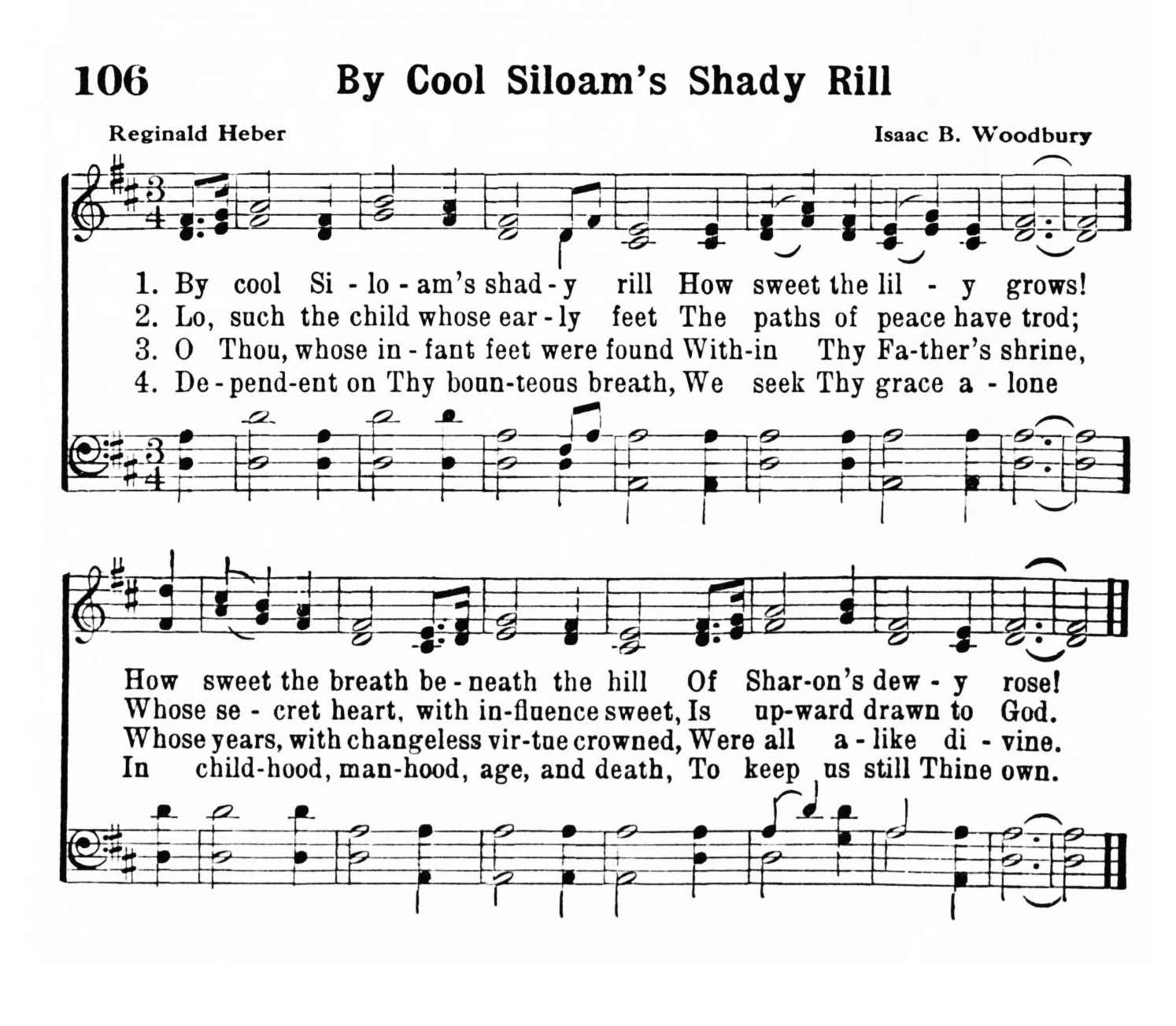
By Cool Siloam's Shady Rill (The Christian Child)
Lyrics
1. By cool Siloam's shady rill
how sweet the lily grows!
How sweet the breath beneath the hill
of Sharon's dewy rose!
how sweet the lily grows!
How sweet the breath beneath the hill
of Sharon's dewy rose!
2. Lo! such the child whose early feet
the paths of peace have trod,
whose secret heart with influence sweet
is upward drawn to God.
the paths of peace have trod,
whose secret heart with influence sweet
is upward drawn to God.
3. By cool Siloam's shady rill
the lily must decay,
the rose that blooms beneath the hill
must shortly fade away;
the lily must decay,
the rose that blooms beneath the hill
must shortly fade away;
4. And soon, too soon, the wintry hour
of life's maturer age
will shake the soul with sorrow's power
and stormy passion's rage.
of life's maturer age
will shake the soul with sorrow's power
and stormy passion's rage.
5. O thou, whose infant feet were found
within thy Father's shrine,
whose years, with changeless virtue crowned,
were all alike divine,
within thy Father's shrine,
whose years, with changeless virtue crowned,
were all alike divine,
6. Dependent on thy bounteous breath
we seek thy grace alone,
through every stage of life, and death,
to keep us still thine own.
we seek thy grace alone,
through every stage of life, and death,
to keep us still thine own.
Bible Reference
John 9:1-11; Luke 2:40-52; Matthew 19:13-15; Psalm 23:1-3; Titus 3:5-7; Galatians 5:22-23
Lectionary & readings
Open today’s (or any date’s) assigned scriptures and find related hymns across church calendars. Useful when planning worship around this song’s themes or its Bible reference.
Hymn scripture: John 9:1-11; Luke 2:40-52; Matthew 19:13-15; Psalm 23:1-3; Titus 3:5-7; Galatians 5:22-23
About This Hymn
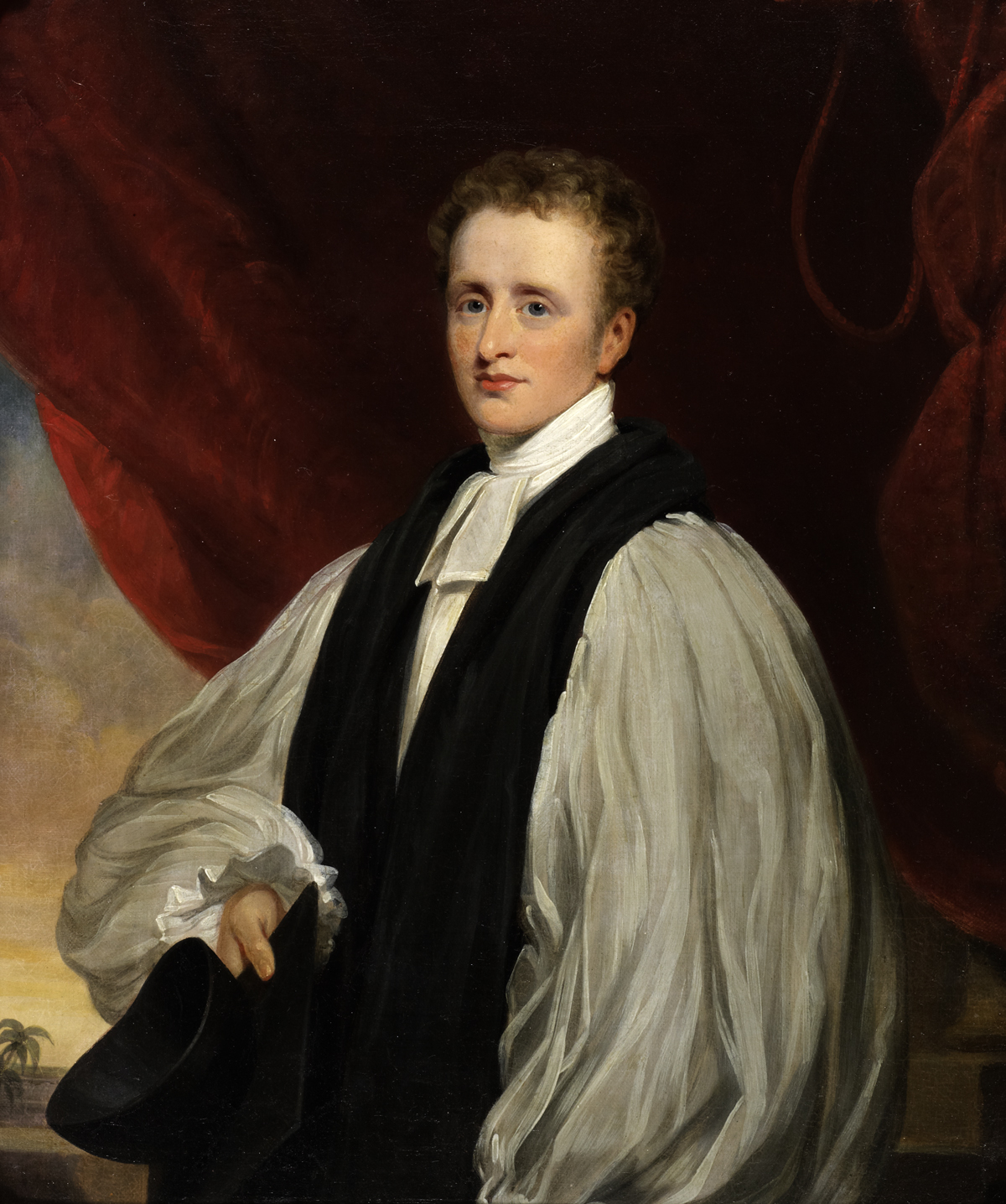
"By Cool Siloam's Shady Rill," often subtitled "The Christian Child," is a beloved hymn written by Reginald Heber in 1812. Although it is frequently sung to the tune I. B. Woodbury, composed later by Isaac Baker Woodbury, the hymn text itself is the work of Heber, the Anglican bishop and distinguished hymn writer. Inspired by the Pool of Siloam in Jerusalem, mentioned in John 9, the hymn uses peaceful natural imagery to portray the beauty of youthful faith and the importance of growing in holiness from childhood.
The opening stanza paints a tranquil picture of the cool waters and shaded surroundings of Siloam. Heber employs this scene as a symbol of spiritual refreshment and purity. Just as the waters of Siloam were associated with healing in the Gospel account, they also represent the cleansing grace of God and the quiet nurture of the Christian life. The calm setting provides an appropriate backdrop for reflecting on the innocence, humility, and teachable spirit that should characterize Christian children.
A central theme of the hymn is the cultivation of Christian virtues from an early age. Rather than emphasizing outward accomplishments, Heber highlights qualities such as gentleness, purity, obedience, modesty, and love. These virtues are presented as the fruit of God's grace working within the heart. The hymn reminds both children and adults that true spiritual beauty is found not in appearance or status but in a life shaped by the character of Christ.
The hymn also reflects the example of Jesus during His earthly youth. Although the Gospels provide only a few details about Christ's childhood, they reveal that He grew in wisdom, stature, and favor with God and man. Heber encourages young believers to follow this pattern by developing a sincere love for God and a willingness to serve others with humility. In doing so, the hymn presents Christian maturity as a lifelong process that begins in childhood through faithful instruction and dependence upon God's grace.
"By Cool Siloam's Shady Rill" has remained a favorite hymn for baptisms, children's services, confirmations, schools, and occasions that emphasize Christian nurture. Its gentle language, biblical imagery, and enduring message continue to remind the church that the quiet work of God's grace in young lives is precious in His sight, producing fruit that endures for eternity.
From the Dictionary of Hymnology
Related terms and concepts automatically matched to this hymn.
All things are possible to him Hymnology
Overview of Charles Wesley's hymn "All things are possible to him," published in Hymns and Sacred Poems (1749).
Read moreAustin, William Biography
Biographical sketch of William Austin (d. 1633), lawyer and author of Devotionis Augustinianae Flamma.
Read moreAustin, John Biography
Biographical sketch of John Austin (c. 1613-1669), Roman Catholic devotional writer and hymn contributor.
Read moreStaff Visualizer
Open in MIDI StudioPowered by HTML MIDI PLAYER, MIDI FILE Made by Hymnal Library. · Study chords & lyrics in MIDI Studio
Want weekly hymns and devotionals?
⭐ Recommend This Hymn
Share this beautiful hymn with others
This hymn is found in these hymnals
Open the hymnal that contains this hymn:
Hymns with the same subject
More hymns about Children
- I’ve Got the Joy, Joy, Joy, Joy (Down in My Heart) - George W. Cooke
- Jingle Bells - James Lord Pierpont
- The King Is Coming (I Heard the Trumpet Sounding) - Bill & Gloria Gaither
- My Worth Is Not In What I Own - Keith & Kristyn Getty, and Graham Kendrick
- Silent Night! Holy Night! - Joseph Mohr
- Angels from the Realms of Glory - James Montgomery
- Hark! The Voice of Jesus Calling - Daniel March
- Jesus Loves the Little Children - C. H. Woolston
More hymn subjects
Latest Updated Hymnals
-
Open
 The People's HymnalUpdated 20 hours ago · 1961
 -
Open
 Book of Common Praise (BoCP1915)Updated 3 months ago · 1915
 -
Open
 Our Great Redeemer's PraiseUpdated 4 months, 3 weeks ago · 2022
 -
Open
 The Parish Hymnal (1873)Updated 5 months ago · 1873
 -
Open
 Book of Common Praise (BCP1998)Updated 5 months, 2 weeks ago · 1998
Hymn Information
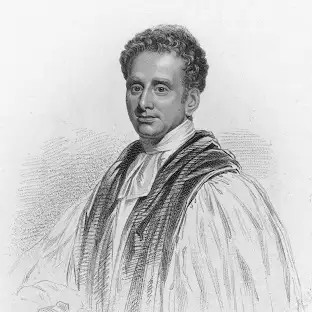
To view the author's biography, click their name above.
MIDI File
Hymns from 1812
Popular Hymns
Recent Blog Posts



Popular Blog Posts
-
 Lessons from the Book of Haggai: Putting God…4 months, 1 week ago
 -
 Easter vs Passover: How a Biblical Feast Bec…6 months, 1 week ago
 -
 The Full Story of the Birth of Jesus Christ:…10 months ago
 -
 The 30 Most Famous Christmas Hymns and Carols1 year, 1 month ago
 -
 The Story Behind the Hymn “Amazing Grace”10 months ago
Visit Us on Social Media
Latest from X (Twitter)
Tweets by HymnalLibraryLatest from Facebook
Latest on YouTube
Loading latest video...
Daily Bible Verse
Disclaimer
The hymns, sheet music, MIDI files, and related content on this website are provided for educational and research purposes only.
- Public Domain: Many of the hymns featured here are in the public domain and may be freely used.
- Copyrighted Works: Some hymns may still be under copyright protection. Where applicable, permission has either been requested from the copyright owner, or the content is shared under the principles of fair use for educational purposes.
⚠️ Important Notice: If you wish to reproduce, distribute, or use any copyrighted hymn beyond personal study or educational use, you must obtain permission directly from the copyright holder. This website does not grant any rights for commercial use yet.
If there is any other question please address it to us in our Contact Page, for further assistance. Thank you for using the site. May God Bless You.