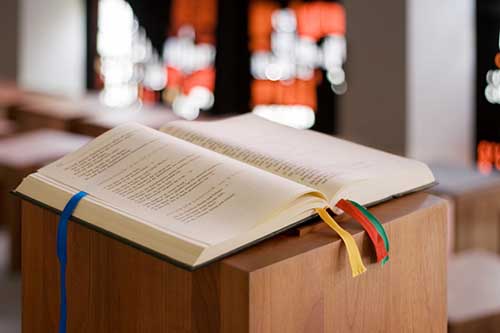
What Is a Lectionary? A Biblical, Historical, and Practical Explanation
The word lectionary simply refers to a collection or schedule of Scripture readings arranged for public worship. The individual passages selected are sometimes called lections, while a pericope refers to a particular section or passage taken from a larger biblical book. A lectionary therefore does not normally contain another version of the Bible. It tells the church which passages are to be read, and when. The Consultation on Common Texts defines a lectionary as a collection of Scripture selections "arranged and intended for proclamation during the worship of the people of God."
The simplest way to understand a lectionary is to think of it as a reading plan for congregational worship. Instead of a pastor or church deciding from week to week which portions of Scripture will be read, a lectionary provides a predetermined sequence. For example, a Sunday might include a reading from the Old Testament, a Psalm, an Epistle, and one of the Gospels. The next Sunday would have another set of passages, and the pattern would continue throughout the year.
This means that a lectionary is concerned primarily with public reading of Scripture, although many churches also use the same readings for preaching, prayer, Bible study, Sunday school, devotional materials, and personal preparation. The Revised Common Lectionary, for example, is explicitly designed to provide a common pattern for biblical proclamation and to help clergy, preachers, musicians, teachers, and congregations prepare for worship.
Is the Lectionary in the Bible?
The Bible certainly commands the public reading of Scripture. Paul told Timothy, "Give attendance to reading" (1 Timothy 4:13), and the Scriptures were regularly read publicly among God's people. Jesus Himself went into the synagogue on the Sabbath and read from the prophet Isaiah (Luke 4:16-21). Paul also instructed that his letters be read publicly among believers (1 Thessalonians 5:27; Colossians 4:16).
However, the Bible does not give the church a detailed three-year or one-year lectionary and does not command churches to follow a particular calendar of appointed readings. This distinction is important. There is a biblical principle of publicly reading Scripture, but the particular systems later developed by Christian churches are matters of church practice rather than explicit biblical commands.
In other words, Christians should not confuse the biblical command to read Scripture publicly with one particular method of scheduling that reading. A church can take the command seriously without necessarily using a formal lectionary.
At the same time, it would be incorrect to say that the idea of organizing Scripture readings is entirely foreign to biblical worship. The Old Testament contains examples of Scripture being read publicly at important gatherings. Deuteronomy 31:9-13 describes Moses commanding the public reading of the law, and Nehemiah 8 records a public assembly in which the law of God was read and explained. The Bible therefore gives us both the practice of public Scripture reading and examples of particular passages being read at particular occasions.
Where Did the Lectionary Come From?
The history of the Christian lectionary is complicated because the earliest Christians did not immediately possess a single universal book containing readings for every Sunday. The early church inherited the practice of reading Scripture publicly from the world of Judaism, while also developing its own patterns as Christian worship developed.
The Jewish synagogue already had traditions of reading Scripture during worship. Luke 4:16-21 shows Jesus participating in this kind of synagogue reading, and Acts 13:15 refers to the "reading of the law and the prophets." Historical evidence shows that Jewish communities developed systematic patterns for reading the Torah and the Prophets. However, the evidence for the exact details and dates of ancient synagogue reading cycles is complex, so it would be too simplistic to say that the modern Christian lectionary was merely copied directly from Judaism. Christian practice developed in its own historical setting.
One of the earliest descriptions of Christian Sunday worship comes from Justin Martyr in the middle of the second century. Justin described Christians gathering on Sunday and hearing the writings of the apostles and the prophets read for as long as time permitted, after which the one presiding would give instruction.
This is significant because it demonstrates that public reading of both Old Testament and New Testament material was already an established feature of Christian worship very early in church history. However, Justin's description does not present the fully developed three-year system familiar from modern lectionaries. Early Christians used different methods, including continuous reading and selections appropriate to particular occasions.
As the Christian calendar developed, churches increasingly appointed particular passages for particular Sundays, feasts, and seasons. Christmas, Easter, Pentecost, martyr commemorations, and other significant occasions created a reason for churches to select Scripture passages especially suited to those celebrations. Over time these selections became increasingly organized into formal systems. Historical evidence indicates that lectionaries were known by the fourth century, while the surviving evidence for complete lectionary books belongs to later centuries.
The result was not one universal lectionary immediately adopted by every Christian church. Different traditions developed different systems. Eastern churches, Western churches, Roman Catholics, Anglicans, Lutherans, and other traditions have all had their own lectionary traditions, sometimes sharing substantial similarities and sometimes differing considerably.
How Does a Lectionary Work?
Most modern lectionaries operate around a cycle of readings. One of the best-known examples is the Revised Common Lectionary, commonly abbreviated RCL. It uses a three-year cycle known as Year A, Year B, and Year C. Each Sunday generally has four readings: a reading from the Hebrew Scriptures or Old Testament, a Psalm, a New Testament Epistle reading, and a Gospel reading. During the Easter season, Acts is commonly used in place of the Old Testament reading.
The Gospel reading usually provides the central focus of the day's readings. The other passages may be connected to it thematically, or they may follow their own more continuous sequence through a biblical book. This is why two churches using the same lectionary may sometimes appear to have readings that are connected by a common theme, while at other times the readings seem to be moving through different books independently.
The Roman Catholic lectionary uses a similar three-year Sunday cycle. In its Sunday schedule, Year A emphasizes Matthew, Year B emphasizes Mark, and Year C emphasizes Luke, while John's Gospel is used especially during Lent and Easter across the three-year cycle. The Catholic weekday lectionary operates on a separate two-year cycle.
The important thing to recognize is that a "three-year lectionary" does not mean that the entire Bible is read in three years. A lectionary selects passages. Some chapters and verses may be read frequently, while other portions may not be appointed at all. The Roman Catholic bishops explicitly note that not all of the Bible is included in the lectionary.
What Are the Different Types of Lectionaries?
There is not just one kind of lectionary. Some are designed primarily for Sunday worship, while others provide readings for every day of the year. Some are built around a single year, while others use a two-year or three-year cycle.
A Sunday lectionary provides readings for the Lord's Day and major festivals. A daily lectionary provides Scripture readings for weekdays as well. Some systems are connected closely to a liturgical calendar containing seasons such as Advent, Christmas, Epiphany, Lent, Easter, Pentecost, and the period commonly called Ordinary Time.
There are also denominational lectionaries. The Revised Common Lectionary was published in 1992 by the Consultation on Common Texts as a revision of the 1983 Common Lectionary. It was developed through an ecumenical process involving representatives from numerous Christian traditions. The RCL itself was influenced by the Roman Catholic Ordo Lectionum Missae produced after the Second Vatican Council.
This history explains why the phrase "the lectionary" can be misleading. There is no single Christian lectionary accepted by every church. The Roman Catholic Church has its lectionary, Anglican and Episcopal traditions have their own forms, Lutheran churches use lectionary systems, and many Protestant churches use the Revised Common Lectionary or an adaptation of it.
Why Do Churches Use a Lectionary?
One major reason is breadth of exposure to Scripture. A preacher who chooses every sermon text independently may, intentionally or unintentionally, spend most of his ministry preaching from familiar books and favorite subjects. A lectionary can force the congregation to encounter passages that might otherwise be neglected.
This can be especially valuable because "all scripture is given by inspiration of God, and is profitable" (2 Timothy 3:16). A structured reading plan can help a congregation hear from different parts of the Bible rather than repeatedly returning to the same familiar passages.
A second reason is discipline and planning. A pastor does not have to spend each week deciding what the congregation will read. The schedule is already established. Music leaders, teachers, Bible study leaders, and congregation members can also prepare around the same passages.
A third reason is unity. Churches using the same lectionary can find themselves hearing the same biblical passages on the same Sunday. The Consultation on Common Texts specifically identifies this shared pattern as one of the purposes of the Revised Common Lectionary. Churches in different locations may therefore be studying and proclaiming the same passages even though they are separated geographically and denominationally.
A fourth benefit is that a lectionary can help a church walk through the biblical story in relation to the major events of Christ's life. Advent emphasizes Christ's coming, Christmas His birth, Lent His suffering and preparation for the cross, Easter His resurrection, and Pentecost the coming of the Holy Spirit and the mission of the church. The passages are therefore not merely random Bible readings. They are placed within a larger theological calendar.
Does a Lectionary Mean the Pastor Cannot Preach Whatever He Wants?
Not necessarily. This depends entirely on the church and its tradition.
In some churches, the appointed readings strongly influence the sermon and worship service. In others, the lectionary is simply a resource. A pastor may follow it closely, modify it, or choose another passage entirely.
It is therefore useful to distinguish a lectionary from a law. A lectionary is a schedule. It does not possess divine authority simply because it has been printed in a church book.
The final authority for the Christian church is the Word of God, not a denominational calendar. A lectionary may help a church organize its reading of Scripture, but it does not decide what Scripture means. The preacher still has the responsibility to interpret the text faithfully, in context, and in harmony with the whole counsel of God.
A church that follows a lectionary should therefore never allow the schedule itself to become more authoritative than Scripture. Likewise, a church that does not use a lectionary should not assume that the absence of one makes it more biblical. The central question is not whether a church has a lectionary, but whether it faithfully reads, explains, and obeys the Scriptures.
What Are the Weaknesses of a Lectionary?
The same structure that gives a lectionary its strengths can also create limitations. Because the passages have already been selected, some parts of Scripture may receive considerably more attention than others. Important verses can also be omitted when only part of a chapter is appointed.
Another concern is the danger of reading Scripture in fragments. A passage may be selected because it fits a particular Sunday theme, while the surrounding chapters contain important information needed to understand the author's argument. Wise preaching must therefore place the lectionary reading back into its literary and historical context.
There is also the danger of allowing the church calendar to become more prominent than Scripture itself. The biblical text must remain central. The calendar can serve Scripture, but Scripture must never become merely a supporting actor for the calendar.
The Revised Common Lectionary itself recognizes that there can be different ways of selecting Old Testament readings. It includes both a more continuous sequence through biblical books and a thematic approach that pairs Old Testament readings with the Gospel.
This illustrates an important truth: choosing what Scripture is read is never completely neutral. Any reading plan makes decisions about what receives emphasis, what is read continuously, what is paired together, and what is omitted. That does not automatically make a lectionary bad, but it means that churches should understand what their particular lectionary is doing.
Is Using a Lectionary Biblical?
The most balanced answer is that using a lectionary can be biblical without being biblically required.
Scripture commands Christians to read, teach, preach, and obey God's Word. It does not prescribe a particular table of readings called "the Christian lectionary." Therefore, a church should not treat a particular lectionary as a divine command.
At the same time, there is nothing inherently unbiblical about organizing the public reading of Scripture. In fact, orderly reading of Scripture can help fulfill the biblical responsibility to give attention to its public proclamation. The question becomes one of wisdom, usefulness, and faithfulness.
A Baptist or other evangelical church that does not follow a traditional church calendar can still benefit from the basic concept. A church might develop its own systematic Scripture-reading schedule, preach through books of the Bible, read longer passages publicly, or use a lectionary as a supplemental resource while maintaining its own preaching program.
For churches committed strongly to expository preaching, this distinction is particularly important. Preaching through a book of the Bible verse by verse or passage by passage already provides a structured method of exposing the congregation to Scripture. Such a church may have less need for a traditional lectionary, though the lectionary can still be useful for public reading, devotional planning, or comparison with how other Christians are reading Scripture.
Lectionary and Personal Bible Study
A lectionary should never replace personal Bible study. Even the best lectionary only points to selected passages. A Christian still needs to read the Bible more broadly and carefully.
Someone who reads only the weekly lectionary readings may know many famous passages while having little familiarity with the larger context of Scripture. A mature approach is therefore to treat a lectionary as one tool among many, not as the totality of one's Bible reading.
The daily readings associated with the Revised Common Lectionary demonstrate this principle. They are designed not only for worship but also to help readers prepare for the coming Sunday and reflect on the previous Sunday's readings.
The Christian should ultimately aim for more than familiarity with isolated verses. He should seek to understand the whole counsel of God, seeing individual passages in their literary context, historical setting, theological context, and relationship to the larger story of redemption.
The Lectionary in Simple Terms
Put simply, a lectionary is an organized schedule that tells a church what portions of Scripture to read on particular days.
A Bible contains the complete collection of inspired Scripture. A lectionary does not. A Bible is the source. A lectionary is a schedule for selecting portions of that source for public reading.
A sermon is an exposition or proclamation of Scripture. A lectionary is not a sermon. A church calendar organizes seasons and special days. A lectionary often works alongside that calendar by assigning Scripture readings to those occasions.
The fact that different churches have different lectionaries also proves that the lectionary itself is not the Word of God. The Word of God is Scripture. The lectionary is a human arrangement intended to help the church hear Scripture publicly and regularly.
Why the Lectionary Still Matters
Whether a church follows a formal lectionary or not, the underlying question is an important one: How will we make sure that the people of God regularly hear the Word of God?
That question should matter to every Christian church. A church may accomplish it through a lectionary, through systematic expository preaching, through consecutive reading of biblical books, or through another carefully planned approach. What matters most is that Scripture is not neglected, distorted, or reduced to a collection of favorite verses.
A good lectionary can help prevent that neglect by putting a broad range of Scripture before the congregation. It can remind Christians that the Bible is larger than the passages we naturally prefer. It can also help believers experience the unity of Scripture as Old Testament, Psalms, Epistles, and Gospels are brought together in worship.
But the lectionary must always remain the servant, not the master. The church does not gather to worship the lectionary. The church gathers to worship God, and the lectionary, where it is used, exists to help the church hear His Word.
The ultimate goal is therefore not simply to complete a three-year reading cycle. The goal is that, through the faithful reading and preaching of Scripture, believers would know Christ, understand His Word, grow in truth, and obey what God has commanded.
A lectionary is a structured schedule of biblical readings for Christian worship. It has ancient roots in the church's practice of publicly reading Scripture, but today's lectionaries are products of particular Christian traditions and historical developments. They can be valuable tools for ensuring that Scripture is regularly proclaimed, but they are not themselves inspired Scripture and are not commanded as a specific system in the Bible. The important issue is not whether a church uses a lectionary, but whether it faithfully gives God's Word the central place it deserves.














No comments yet. Be the first to share your thoughts!