





Thanksgiving: What Is It, Where Did It Come …
6 hours ago
Thou, who at Thy first Eucharist didst pray
By W. H. Turton
Lyrics
1. Lord, who at thy first Eucharist did pray
That all thy Church might be forever one,
Grant us at ev'ry Eucharist to say
With longing heart and soul, "Thy will be done."
O may we all one bread, one body be,
Through this blest Sacrament of Unity.
That all thy Church might be forever one,
Grant us at ev'ry Eucharist to say
With longing heart and soul, "Thy will be done."
O may we all one bread, one body be,
Through this blest Sacrament of Unity.
*1 At that first Eucharist before you died,
O Lord, you prayed that all be one in you;
At this our Eucharist again preside,
And in our hearts your law of love renew.
O may we all one bread, one body be,
Through this blest Sacrament of Unity.
O Lord, you prayed that all be one in you;
At this our Eucharist again preside,
And in our hearts your law of love renew.
O may we all one bread, one body be,
Through this blest Sacrament of Unity.
2. For all thy Church, O Lord, we intercede;
Make thou our sad divisions soon to cease;
Draw us the nearer each, to each we plead,
By drawing all to thee, O Prince of Peace;
Thus may we all one bread, one body be,
Through this blest Sacrament of Unity.
Make thou our sad divisions soon to cease;
Draw us the nearer each, to each we plead,
By drawing all to thee, O Prince of Peace;
Thus may we all one bread, one body be,
Through this blest Sacrament of Unity.
3. We pray thee, too, for wand'rers from thy fold;
O bring them back, Good Shepherd of the sheep,
Back to the faith which saints believed of old,
Back to the Church which still that faith doth keep;
Soon may we all one bread, one body be,
Through this blest Sacrament of Unity.
O bring them back, Good Shepherd of the sheep,
Back to the faith which saints believed of old,
Back to the Church which still that faith doth keep;
Soon may we all one bread, one body be,
Through this blest Sacrament of Unity.
4. So, Lord, at length when sacraments shall cease,
May we be one with all thy Church above,
One with thy saints in one unbroken peace,
One with thy saints in one unbounded love;
More blessed still in peace and love to be
One with the Trinity in Unity.
May we be one with all thy Church above,
One with thy saints in one unbroken peace,
One with thy saints in one unbounded love;
More blessed still in peace and love to be
One with the Trinity in Unity.
Bible Reference
John 17:11; John 17:20-23; 1 Corinthians 10:16-17; 1 Corinthians 12:12-13; Ephesians 4:1-6
About This Hymn
“Thou, Who at Thy First Eucharist Didst Pray” is a Eucharistic hymn by William H. Turton, written in 1881. Turton was an Anglican hymn writer whose hymns were published in collections under the title A Few Hymns Written by a Layman. Hymnary records this hymn as one of his hymns concerning Christian unity. It was used at St. Mary Magdalene's, Munster Square, London, on June 22, 1881, at the anniversary service of the English Church Union. The hymn was intended to be sung after the Agnus Dei at a choral celebration.
The hymn draws its central theme from Christ's prayer in John 17, especially His prayer that His disciples might be one. The opening stanza looks back to the first Eucharist and to the prayer of Jesus before His death. The refrain expresses the desire that believers may become “one Bread, one Body,” drawing upon the biblical imagery of 1 Corinthians 10:16-17, where Paul connects participation in the bread and cup with the unity of the body of Christ. The Eucharist is therefore presented in the hymn not merely as a sacred observance, but as a reminder of the unity Christ desires among His people.
The later stanzas extend this prayer for unity beyond the present life. The worshiper asks that Christians may be joined together in peace and love, and ultimately be united with the whole Church above. The hymn concludes by looking toward the perfect unity of believers with the Trinity. This gives the hymn a strong ecclesial and eschatological dimension, connecting Holy Communion with Christian fellowship, reconciliation, and the hope of complete unity in God's presence.
Hymnary records the meter as 10.10.10.10.10.10 and lists several tunes associated with the text, including SONG I, UNDE ET MEMORES, and SACRAMENTUM UNITATIS. In The Book of Praise, the tune SONG I is identified as a composition by Orlando Gibbons. The hymn has consequently appeared in Anglican, Protestant, and ecumenical hymnals in forms adapted for Eucharistic and Communion worship.
From the Dictionary of Hymnology
Related terms and concepts automatically matched to this hymn.
Agnus Dei Qui tollis peccata mundi History
Hymnological record of the Agnus Dei, detailing its liturgical origins, medieval development, Reformation adaptations, and English translations.
Read moreAdoro Te devote, latens Deitas History
Detailed history of St. Thomas Aquinas's famous Eucharistic hymn "Adoro Te devote," tracing its origins, liturgical use, manuscript traditions, and numerous English translations.
Read moreAh, when shall I awake History
Hymnological entry for Charles Wesley's 1741 prayer hymn "Ah, when shall I awake," detailing its publication history and inclusion in the Wesleyan Hymn-Book.
Read more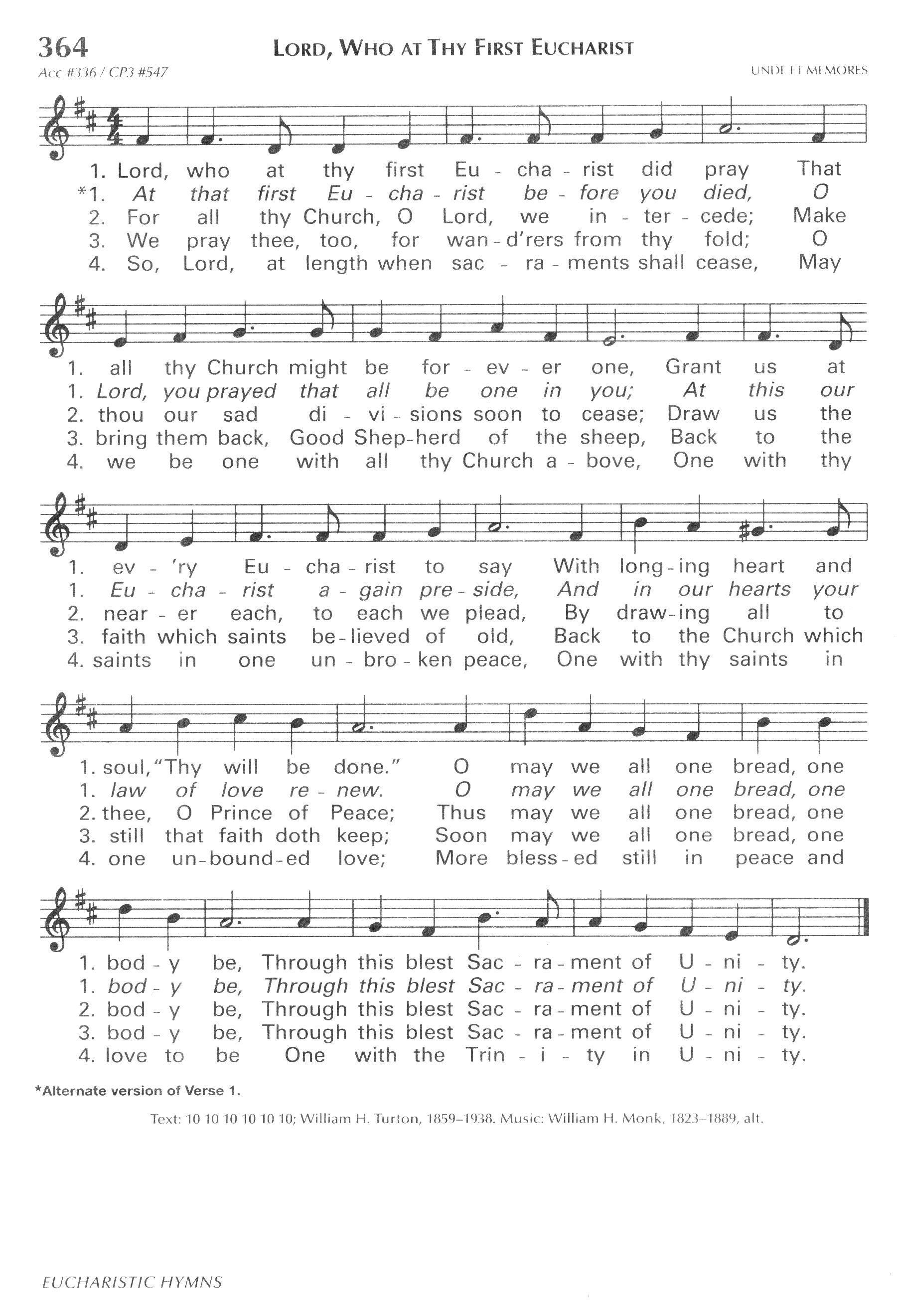

📬 Subscribe to Our Devotional Updates
Receive weekly hymns, devotionals, and website features directly in your inbox.
✅ Thank you! You'll start receiving our updates soon.
⭐ Recommend This Hymn
Share this beautiful hymn with others
This hymn is found in these hymnals
Open the hymnal that contains this hymn:
Hymns with the same subject
More hymns about Christian Love, Church, Communion, Fellowship, Lord's Day, Lordship of Christ, Worship
- In the Garden — C. Austin Miles
- Onward Christian Soldiers — S. Baring-Gould
- Blest Be the Tie That Binds — John Fawcett
- Fairest Lord Jesus — Friedrich von Spee
- There's A Church In The Valley By The Wildwood — W. S. Pitts
- A Christian Home — Barbara B. Hart
- In Christ There Is No East or West — John Oxenham
- A friend of Jesus! O what bliss — Joseph C. Ludgate
More hymn subjects
Explore other themes across the library.
Hymns about Judgment
Hymns about Altar Call
Hymns about Providence
Hymns about Blessing
Hymns about The Holy Trinity
Hymns about Mercy of God
Hymns about Creation
Hymns about Endtime
Browse all subjects →
Recently Added Hymns
Latest Updated Hymnals
-
Open
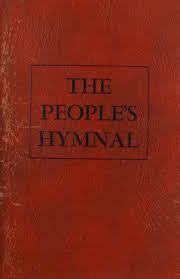 The People's HymnalUpdated 6 hours ago · 1961
 -
Open
 Book of Common Praise (BoCP1915)Updated 2 months, 3 weeks ago · 1915
 -
Open
 Our Great Redeemer's PraiseUpdated 4 months, 2 weeks ago · 2022
 -
Open
 The Parish Hymnal (1873)Updated 4 months, 3 weeks ago · 1873
 -
Open
 Book of Common Praise (BCP1998)Updated 5 months ago · 1998
Hymn Information

To view the author's biography, click their name above.
MIDI File
Ready to load
Download MIDI
Popular Hymns
Recent Blog Posts



Popular Blog Posts
-
 Lessons from the Book of Haggai: Putting God…4 months ago
 -
 Easter vs Passover: How a Biblical Feast Bec…6 months ago
 -
 The Full Story of the Birth of Jesus Christ:…9 months, 3 weeks ago
 -
 The 30 Most Famous Christmas Hymns and Carols1 year, 1 month ago
 -
 The Story Behind the Hymn “Amazing Grace”9 months, 3 weeks ago
Visit Us on Social Media
Latest from X (Twitter)
Tweets by HymnalLibraryLatest from Facebook
Latest on YouTube
Loading latest video...
Daily Bible Verse
Disclaimer
The hymns, sheet music, MIDI files, and related content on this website are provided for educational and research purposes only.
- Public Domain: Many of the hymns featured here are in the public domain and may be freely used.
- Copyrighted Works: Some hymns may still be under copyright protection. Where applicable, permission has either been requested from the copyright owner, or the content is shared under the principles of fair use for educational purposes.
⚠️ Important Notice: If you wish to reproduce, distribute, or use any copyrighted hymn beyond personal study or educational use, you must obtain permission directly from the copyright holder. This website does not grant any rights for commercial use yet.
If there is any other question please address it to us in our Contact Page, for further assistance. Thank you for using the site. May God Bless You.