
10 Famous Hymns That Were Published Posthumo…
6 days, 1 hour ago
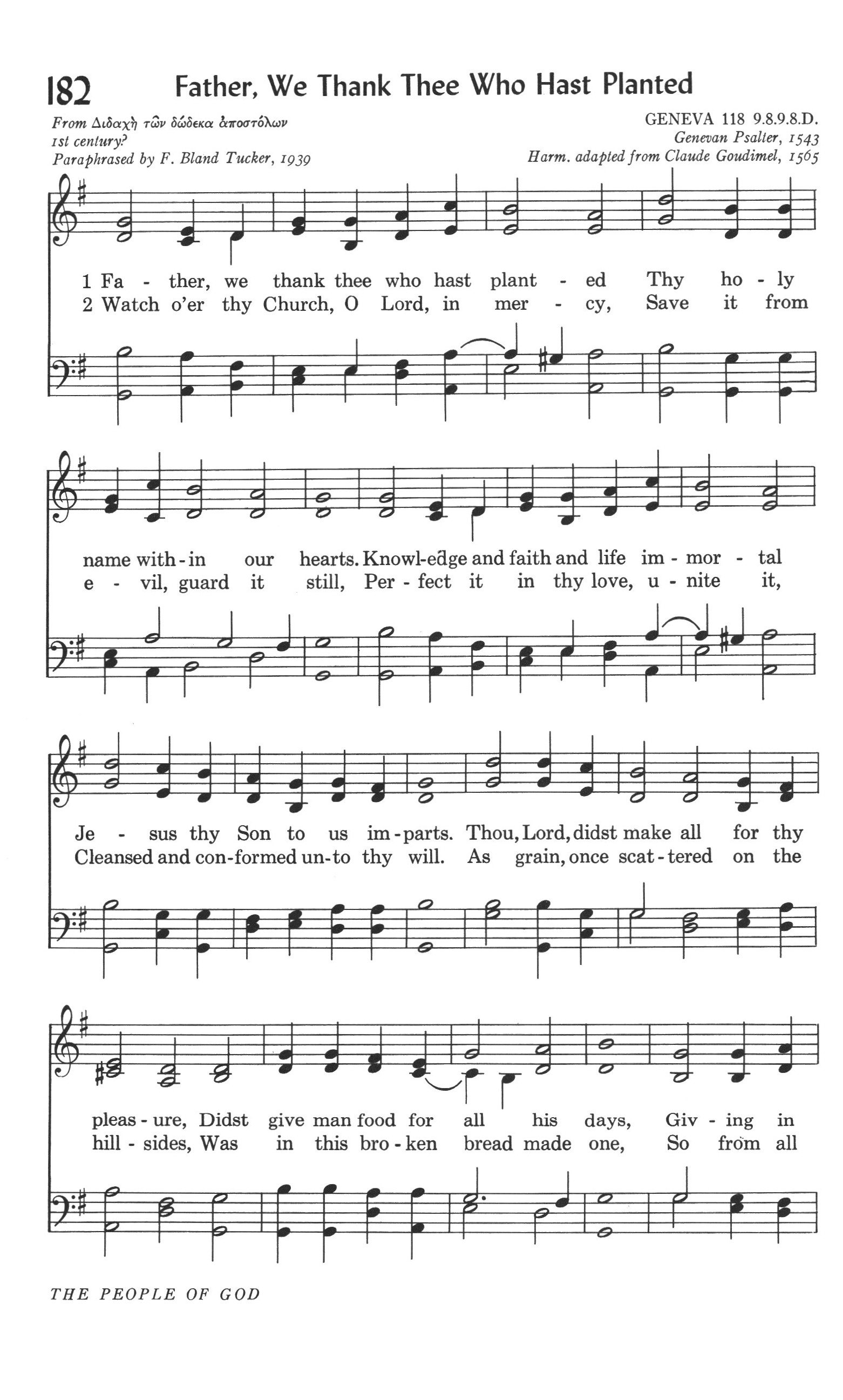
Father, We Thank Thee, Who Hast Planted
By Bland Tucker (1939)
Lyrics
1. Father, we thank Thee who hast planted
Thy holy Name within our hearts.
Knowledge and faith and life immortal
Jesus Thy Son to us imparts.
Thou, Lord, didst make all for Thy pleasure,
didst give man food for all his days,
giving in Christ the Bread eternal;
Thine is the pow'r, be Thine the praise.
Thy holy Name within our hearts.
Knowledge and faith and life immortal
Jesus Thy Son to us imparts.
Thou, Lord, didst make all for Thy pleasure,
didst give man food for all his days,
giving in Christ the Bread eternal;
Thine is the pow'r, be Thine the praise.
2. Watch o'er Thy church, O Lord, in mercy,
save it from evil, guard it still.
Perfect it in Thy love, unite it,
cleansed and conformed unto Thy will.
As grain, once scattered on the hillsides,
was in this broken bread made one,
so from all lands Thy church be gathered
into Thy kingdom by Thy Son.
save it from evil, guard it still.
Perfect it in Thy love, unite it,
cleansed and conformed unto Thy will.
As grain, once scattered on the hillsides,
was in this broken bread made one,
so from all lands Thy church be gathered
into Thy kingdom by Thy Son.
Bible Reference
John 15:1-5; 1 Corinthians 10:16-17; 1 Corinthians 11:23-26; Acts 2:42
Lectionary & readings
Open today’s (or any date’s) assigned scriptures and find related hymns across church calendars. Useful when planning worship around this song’s themes or its Bible reference.
Hymn scripture: John 15:1-5; 1 Corinthians 10:16-17; 1 Corinthians 11:23-26; Acts 2:42
About This Hymn
“Father, We Thank Thee, Who Hast Planted” is a Eucharistic hymn translated by Bland Tucker in 1939. The hymn is a prayer of thanksgiving centered upon Christ, the church, and the spiritual nourishment God provides to His people. Its language reflects the worship of the early Christian church, particularly the gathering of believers around the Lord’s Table. The hymn gives thanks to God for planting His people, feeding them with spiritual food, and joining them together in Christian fellowship.
The hymn's imagery of planting is closely related to the biblical picture of Christ as the true source of spiritual life. In John 15:1-5, Jesus declares, “I am the true vine, and my Father is the husbandman” (KJV). He teaches His disciples that they must abide in Him in order to bear fruit. The language of planting and growth therefore points toward the life-giving relationship between Christ and His people. Christian faith is not merely an outward association with Christ but a continual dependence upon Him.
The Eucharistic character of the hymn is also connected with 1 Corinthians 10:16-17, where Paul speaks of the communion of the body and blood of Christ and the unity of believers who partake of the one bread. The Lord's Supper is both an act of remembrance and a declaration of fellowship. As believers gather at the Table, they confess their common dependence upon Christ and their unity as members of His body.
First Corinthians 11:23-26 provides the central New Testament account of the Lord's Supper. Paul recounts how Christ took bread and the cup and commanded His disciples to remember Him. The hymn's thanksgiving therefore points toward the sacrificial work of Jesus. The Table directs the church back to Calvary, where Christ gave Himself for sinners, and forward to His promised return.
Acts 2:42 describes the early believers continuing steadfastly in “the apostles’ doctrine and fellowship, and in breaking of bread, and in prayers” (KJV). The hymn reflects this pattern of Christian worship, bringing together teaching, fellowship, prayer, thanksgiving, and the breaking of bread. It presents the church as a community gathered around the saving work of Christ.
The hymn's emphasis on spiritual nourishment also recalls Christ's declaration in John 6:35, “I am the bread of life: he that cometh to me shall never hunger.” God provides what His people need, not merely for the body but for the soul. The Christian is sustained by Christ's grace and continually strengthened through fellowship with Him.
“Father, We Thank Thee, Who Hast Planted” is therefore a hymn of Eucharistic thanksgiving, Christian unity, and dependence upon Christ. Its language encourages worshippers to recognize God as the One who plants, nourishes, gathers, and sustains His church. Through its rich biblical imagery, the hymn directs attention to Christ's sacrifice, the fellowship of believers, and the hope of eternal life. It is especially fitting for Holy Communion, where the church gathers in gratitude to remember Christ's death, celebrate His living presence, and look forward to the fulfillment of His kingdom.
Staff Visualizer
Open in MIDI StudioPowered by HTML MIDI PLAYER, MIDI FILE Made by Hymnal Library. · Study chords & lyrics in MIDI Studio
Want weekly hymns and devotionals?
⭐ Recommend This Hymn
Share this beautiful hymn with others
This hymn also appears in these hymnals
Click a spine to pull out the hymnal, then open it.
You might also like
Hymns with the same subject
More hymns about God the Father, Love of God, Thanksgiving
- Through the Love of God Our Savior - Mary Peters
- O Brother Man, Fold to Thy Heart Thy Brother - John Greenleaf Whittier
- Heavenly Father, Hear Our Prayer - Barbara E. Adam
- O Love, How Deep, How Broad, How High - Thomas á Kempis
- Heavenly Father, to Thee We Pray - John Read
- Praise and Thanksgiving - Marie J. Post
- How Great Thou Art - Carl Boberg
- Holy, Holy, Holy! Lord God Almighty! - Reginald Heber
More hymn subjects
Explore other themes across the library.
Hymns about Harvest
Hymns about Lordship of Christ
Hymns about Praise
Hymns about Jesus Christ
Hymns about Grace
Hymns about Salvation
Hymns about Church
Hymns about Humility
Browse all subjects →
Recently Added Hymns
-
 Joy Fills Our Inmost Hearts TodayW. Chatterton Dix 1865
 -
 Bright Angel Hosts Are Heard on HighRichard Robert Chope circa. 1870s
 -
 In the Early Morning, Early (Christmas Morning)Frederick George Lee circa. 1880s
 -
 A Boy Is Born In BethlehemAnonymous circa. 1400s
 -
 A Shepherd Band Their Flocks Are Keepingunknown circa. 1860s
Latest Updated Hymnals
-
Open
 The New Apostolic Church HymnalUpdated 4 days, 6 hours ago · 2008
 -
Open
 400+ Christmas Carols Book: Sheet Music for PianoUpdated 5 days, 8 hours ago · 2014
 -
Open
 The Temple HymnalUpdated 5 days, 16 hours ago · 1918
 -
Open
 The Popular HymnalUpdated 5 days, 16 hours ago · 1918
 -
Open
 The Highway HymnalUpdated 5 days, 17 hours ago · 1886
Hymn Information
Click a linked name to open their biography.
MIDI File
More Hymns by Bland Tucker
Popular Hymns
Recent Blog Posts


Popular Blog Posts
-
 Lessons from the Book of Haggai: Putting God…4 months, 4 weeks ago
 -
 Easter vs Passover: How a Biblical Feast Bec…6 months, 4 weeks ago
 -
 The Full Story of the Birth of Jesus Christ:…10 months, 2 weeks ago
 -
 The 30 Most Famous Christmas Hymns and Carols1 year, 2 months ago
 -
 The Story Behind the Hymn “Amazing Grace”10 months, 2 weeks ago
Visit Us on Social Media
Latest from X (Twitter)
Tweets by HymnalLibraryLatest from Facebook
Latest on YouTube
Loading latest video...
Daily Bible Verse
Disclaimer
The hymns, sheet music, MIDI files, and related content on this website are provided for educational and research purposes only.
- Public Domain: Many of the hymns featured here are in the public domain and may be freely used.
- Copyrighted Works: Some hymns may still be under copyright protection. Where applicable, permission has either been requested from the copyright owner, or the content is shared under the principles of fair use for educational purposes.
⚠️ Important Notice: If you wish to reproduce, distribute, or use any copyrighted hymn beyond personal study or educational use, you must obtain permission directly from the copyright holder. This website does not grant any rights for commercial use yet.
If there is any other question please address it to us in our Contact Page, for further assistance. Thank you for using the site. May God Bless You.
Recently Added · Dictionary of Hymnology
Browse dictionary →
Can’t find a hymn or lyric?
Leave your question in the forum for others to answer — requests, missing lines, writers, and worship ideas welcome.