


10 Famous Hymns That Were Published Posthumo…
1 day, 21 hours ago
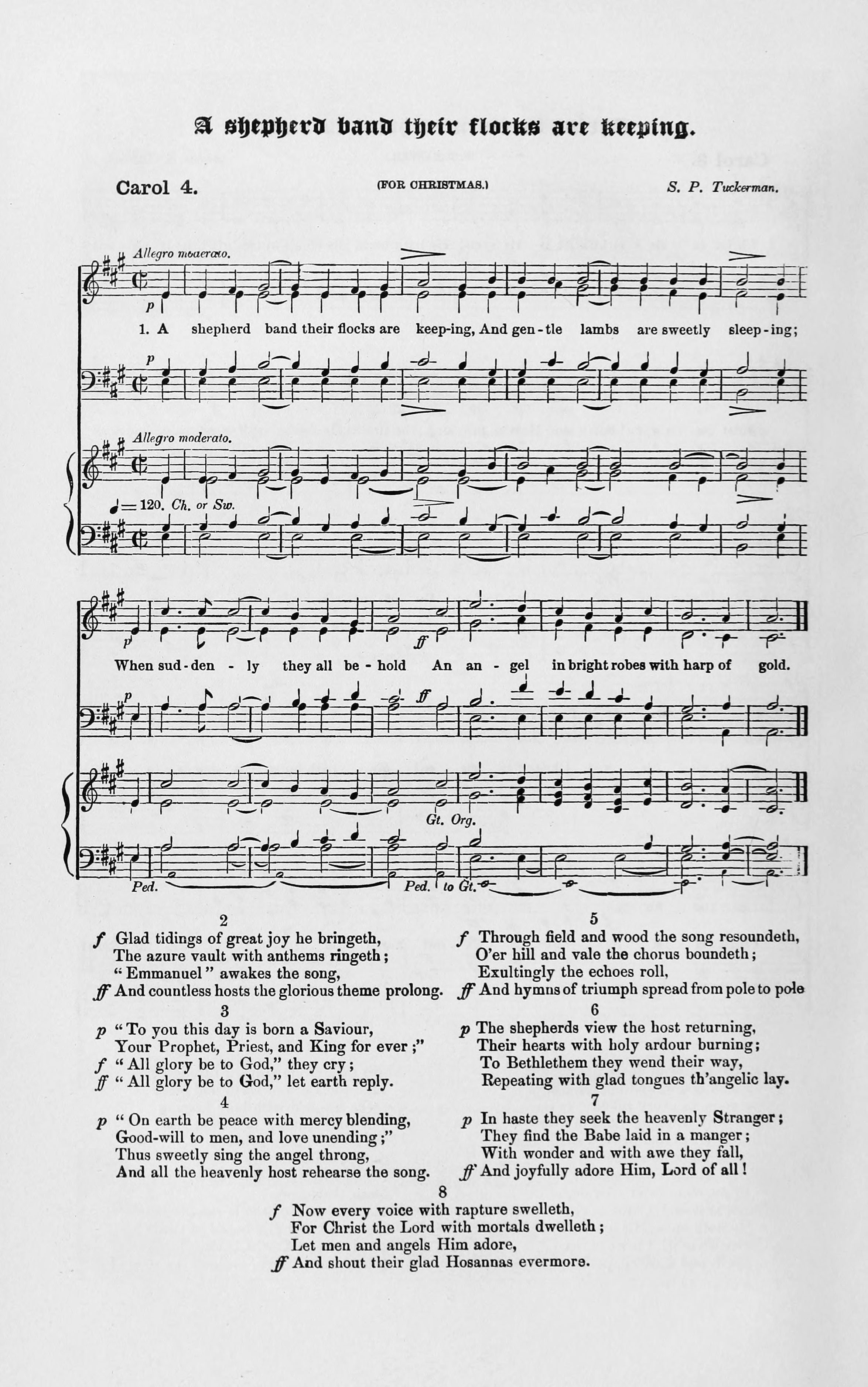
A Shepherd Band Their Flocks Are Keeping
By unknown (circa. 1860s)
Lyrics
1. A shepherd band their flocks are keeping,
And gentle lambs are sweetly sleeping;
When suddenly they all behold
An angel in bright robes with harp of gold.
And gentle lambs are sweetly sleeping;
When suddenly they all behold
An angel in bright robes with harp of gold.
2. Glad tidings of great joy he bringeth,
The azure vault with anthems ringeth;
"Emmanuel" awakes the song,
And countless hosts the glorious theme prolong.
The azure vault with anthems ringeth;
"Emmanuel" awakes the song,
And countless hosts the glorious theme prolong.
3. "To you this day is born a Saviour,
Your Prophet, Priest, and King for ever;"
"All glory be to God," they cry;
"All glory be to God," let earth reply.
Your Prophet, Priest, and King for ever;"
"All glory be to God," they cry;
"All glory be to God," let earth reply.
4. "On earth be peace with mercy blending,
Good-will to men, and love unending;"
Thus sweetly sing the angel throng,
And all the heavenly host rehearse the song.
Good-will to men, and love unending;"
Thus sweetly sing the angel throng,
And all the heavenly host rehearse the song.
5. Thro' field and wood the song resoundeth,
O'er hill and value the chorus boundeth;
Exultingly the echoes roll,
And hymns of triumph spread from pole to pole.
O'er hill and value the chorus boundeth;
Exultingly the echoes roll,
And hymns of triumph spread from pole to pole.
6. The shepherds view the host returning,
Their hearts with holy ardour burning;
To Bethlehem they wend their way,
Repeating with glad tongues th' angelic lay.
Their hearts with holy ardour burning;
To Bethlehem they wend their way,
Repeating with glad tongues th' angelic lay.
7. In haste they seek the heavenly Stranger;
They find the Babe laid in a manger;
With wonder and with awe they fall,
And joyfully adore Him, Lord of all!
They find the Babe laid in a manger;
With wonder and with awe they fall,
And joyfully adore Him, Lord of all!
8. Now every voice with rapture swelleth,
For Christ the Lord with mortals dwelleth;
Let men and angels Him adore,
And shout their glad Hosannnas evermore.
For Christ the Lord with mortals dwelleth;
Let men and angels Him adore,
And shout their glad Hosannnas evermore.
Bible Reference
Luke 2:8-20; Isaiah 9:6-7; Matthew 1:21-23; Luke 1:32-33; Luke 2:13-14
Lectionary & readings
Open today’s (or any date’s) assigned scriptures and find related hymns across church calendars. Useful when planning worship around this song’s themes or its Bible reference.
Hymn scripture: Luke 2:8-20; Isaiah 9:6-7; Matthew 1:21-23; Luke 1:32-33; Luke 2:13-14
About This Hymn
“A Shepherd Band Their Flocks Are Keeping” is a Christmas hymn that retells the announcement of the birth of Jesus Christ to the shepherds near Bethlehem. The English text is credited as anonymous in hymn catalogues, and its original author and date of composition have not been reliably established. Hymnary.org records the text in several hymnals, including Voices of Praise: for School and Church and Home (1883) and Carols Old and Carols New (1916). The tune associated with the hymn is attributed to Michael Praetorius, the German composer and music theorist whose extensive work helped preserve and develop Lutheran church music. Hymnary lists the tune as public domain and identifies its musical source as Praetorius (1609).
The hymn opens with shepherds watching their flocks when an angel suddenly appears and announces the good news of Christ's birth. This scene follows Luke 2:8-14, where the angel declares that a Saviour has been born in the city of David and a multitude of the heavenly host praises God. The hymn expands the biblical account into a vivid poetic scene, describing the angel's appearance, the heavenly music, and the proclamation of peace and goodwill. Its language invites singers to imagine the wonder experienced by the shepherds as an ordinary night of watching becomes a revelation of God's saving purpose.
The second and third stanzas emphasize the identity of the newborn child. He is proclaimed as Saviour, Prophet, Priest, and King, titles that direct attention beyond the circumstances of His birth to His redemptive mission and divine authority. The name Emmanuel, meaning God with us, reinforces the Christian confession that in Jesus Christ God has come near to humanity. The hymn therefore presents Christmas not merely as a beautiful scene involving angels and shepherds, but as the announcement of the promised Redeemer.
The song also gives prominence to the angels' praise. Their proclamation of glory to God and peace on earth echoes the biblical account and calls the whole creation to join in worship. The hymn imagines the angelic song resounding across fields, woods, and hills, symbolizing the far-reaching significance of Christ's birth. The message of peace is rooted in God's gracious action through Christ, rather than in a claim that all earthly conflict has already disappeared. The birth of Jesus announces God's saving work and the hope of reconciliation.
In the closing stanzas, the shepherds leave the angelic vision and travel to Bethlehem, where they find the child lying in a manger. Their response is one of wonder, reverence, and joyful adoration. Their movement from hearing the announcement to seeking Christ provides a model of faith responding to God's revelation. The final stanza broadens the invitation to include both humanity and the angels, calling all to adore the Lord who has come to dwell among mortals.
This hymn is well suited to Christmas worship, carol services, and celebrations of the Incarnation. Its narrative structure makes the biblical story accessible, while its repeated emphasis on praise encourages the congregation to respond to the good news with worship. Through its depiction of the shepherds, the angels, and the child in Bethlehem, the hymn celebrates Jesus Christ as Saviour and King and invites believers to join the heavenly host in giving glory to God.
From the Dictionary of Hymnology
Related terms and concepts automatically matched to this hymn.
Adeste fideles laeti triumphantes Latin Hymn
The Christmas hymn whose authorship and date are unknown; probably a French or German hymn of the 17th or 18th century. Its best-known English translations are Oakeley's "O come, all ye faithful, joyfully triumphant" and Caswall's and Mercer's versions.
Read moreAll things are ready! there's a place of rest Hymn
An anonymous Communion hymn whose source is unknown, found in three forms: a three-stanza version of 1859, a four-stanza version in Thring’s collection, and a five-stanza cento by Thring.
Read moreAll yesterday is gone Hymn
An anonymous invitation hymn found in a few early nineteenth-century English collections, including Pratt’s of 1829, and in several American hymnals. Its author is unknown.
Read moreStaff Visualizer
Open in MIDI StudioPowered by HTML MIDI PLAYER, MIDI FILE Made by Hymnal Library. · Study chords & lyrics in MIDI Studio
Want weekly hymns and devotionals?
⭐ Recommend This Hymn
Share this beautiful hymn with others
This hymn also appears in these hymnals
Click a spine to pull out the hymnal, then open it.
Hymns with the same subject
More hymns about Christmas, Glory of God, Incarnation, Peace, Praise
- O Holy Night - Placide Cappeau
- While Shepherds Watched Their Flocks - Nahum Tate
- Glory Be to God on High - Charles Wesley
- Calypso Carol (See him lying on a bed of straw) - Michael Perry
- Hark! The Herald Angels Sing - Charles Wesley
- O Gladsome Light - Robert Seymour Bridges
- Thou Who Wast Rich beyond All Splendor - Frank Houghton
- Savior of the Nations, Come - St. Ambrose
More hymn subjects
Latest Updated Hymnals
-
Open
 The New Apostolic Church HymnalUpdated 2 hours ago · 2008
-
Open
 400+ Christmas Carols Book: Sheet Music for PianoUpdated 1 day, 4 hours ago · 2014
-
Open
 The Temple HymnalUpdated 1 day, 12 hours ago · 1918
-
Open
 The Popular HymnalUpdated 1 day, 12 hours ago · 1918
-
Open
 The Highway HymnalUpdated 1 day, 12 hours ago · 1886
Hymn Information

Click a linked name to open their biography.
MIDI File
Popular Hymns
Recent Blog Posts


Popular Blog Posts
-
 Lessons from the Book of Haggai: Putting God…4 months, 3 weeks ago
-
 Easter vs Passover: How a Biblical Feast Bec…6 months, 3 weeks ago
-
 The Full Story of the Birth of Jesus Christ:…10 months, 2 weeks ago
-
 The 30 Most Famous Christmas Hymns and Carols1 year, 1 month ago
-
 The Story Behind the Hymn “Amazing Grace”10 months, 1 week ago
Visit Us on Social Media
Latest from X (Twitter)
Tweets by HymnalLibraryLatest from Facebook
Latest on YouTube
Loading latest video...
Daily Bible Verse
Disclaimer
The hymns, sheet music, MIDI files, and related content on this website are provided for educational and research purposes only.
- Public Domain: Many of the hymns featured here are in the public domain and may be freely used.
- Copyrighted Works: Some hymns may still be under copyright protection. Where applicable, permission has either been requested from the copyright owner, or the content is shared under the principles of fair use for educational purposes.
⚠️ Important Notice: If you wish to reproduce, distribute, or use any copyrighted hymn beyond personal study or educational use, you must obtain permission directly from the copyright holder. This website does not grant any rights for commercial use yet.
If there is any other question please address it to us in our Contact Page, for further assistance. Thank you for using the site. May God Bless You.
Recently Added · Dictionary of Hymnology
Browse dictionary →
Can’t find a hymn or lyric?
Leave your question in the forum for others to answer — requests, missing lines, writers, and worship ideas welcome.