



10 Famous Hymns That Were Published Posthumo…
1 day, 22 hours ago
A Boy Is Born In Bethlehem
By Anonymous ; tr. Henry I. D. Ryder ; adapt. Michael Praetorius ; adapt. George R. Woodward (circa. 1400s)
Lyrics
1. A Boy is born in Bethlehem,
Joy bringing to Jerusalem.
He lieth in a manger poor
Whose kingdom shall for aye endure.
Joy bringing to Jerusalem.
He lieth in a manger poor
Whose kingdom shall for aye endure.
2. The ox and ass knew and adored
The Infant that was Christ the Lord.
The kings of Saba came to bring
Gold, myrrh and incense to their king.
The Infant that was Christ the Lord.
The kings of Saba came to bring
Gold, myrrh and incense to their king.
3. The offspring He of virgin bright,
Made mother by high Heaven’s might.
One after one the cot forlorn
Entering, they hail their prince new born.
Made mother by high Heaven’s might.
One after one the cot forlorn
Entering, they hail their prince new born.
4. The serpent’s venom knew Him not,
Though of our blood He chose His lot:
Made like to us in human kin,
Unlike us in respect of sin.
Though of our blood He chose His lot:
Made like to us in human kin,
Unlike us in respect of sin.
5. That like Him He might make us be,
And with Himself and God agree.
In this birth’s joy let all accord,
And bless for ever Christ the Lord.
And with Himself and God agree.
In this birth’s joy let all accord,
And bless for ever Christ the Lord.
Bible Reference
Luke 2:1-20; Matthew 2:1-11; Isaiah 9:6-7; John 1:14
Lectionary & readings
Open today’s (or any date’s) assigned scriptures and find related hymns across church calendars. Useful when planning worship around this song’s themes or its Bible reference.
Hymn scripture: Luke 2:1-20; Matthew 2:1-11; Isaiah 9:6-7; John 1:14
About This Hymn
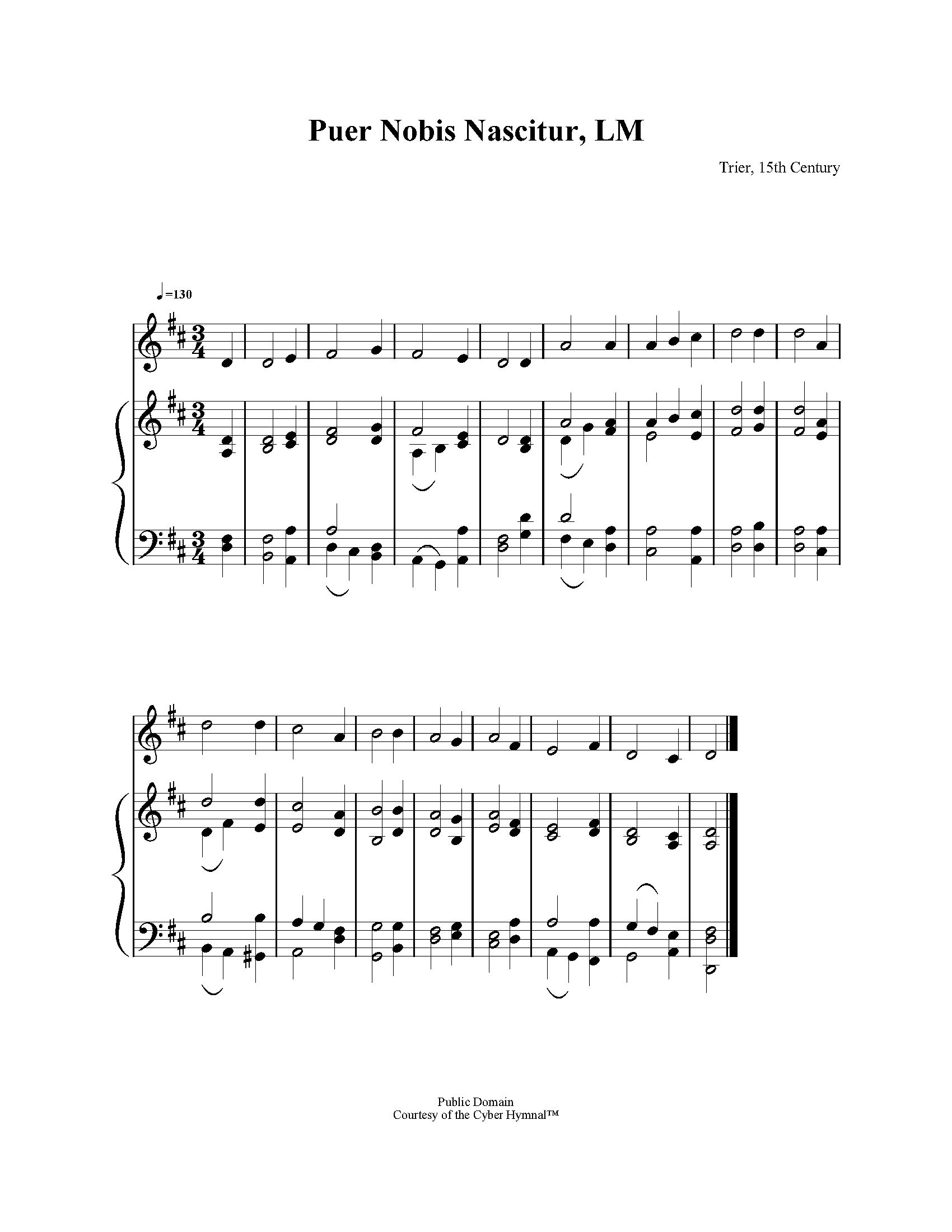
“A Boy Is Born in Bethlehem” is an English translation of a medieval Latin Christmas hymn celebrating the birth of Jesus Christ. The text is associated with the Latin title “Puer natus in Bethlehem,” and the English translation is credited to Henry I. D. Ryder. Hymnary.org identifies the source as a fourteenth-century Benedictine processional and records the English text in Orby Shipley's Annus Sanctus, volume 1, published in London and New York by Burns & Oates in 1884. The hymn is set to the traditional melody PUER NOBIS NASCITUR, adapted by Michael Praetorius in 1609. The underlying melody is older than Praetorius's setting and is associated with a fifteenth-century manuscript from Trier, Germany. The original composer is unknown.
The hymn proclaims the birth of Christ as the arrival of the promised King and Saviour. Its opening announcement directs the worshipper to Bethlehem, the biblical birthplace of Jesus, and invites Christians to rejoice in the fulfillment of God's saving purpose. The nativity is not presented merely as the arrival of an extraordinary child, but as the coming of the Lord whose kingdom and authority extend beyond the earthly circumstances of His birth. The message corresponds with Luke 2:11, where the angel announces the birth of a Saviour, Christ the Lord, and with Isaiah 9:6-7, which describes the promised ruler whose kingdom is marked by justice and peace.
The hymn's traditional Latin source belongs to the rich history of medieval Christmas worship. Processional hymns were used in the public worship of the church, helping congregations and religious communities celebrate the major events of the Christian year through song. By translating this text into English, Henry I. D. Ryder helped make its message accessible to English-speaking worshippers. The English version preserves the central theme of joyful proclamation: Christ has come, and His birth calls forth the praise of His people.
The tune PUER NOBIS NASCITUR is an important part of the hymn's historical identity. Although commonly associated with Michael Praetorius because of his early printed setting, the melody itself predates him. Hymnary traces its history through a fifteenth-century Trier manuscript and notes related versions in later hymn collections. Praetorius's work helped preserve and circulate the melody, allowing it to become associated with a variety of hymns across the church year. The tune is used with Long Meter texts and has remained part of the historic repertory of Christmas and other seasonal hymns.
Theologically, the hymn invites believers to respond to the Incarnation with faith, joy, and adoration. The birth of Jesus reveals God's gracious action in history and points toward the redemption accomplished through Christ. John 1:14 declares that the Word was made flesh and dwelt among us, while Matthew 2 records the visit of the wise men, who came to worship the child. These passages illuminate the hymn's emphasis on the identity of the newborn King and the appropriate response of worship.
“A Boy Is Born in Bethlehem” is suitable for Christmas services, traditional carol programmes, and worship focused on the Incarnation. It connects modern congregations with centuries of Christian singing and reminds them that the celebration of Christ's birth is rooted in a long history of biblical proclamation, liturgical poetry, and sacred music. Through its medieval origins, English translation, and traditional tune, the hymn offers a historic expression of Christian joy at the coming of Jesus Christ.
From the Dictionary of Hymnology
Related terms and concepts automatically matched to this hymn.
A beautiful land by faith I see Hymn
This hymn on heaven was given anonymously in the American Shining Star, New York, 1862, where it was entitled “The beautiful land.” It is widely used in America and appears in a few English Sunday school books.
Read moreA mourning class, a vacant seat Hymn
An anonymous hymn on the death of a scholar, first printed in the American Union Hymns of 1835. It is widely used in America but only in a few British Sunday school books.
Read moreA voice upon the midnight air Hymn
An anonymous Passiontide hymn contributed to J. Martineau’s Hymns for the Christian Church and Home, 1840, and later used in many Unitarian collections in Britain and America.
Read moreStaff Visualizer
Open in MIDI StudioPowered by HTML MIDI PLAYER, MIDI FILE Made by Hymnal Library. · Study chords & lyrics in MIDI Studio
Want weekly hymns and devotionals?
⭐ Recommend This Hymn
Share this beautiful hymn with others
This hymn also appears in these hymnals
Click a spine to pull out the hymnal, then open it.
Hymns with the same subject
More hymns about Christmas, Incarnation, Jesus Christ, Praise
- O Holy Night - Placide Cappeau
- While Shepherds Watched Their Flocks - Nahum Tate
- Let All Together Praise Our God - Nikolaus Herman
- The Word Whom Earth and Sea and Sky - Venantius Honorius Clementianus Fortunatus
- O Come, O Come, Emmanuel - J. M. Neale
- Go, Tell It on the Mountain - John W. Work
- Away in a Manger - Martin Luther
- Good Christian Men, Rejoice - J. M. Neale
More hymn subjects
Latest Updated Hymnals
-
Open
 The New Apostolic Church HymnalUpdated 3 hours ago · 2008
-
Open
 400+ Christmas Carols Book: Sheet Music for PianoUpdated 1 day, 5 hours ago · 2014
-
Open
 The Temple HymnalUpdated 1 day, 13 hours ago · 1918
-
Open
 The Popular HymnalUpdated 1 day, 13 hours ago · 1918
-
Open
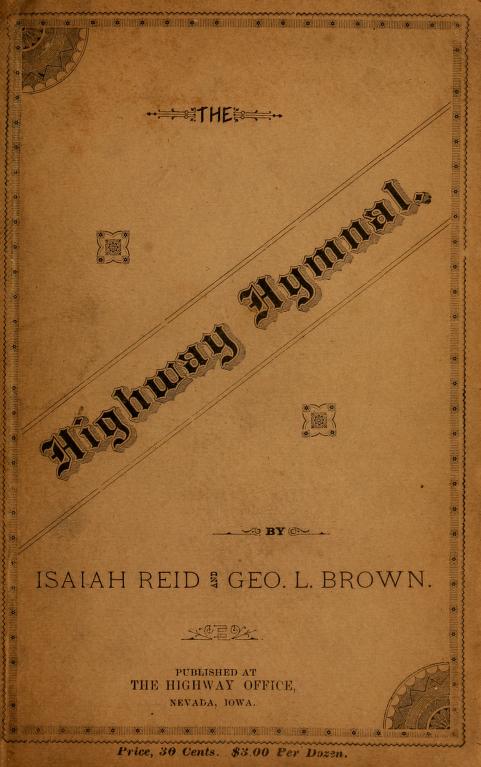 The Highway HymnalUpdated 1 day, 14 hours ago · 1886
Hymn Information
Click a linked name to open their biography.
MIDI File
Hymns from circa. 1400s
Popular Hymns
Recent Blog Posts


Popular Blog Posts
-
 Lessons from the Book of Haggai: Putting God…4 months, 3 weeks ago
-
 Easter vs Passover: How a Biblical Feast Bec…6 months, 3 weeks ago
-
 The Full Story of the Birth of Jesus Christ:…10 months, 2 weeks ago
-
 The 30 Most Famous Christmas Hymns and Carols1 year, 1 month ago
-
 The Story Behind the Hymn “Amazing Grace”10 months, 1 week ago
Visit Us on Social Media
Latest from X (Twitter)
Tweets by HymnalLibraryLatest from Facebook
Latest on YouTube
Loading latest video...
Daily Bible Verse
Disclaimer
The hymns, sheet music, MIDI files, and related content on this website are provided for educational and research purposes only.
- Public Domain: Many of the hymns featured here are in the public domain and may be freely used.
- Copyrighted Works: Some hymns may still be under copyright protection. Where applicable, permission has either been requested from the copyright owner, or the content is shared under the principles of fair use for educational purposes.
⚠️ Important Notice: If you wish to reproduce, distribute, or use any copyrighted hymn beyond personal study or educational use, you must obtain permission directly from the copyright holder. This website does not grant any rights for commercial use yet.
If there is any other question please address it to us in our Contact Page, for further assistance. Thank you for using the site. May God Bless You.
Recently Added · Dictionary of Hymnology
Browse dictionary →
Can’t find a hymn or lyric?
Leave your question in the forum for others to answer — requests, missing lines, writers, and worship ideas welcome.