



What Is the Difference Between Psalms, Hymns…
1 day, 4 hours ago
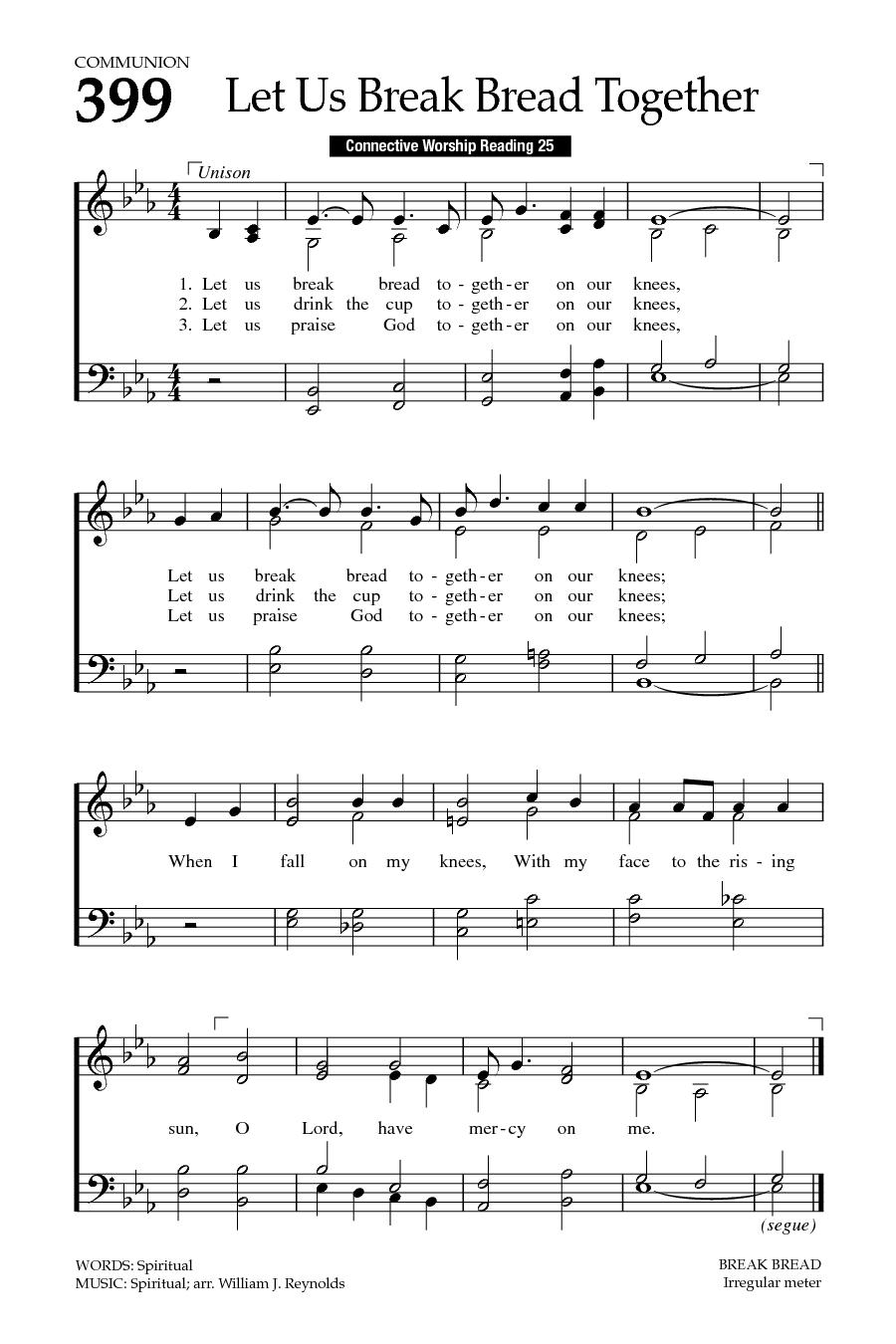
Let Us Break Bread Together
By Anonymous (1925)
Lyrics
1. Let us break bread together on our knees.
Let us break bread together on our knees.
Let us break bread together on our knees.
Refrain:
When I fall on my knees with my face to the rising sun,
O Lord have mercy on me.
When I fall on my knees with my face to the rising sun,
O Lord have mercy on me.
2. Let us drink wine together on our knees.
Let us drink wine together on our knees.
Let us drink wine together on our knees.
3. Let us praise God together on our knees.
Let us praise God together on our knees.
Let us praise God together on our knees.
Bible Reference
Luke 22:19
Lectionary & readings
Open today’s (or any date’s) assigned scriptures and find related hymns across church calendars. Useful when planning worship around this song’s themes or its Bible reference.
Hymn scripture: Luke 22:19
About This Hymn
“Let Us Break Bread Together” is a traditional African American spiritual deeply rooted in the faith and resilience of enslaved Christians in the United States during the 18th and 19th centuries. It is a Communion hymn that reflects a posture of humility and reverence before God, as the repeated refrain, “on our knees, with my face to the rising sun,” symbolizes worship, surrender, and expectation of Christ’s presence. The hymn’s simplicity and repetition reflect the oral traditions of the spirituals, allowing it to be easily remembered and sung in gatherings, often without written music.
The exact origins of the hymn are unknown, but it was first collected and published in The Second Book of Negro Spirituals in 1925 by James Weldon Johnson and J. Rosamond Johnson. Like many spirituals, it likely emerged as a communal expression of faith among enslaved African Americans, who used music to communicate hope, lament, and trust in God’s promises. The emphasis on kneeling reflects both humility and a longing for spiritual freedom, while “the rising sun” may carry a dual meaning, symbolizing both the return of Christ and the dawning of hope even in the face of suffering.
The hymn quickly became beloved in Christian worship services, particularly for its use during Communion. Its repetitive structure and meditative tone encourage congregational participation and reflection on Christ’s sacrifice. The simple melody, often sung in unison, has made it accessible to all generations and traditions, and its spiritual roots carry deep historical and theological significance. This hymn embodies the biblical teaching of humility in worship, as seen in passages like Philippians 2:10-11, which describes every knee bowing before Christ, and in Christ’s own example at the Last Supper in Luke 22:19-20, where He established the Lord’s Supper as a remembrance of His sacrifice.
Beyond its use in Communion services, “Let Us Break Bread Together” holds an important place in the legacy of African American sacred music. Spirituals were often a means of spiritual encouragement, cultural identity, and subtle resistance against the oppression of slavery. Through this hymn, enslaved Christians expressed a hope in Christ that transcended earthly suffering. The imagery of kneeling and looking toward the rising sun not only reflects worship but also a forward-looking faith, anticipating eternal fellowship with Christ.
Today, “Let Us Break Bread Together” is sung in many denominations and cultures worldwide. Its simplicity allows it to serve as both a reflective solo piece and a congregational hymn. While deeply tied to its African American roots, its themes of humility, unity, and anticipation of Christ’s return resonate universally with Christians. It calls believers to approach the Lord’s Table with reverence, remembering that salvation was purchased by the broken body and shed blood of Jesus Christ. In this way, the hymn continues to bridge historical, cultural, and denominational divides, uniting worshipers in a shared act of devotion.
From the Dictionary of Hymnology
Related terms and concepts automatically matched to this hymn.
A beautiful land by faith I see Hymn
This hymn on heaven was given anonymously in the American Shining Star, New York, 1862, where it was entitled “The beautiful land.” It is widely used in America and appears in a few English Sunday school books.
Read moreAlles ist an Gottes Segen Hymn
An anonymous German hymn on Christian faith and patience, dating from about 1673. Miss Winkworth translated it as “All things hang on our possessing.”
Read moreA mourning class, a vacant seat Hymn
An anonymous hymn on the death of a scholar, first printed in the American Union Hymns of 1835. It is widely used in America but only in a few British Sunday school books.
Read moreStaff Visualizer
Open in MIDI StudioPowered by HTML MIDI PLAYER, MIDI FILE Made by Hymnal Library. · Study chords & lyrics in MIDI Studio
Want weekly hymns and devotionals?
⭐ Recommend This Hymn
Share this beautiful hymn with others
This hymn also appears in these hymnals
Click a spine to pull out the hymnal, then open it.
More hymn subjects
Latest Updated Hymnals
-
Open
 Book of Common Praise (BoCP1915)Updated 8 hours ago · 1915
-
Open
 The New Apostolic Church HymnalUpdated 1 week, 6 days ago · 2008
-
Open
 400+ Christmas Carols Book: Sheet Music for PianoUpdated 2 weeks ago · 2014
-
Open
 The Temple HymnalUpdated 2 weeks ago · 1918
-
Open
 The Popular HymnalUpdated 2 weeks ago · 1918
Hymn Information

Click a linked name to open their biography.
MIDI File
Popular Hymns
Recent Blog Posts



Popular Blog Posts
-
 Lessons from the Book of Haggai: Putting God…5 months, 1 week ago
-
 Easter vs Passover: How a Biblical Feast Bec…7 months, 1 week ago
-
 The Full Story of the Birth of Jesus Christ:…10 months, 4 weeks ago
-
 The 30 Most Famous Christmas Hymns and Carols1 year, 2 months ago
-
 The Story Behind the Hymn “Amazing Grace”10 months, 3 weeks ago
Visit Us on Social Media
Latest from X (Twitter)
Tweets by HymnalLibraryLatest from Facebook
Latest on YouTube
Loading latest video...
Daily Bible Verse
Disclaimer
The hymns, sheet music, MIDI files, and related content on this website are provided for educational and research purposes only.
- Public Domain: Many of the hymns featured here are in the public domain and may be freely used.
- Copyrighted Works: Some hymns may still be under copyright protection. Where applicable, permission has either been requested from the copyright owner, or the content is shared under the principles of fair use for educational purposes.
⚠️ Important Notice: If you wish to reproduce, distribute, or use any copyrighted hymn beyond personal study or educational use, you must obtain permission directly from the copyright holder. This website does not grant any rights for commercial use yet.
If there is any other question please address it to us in our Contact Page, for further assistance. Thank you for using the site. May God Bless You.
Recently Added · Dictionary of Hymnology
Browse dictionary →
Can’t find a hymn or lyric?
Leave your question in the forum for others to answer — requests, missing lines, writers, and worship ideas welcome.