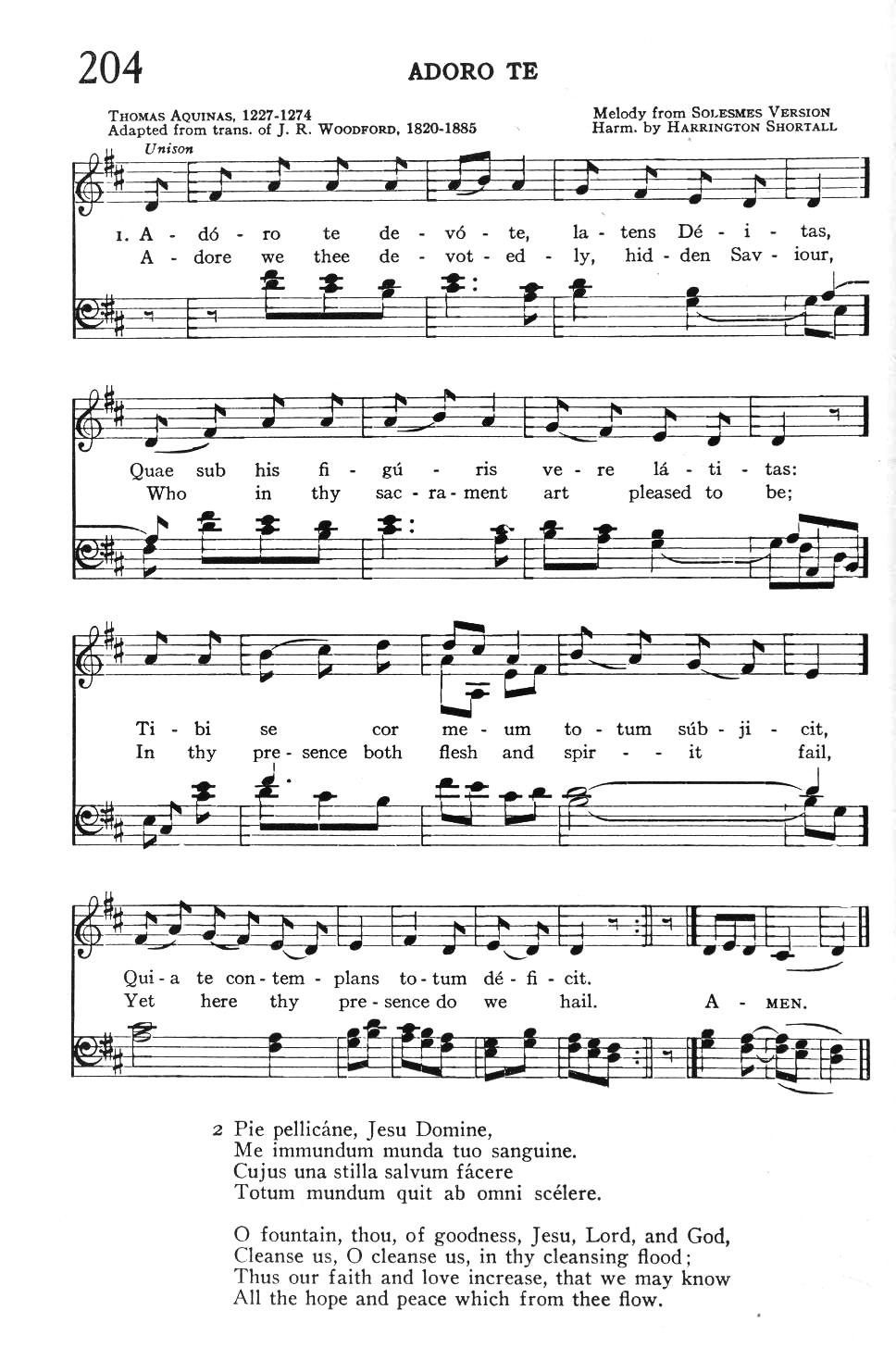



"Adoro Te devote, latens Deitas" is a celebrated Eucharistic hymn authored by St. Thomas Aquinas. While there is no exact record of its composition date, historical circumstances suggest it was written around 1260. During this period, Aquinas was engaged in Paris writing on the Eucharist (1259) and subsequently compiled the office for the newly established festival of Corpus Christi (1263) at the request of Pope Urban IV, for which he produced several renowned hymns including "Pange lingua gloriosi Corporis mysterium," "Lauda Sion," "Sacris solemniis," and "Verbum supernum." Although "Adoro Te devote" was never incorporated into the public liturgical services of the medieval Church, it was added at an early date to various Missals as a private devotion before or after Mass. Hymnologists have noted that Aquinas adopted an exceptionally simple style for this text, refraining from rhetorical pomp when approaching the Eucharistic mystery.
The Latin text was published by Hermann Adalbert Daniel in 1841 (Thesaurus Hymnologicus, Vol. I, No. 242) and by Franz Joseph Mone in 1853 (Lateinische Hymnen des Mittelalters, Vol. I, No. 209) from a Reichenau manuscript of the thirteenth or fourteenth century. Mone's text included various readings and critical remarks, alongside two distinct refrains: "Ave Jesu verum manna, Christe Jesu adauge fidem omnium credentium" (found in seventeenth-century devotional sources) and "Bone Jesu, pastor fidelium adauge fidem omnium in te sperantium" (from a Koblenz manuscript). Later versions, such as those printed in John Henry Newman's Hymni Ecclesiae (1838, 1865) from the Paris Breviary, introduced textual alterations such as changing the opening line to "Adoro te supplex, latens Deitas" and replacing the pelican imagery ("Pie pellicane Jesu Domine") with "O fons puritatis, Jesu Domine."
The hymn has inspired many English translations, five of which entered common congregational use:
-
"O Godhead hid, devoutly I adore Thee": Translated by Edward Caswall in seven stanzas for his Lyra Catholica (1849, p. 247), complete with refrain. It was revised in his Hymns and Poems (1873) and widely adopted in Roman Catholic hymnals, frequently with the refrain omitted.
-
"Humbly I adore Thee, hidden Deity": Translated by John Mason Neale in seven four-line stanzas for his Mediaeval Hymns (1851). It was included with minor alterations in The People's Hymnal (1867, No. 178) and various private devotional manuals.
-
"Thee we adore, O hidden Saviour, Thee": Translated by Bishop James Russell Woodford in 1850 and published in his Hymns Arranged for the Sundays, &c. (1852). Woodford based his text on the Paris Breviary edition, omitting stanzas II, III, and IV to reduce the hymn to four stanzas. This translation underwent several editorial variations across collections such as Hymns Ancient and Modern (1861), the Sarum Hymnal (1868), and Church Hymns (1871).
-
"Prostrate I adore Thee, Deity unseen": A composite rendering featured in the Appendix to the Hymnal Noted (No. 216), constructed from the translations of E. B. Pusey, Edward Caswall, and John David Chambers.
-
"I adore Thee truly, hidden Deity": Translated by William Josiah Irons for his Psalms and Hymns for the Church (1875).
Beyond those in common use, several additional nineteenth-century translations were published, including renderings by E. B. Pusey (1847), Isaac Williams (1839), William Palmer (1845), John David Chambers (1857), J. W. Hewett (1859), John Wallace (1874), and C. H. Poole (1875).
Related Hymns
Hymns in the library connected to this dictionary topic.
Related Hymn Sheets
3 shown at a time — use the arrows to browse all 6 sheets.
Related Authors
Writers connected to this dictionary topic.
Keywords
Related terms for this dictionary entry.
Recent Dictionary Entries
Newly added terms from the Dictionary of Hymnology.
If you notice any mistake or have suggestions, please contact us on our contact page.