

Don’t Put Your Elderly in Homes: What Does t…
6 hours ago
Behold, the Bridegroom Cometh
Lyrics
1. Behold the Bridegroom cometh in the middle of the night,
And blest is he whose loins are girt, whose lamp is burning bright;
But woe to that dull servant, whom the Master shall surprise
With lamp untrimmed, unburning and with slumber in his eyes.
And blest is he whose loins are girt, whose lamp is burning bright;
But woe to that dull servant, whom the Master shall surprise
With lamp untrimmed, unburning and with slumber in his eyes.
2. Do thou, my soul, beware, beware lest thou in sleep sink down,
Lest thou be given o’er to death, and lose the golden crown;
But see that thou be sober, with a watchful eye, and thus
Cry, "Holy, holy, holy God, have mercy upon us!"
Lest thou be given o’er to death, and lose the golden crown;
But see that thou be sober, with a watchful eye, and thus
Cry, "Holy, holy, holy God, have mercy upon us!"
3. That day, the day of fear, shall come; my soul, slack not thy toil,
But light thy lamp, and feed it well, and make it bright with oil;
Who knowest not how soon may sound the cry at eventide,
"Behold the Bridegroom comes! Arise! He come to meet the Bride!"
But light thy lamp, and feed it well, and make it bright with oil;
Who knowest not how soon may sound the cry at eventide,
"Behold the Bridegroom comes! Arise! He come to meet the Bride!"
4. Beware, my soul! take thou good heed lest thou in slumber lie,
And, like the five, remain without, and knock, and vainly cry;
But watch, and bear thy lamp undimmed, and Christ shall gird thee on
His own bright wedding robe of light,--the glory of the Son.
And, like the five, remain without, and knock, and vainly cry;
But watch, and bear thy lamp undimmed, and Christ shall gird thee on
His own bright wedding robe of light,--the glory of the Son.
Bible Reference
Matthew 25:1-13; Matthew 24:42-44; Mark 13:33-37; Luke 12:35-40; 1 Thessalonians 5:1-6; Revelation 19:6-9
About This Hymn
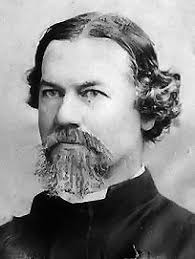
"Behold, the Bridegroom Cometh in the Middle of the Night" is a solemn Advent and Second Coming hymn translated by Gerard Moultrie from an ancient Greek hymn of the Eastern Church. Moultrie's English translation was published in 1864 in Lyra Messianica, and a fuller version appeared in his Hymns and Lyrics for the Seasons and Saints' Days of the Church in 1867. The original Greek text comes from the Midnight Office of the Greek Church and is traditionally associated with the eighth century.
The hymn draws its central imagery from Christ's parable of the ten virgins in Matthew 25:1-13. The Bridegroom represents Christ, while the midnight arrival recalls the unexpected cry announcing His coming. The wise servants are those who remain spiritually prepared, with their lamps burning brightly. The foolish servants, by contrast, are caught unprepared. Moultrie's translation therefore turns the biblical parable into a personal exhortation, repeatedly calling the individual soul to wakefulness, sobriety, and readiness for the appearing of Christ.
The opening stanza presents the dramatic contrast between the blessed servant whose lamp is burning and the careless servant whom the Master finds sleeping. This imagery is deeply rooted in Christ's repeated commands to watch and be ready. The precise time of the Bridegroom's coming is unknown, and the darkness of midnight emphasizes the unexpected nature of His arrival. The hymn therefore warns against spiritual complacency. The Christian life is portrayed as a continual preparation for the moment when the Lord shall return.
The second stanza makes the message intensely personal by addressing the worshiper's own soul. Instead of merely describing the foolish virgins, Moultrie urges the singer to examine his or her own spiritual condition. The soul must not sink into spiritual sleep or become careless about eternal things. The prayer, "Holy, holy, holy God, have mercy upon us," gives the hymn a penitential character. Readiness for Christ's coming is not presented as self-confidence, but as watchfulness accompanied by dependence upon divine mercy.
The third stanza looks toward the day of judgment, calling it "the day of fear." Yet the warning is also an encouragement to faithful labor. The believer is told to keep the lamp burning and to supply it with oil, echoing the central imagery of the wise virgins. The hymn stresses the uncertainty of the time of Christ's return. Since no one knows when the Bridegroom will come, believers must remain prepared rather than postponing repentance, obedience, and faithful service.
The final stanza returns to the five foolish virgins who discovered too late that they were unprepared. Their exclusion from the wedding feast becomes a solemn warning concerning the consequences of spiritual negligence. Yet the hymn ends with a beautiful image of hope: Christ Himself will gird His faithful servants and clothe them with His "bright wedding robe of light." The ultimate readiness of the believer is therefore connected with Christ's gracious provision and the glory of the Son.
Moultrie's translation is written in 14.14.14.14 meter, although hymnals have sometimes adapted it to other metrical arrangements. It has appeared in numerous hymnals and has been paired with melodies including BRIDEGROOM by George Alexander Macfarren and SECOND MODE MELODY, an ancient melody later associated with the text.
"Behold, the Bridegroom Cometh in the Middle of the Night" is especially appropriate for Advent, services concerning Christ's Second Coming, Lent, and occasions emphasizing spiritual watchfulness. Its message is both warning and hopeful. Christ will come, the hour is unknown, and His people are called to remain awake, faithful, and spiritually prepared. The hymn ultimately directs the believer away from complacency and toward the glorious expectation of meeting the heavenly Bridegroom.
From the Dictionary of Hymnology
Related terms and concepts automatically matched to this hymn.
Agnus Dei Qui tollis peccata mundi History
Hymnological record of the Agnus Dei, detailing its liturgical origins, medieval development, Reformation adaptations, and English translations.
Read moreAgnes, fair martyr History
Hymnological record of Mary Dunlop Moultrie's nineteenth-century hymn for St. Agnes's Day, detailing its deathbed composition and subsequent adaptation for church collections.
Read moreArrayed in robes of virgin white Hymnology
An entry on Gerard Moultrie's hymn for the Festival of Martyrs.
Read more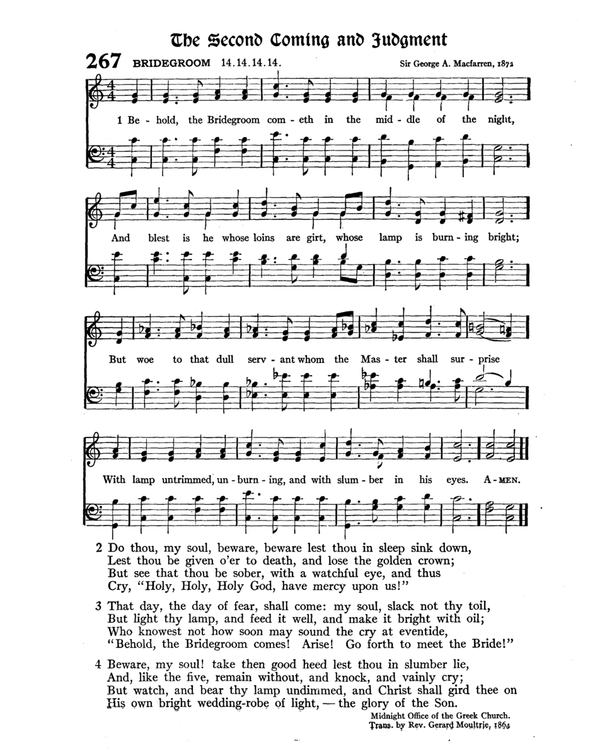

📬 Subscribe to Our Devotional Updates
Receive weekly hymns, devotionals, and website features directly in your inbox.
✅ Thank you! You'll start receiving our updates soon.
⭐ Recommend This Hymn
Share this beautiful hymn with others
This hymn is found in these hymnals
Open the hymnal that contains this hymn:
More hymn subjects
Recently Added Hymns
-
 Let All Together Praise Our GodNikolaus Herman 1560
 -
 Holy, Holy, Holy, Lord, God of hosts, Eternal KingChristopher Wordsworth 1862
 -
 Hail, Redeemer, King DivinePatrick Brennan 1856
 -
 Father, We Thank Thee, Who Hast PlantedBland Tucker 1939
 -
 Father, See Thy Children Bending at Thy ThroneWilliam B. Trevelyan 1906
Latest Updated Hymnals
-
Open
 The People's HymnalUpdated 2 weeks, 3 days ago · 1961
 -
Open
 Book of Common Praise (BoCP1915)Updated 2 months, 3 weeks ago · 1915
 -
Open
 Our Great Redeemer's PraiseUpdated 4 months, 2 weeks ago · 2022
 -
Open
 The Parish Hymnal (1873)Updated 4 months, 3 weeks ago · 1873
 -
Open
 Book of Common Praise (BCP1998)Updated 5 months ago · 1998
Hymn Information
To view the author's biography, click their name above.
MIDI File
Ready to load
Download MIDI
More Hymns by Gerard Moultrie
Popular Hymns
Recent Blog Posts



Popular Blog Posts
-
 Lessons from the Book of Haggai: Putting God…4 months ago
 -
 Easter vs Passover: How a Biblical Feast Bec…6 months ago
 -
 The Full Story of the Birth of Jesus Christ:…9 months, 3 weeks ago
 -
 The 30 Most Famous Christmas Hymns and Carols1 year, 1 month ago
 -
 The Story Behind the Hymn “Amazing Grace”9 months, 2 weeks ago
Visit Us on Social Media
Latest from X (Twitter)
Tweets by HymnalLibraryLatest from Facebook
Latest on YouTube
Loading latest video...
Daily Bible Verse
Disclaimer
The hymns, sheet music, MIDI files, and related content on this website are provided for educational and research purposes only.
- Public Domain: Many of the hymns featured here are in the public domain and may be freely used.
- Copyrighted Works: Some hymns may still be under copyright protection. Where applicable, permission has either been requested from the copyright owner, or the content is shared under the principles of fair use for educational purposes.
⚠️ Important Notice: If you wish to reproduce, distribute, or use any copyrighted hymn beyond personal study or educational use, you must obtain permission directly from the copyright holder. This website does not grant any rights for commercial use yet.
If there is any other question please address it to us in our Contact Page, for further assistance. Thank you for using the site. May God Bless You.