



12 Ways to Deepen Your Relationship with God
1 week, 2 days ago
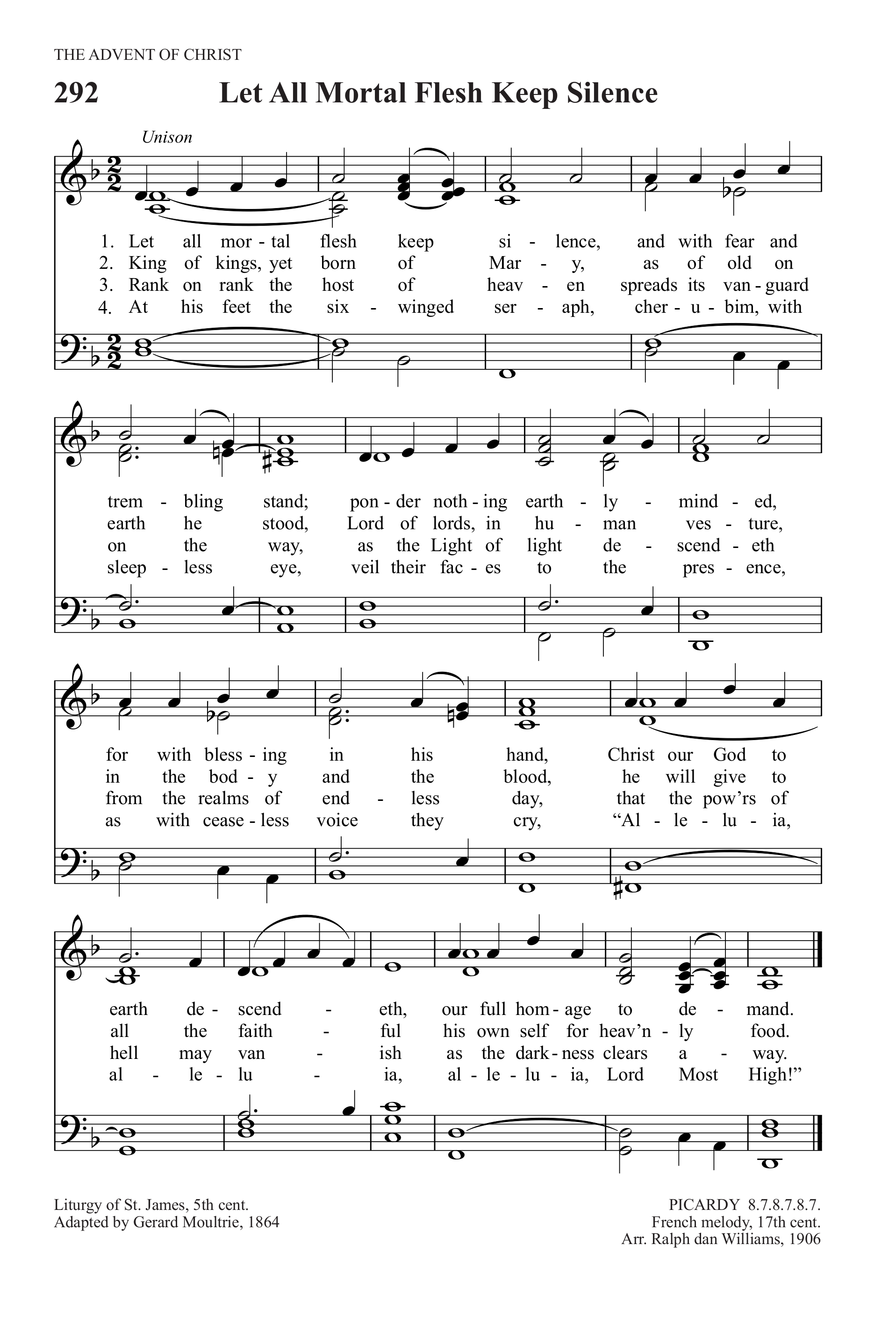
Let All Mortal Flesh Keep Silence
By Gerard Moultrie (1864)
Mark it for others looking for a hymn like this.
New
Lyrics
1. Let all mortal flesh keep silence,
and with fear and trembling stand;
ponder nothing earthly minded,
for, with blessing in His hand,
Christ our God to earth descendeth,
our full homage to demand.
2. King of kings, yet born of Mary,
as of old on earth He stood,
Lord of lords, in human vesture,
in the body and the blood.
He will give to all the faithful
His own self for heav'nly food.
3. Rank on rank the host of heaven
spreads its vanguard on the way,
as the Light of light descendeth
from the realms of endless day,
that the pow'rs of hell may vanish
as the darkness clears away.
4. At His feet the six-winged seraph,
cherubim with sleepless eye,
veil their faces to the Presence,
as with ceaseless voice they cry,
“Alleluia, alleluia,
alleluia, Lord Most High!”
Bible Reference
Habakkuk 2:20; Philippians 2:5-11; Revelation 19:11-16; John 1:14
Lectionary & readings
Open today’s (or any date’s) assigned scriptures and find related hymns across church calendars. Useful when planning worship around this song’s themes or its Bible reference.
Hymn scripture: Habakkuk 2:20; Philippians 2:5-11; Revelation 19:11-16; John 1:14
About This Hymn
“Let All Mortal Flesh Keep Silence” is one of the most solemn and awe filled hymns in Christian worship, calling believers to reverent silence before the mystery of Christ’s incarnation and redemptive work. Translated into English by Gerard Moultrie from an ancient Greek text of the Liturgy of St. James, the hymn carries with it the weight of early Christian worship and theology. Its language is majestic and restrained, inviting worshipers to lay aside earthly thoughts and distractions in order to behold the coming of Christ with humility and wonder.
The hymn opens with a call to silence, not as emptiness, but as reverent attentiveness. All human pride, fear, and self reliance are set aside in the presence of Christ the King, who comes not merely as teacher or example, but as the Lord of heaven and earth. The text emphasizes that Christ comes to earth to give Himself as heavenly food, a clear reference to both the incarnation and the sacrificial giving of His life. This imagery connects Bethlehem and Calvary, reminding worshipers that the child born in humility is the same Savior who offers Himself for the life of the world.
The hymn draws richly from biblical and liturgical imagery. Christ is portrayed as attended by angelic hosts, echoing the visions of heavenly worship found in Scripture. Yet this heavenly glory does not distance Him from humanity. Instead, it magnifies the wonder that the eternal Word took flesh and dwelt among us. The hymn holds together majesty and meekness, power and humility, silence and song.
Theologically, the hymn reflects a high Christology. Jesus is confessed as fully divine and fully human, reigning in glory while stooping in grace. Worship is portrayed not as casual expression, but as reverent encounter with holy mystery. This makes the hymn especially fitting for Advent, Christmas, and communion services, where the church reflects on Christ’s coming and His self giving love.
“Let All Mortal Flesh Keep Silence” has endured because it teaches the church how to worship as much as what to believe. It reminds believers that some truths are best approached with quiet reverence rather than many words. In calling the faithful to silence, the hymn opens the heart to awe, gratitude, and worship before Christ, who comes still to dwell with His people in grace and glory.
From the Dictionary of Hymnology
Related terms and concepts automatically matched to this hymn.
What care the saints of God, if they Hymn
G. Moultrie Confessors festival hymn; Hymns and Lyrics, 1867, p. 159 (9×6). Abbreviated in the 1869 Appendix to the S. P. C. K. Psalms & Hymns; Thring’s Collection, 1882, and others.
Read moreIdou ho Nymphios erchetai / Jesus, hastening for the world to suffer Hymn
Eastern Church midnight Bridegroom hymn, translated by G. Moultrie (1864); and Dr. Neale’s Palm Sunday cento from St. Andrew of Crete’s canon (cir. 660–732).
Read moreO rubentes coeli rosae Latin Hymn
Hymn on St. Ursula and the 11,000 virgins (Mone 1187 from 15th-cent. Basel MS; Daniel iv.). Moultrie’s imitation “Heavenly garland, rosy red” (1864–67).
Read moreStaff Visualizer
Open in MIDI StudioPowered by HTML MIDI PLAYER, MIDI FILE Made by Hymnal Library. · Study chords & lyrics in MIDI Studio
Want weekly hymns and devotionals?
This hymn also appears in these hymnals
Click a spine to pull out the hymnal, then open it.
Hymns with the same subject
More hymns about Kingship of Christ, Sovereignty of God
- Holy, Holy, Holy! Lord God Almighty! - Reginald Heber
- He Shall Reign Forevermore - Chris Tomlin
- The Lord in Zion Reigneth - Fanny J. Crosby
- Christ, By Heavenly Hosts Adored - Henry Harbaugh
- Day of Wrath! O Day of Mourning! - Thomas of Celano
- Christ's Condescension and Glorification; or, God Made Man - Isaac Watts
- Because He Lives - Bill & Gloria Gaither
- How Great Thou Art - Carl Boberg
More hymn subjects
Recently Added Hymns
-
 Holy Father, We Adore TheeE. F. Stewart circa. 1870s
-
 Holy Father, Great CreatorAlexander Viets Griswold 1837
-
Holy Father, cheer our way (Light at Evening Time)Richard H. Robinson 1869
-
 I Could Not Do Without Thee, O Savior of the LostFrances R. Havergal 1873
-
I Bow My Forehead to the DustJohn Greenleaf Whittier 1865
Latest Updated Hymnals
-
Open
 Book of Common Praise (BoCP1915)Updated 1 week, 3 days ago · 1915
-
Open
 400+ Christmas Carols Book: Sheet Music for PianoUpdated 2 weeks, 2 days ago · 2014
-
Open
 Psalms of GraceUpdated 2 weeks, 3 days ago · 2022
-
Open
 Spurgeon's Own Hymn BookUpdated 2 weeks, 3 days ago · 1866
-
Open
 The New Apostolic Church HymnalUpdated 1 month, 1 week ago · 2008
Hymn Information

Click a linked name to open their biography.
MIDI File
More Hymns by Gerard Moultrie
Popular Hymns
Recent Blog Posts



Popular Blog Posts
-
 Lessons from the Book of Haggai: Putting God…6 months ago
-
 Easter vs Passover: How a Biblical Feast Bec…8 months ago
-
 The Full Story of the Birth of Jesus Christ:…11 months, 3 weeks ago
-
 The 30 Most Famous Christmas Hymns and Carols1 year, 3 months ago
-
 The Story Behind the Hymn “Amazing Grace”11 months, 2 weeks ago
Visit Us on Social Media
Latest from X (Twitter)
Tweets by HymnalLibraryLatest from Facebook
Latest on YouTube
Loading latest video...
Daily Bible Verse
Disclaimer
The hymns, sheet music, MIDI files, and related content on this website are provided for educational and research purposes only.
- Public Domain: Many of the hymns featured here are in the public domain and may be freely used.
- Copyrighted Works: Some hymns may still be under copyright protection. Where applicable, permission has either been requested from the copyright owner, or the content is shared under the principles of fair use for educational purposes.
⚠️ Important Notice: If you wish to reproduce, distribute, or use any copyrighted hymn beyond personal study or educational use, you must obtain permission directly from the copyright holder. This website does not grant any rights for commercial use yet.
If there is any other question please address it to us in our Contact Page, for further assistance. Thank you for using the site. May God Bless You.
Recently Added · Dictionary of Hymnology
Browse dictionary →- Index of Authors and Translators (H–Z) 6 days, 18 hours ago · History 1
- Index of First Lines (We–Z) / Index of Authors (A–Hincks) 6 days, 18 hours ago · History 2
- Work while it is to-day / Yet there is room / Yonge, Charlotte M. / Zyma vetus 6 days, 18 hours ago · Hymn 1
- Wordsworth, Elizabeth 6 days, 18 hours ago · Biography 0
- Wilton, Richard / Winks, William Edward / Wiseman, Card. Nicholas / Woodward, G. R. / Wordsworth, Bp. C. 6 days, 18 hours ago · Biography 1
Can’t find a hymn or lyric?
Leave your question in the forum for others to answer — requests, missing lines, writers, and worship ideas welcome.