About John Henry Newman
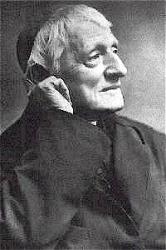
John Henry Newman (1801–1890) stands as one of the most towering intellectual and spiritual figures of the 19th century, a man whose journey from the pulpit of the University Church of St. Mary the Virgin to the rank of Cardinal redefined the religious landscape of England. Born in London and educated at Trinity College, Oxford, Newman became a fellow of Oriel College and a central leader of the "Oxford Movement." Alongside figures like John Keble and Edward Pusey, he sought to recover the "catholicity" of the Church of England through the influential Tracts for the Times. His eventual conversion to Roman Catholicism in 1845 was a seismic event in Victorian society, leading him to found the Oratory of St. Philip Neri in Birmingham and later serve as the Rector of the Catholic University of Ireland. His Apologia Pro Vita Sua remains a masterpiece of spiritual autobiography, defending his integrity and the logic of his religious evolution.
In the realm of hymnody, Newman’s contributions are relatively few in number but extraordinary in their quality and endurance. His most famous hymn, "Lead, Kindly Light," was written in 1833 while he was stranded on a boat in the Mediterranean, physically ill and spiritually unsettled about the future of the English Church. The hymn’s imagery of a "distant scene" and "encircling gloom" resonated deeply with a public grappling with the uncertainties of the industrial age and the shadows of doubt. Unlike many hymns of the era that focused on triumphalism, Newman’s verses offered a vulnerable, intimate prayer for guidance, one step at a time. This "brilliant original piece" quickly transcended denominational boundaries to become a universal anthem for those seeking light in times of personal or societal darkness.
Another of Newman’s major contributions comes from his epic poem The Dream of Gerontius, which depicts the journey of a soul from death to the throne of God. From this work, the church extracted the majestic hymn "Praise to the Holiest in the Height." This text is a profound theological meditation on the Incarnation and the Atonement, celebrating the "second Adam" who came to the rescue of the human race. Furthermore, Newman was a prolific translator of Latin office hymns from the Roman and Paris Breviaries. His translations, such as "Come, Holy Ghost, Who Ever One" (Nunc Sancte nobis), brought the ancient liturgical rhythms of the early church into the English-speaking world, influencing the development of the Hymns Ancient and Modern collection.
Throughout his later years at the Edgbaston Oratory in Birmingham, Newman continued to write verse that was deeply rooted in his new Catholic identity, including hymns dedicated to St. Philip Neri and the Blessed Virgin Mary. While he was a master of "inimitable prose," his hymns revealed a more lyrical, mystical side of his personality. When he was created a Cardinal in 1879, it was seen as a final vindication of his long and often controversial path. Today, Newman is remembered not just as a theologian and saint, but as a poet who provided the church with a vocabulary for the "one true Faith" and the "ancient Creed," bridging the gap between historical tradition and the modern searching soul.
From the Dictionary of Hymnology
Related terms and topics automatically matched to this author.
Aeterna coeli gloria History
Hymnological profile of the fifth-century Friday Lauds hymn "Aeterna coeli gloria," detailing its manuscript sources, acrostic structure, and English translations.
Read moreAeterne rerum conditor History
Hymnological profile of Saint Ambrose's Sunday morning hymn "Aeterne rerum conditor," including patristic evidence of authenticity, manuscript traditions, and English translations.
Read moreAdsis superne Spiritus, Pater benigne pauperum History
Hymnological profile of "Adsis superne Spiritus, Pater benigne pauperum," an anonymous 18th-century Whitsuntide hymn from the Paris Breviary, detailing its usage and English translations.
Read more