

What Is Godliness?
1 week, 4 days ago
Adoro Te Devote, Latens Deitas
Lyrics
1. Adoro te devote, latens Deitas,
Quae sub his figuris vere latitas:
Tibi se cor meum totum subicit,
Quia te contemplans totum deficit.
Quae sub his figuris vere latitas:
Tibi se cor meum totum subicit,
Quia te contemplans totum deficit.
2. Visus, tactus, gustus in te fallitur,
Sed auditus solo tuto creditur:
Credo quidquid dixit Dei Filius:
Nil hoc verbo veritatis verbo verius.
Sed auditus solo tuto creditur:
Credo quidquid dixit Dei Filius:
Nil hoc verbo veritatis verbo verius.
3. In cruce latebat sola Deitas,
At hic latet simul et humanitas:
Ambo tamen credens atque confitens,
Peto quod petivit latro paenitens.
At hic latet simul et humanitas:
Ambo tamen credens atque confitens,
Peto quod petivit latro paenitens.
4. Plagas, sicut Thomas, non intueor:
Deum tamen meum te confiteor:
Fac me tibi semper magis credere,
In te spem habere, te diligere.
Deum tamen meum te confiteor:
Fac me tibi semper magis credere,
In te spem habere, te diligere.
5. O memoriale mortis Domini,
Panis vivus vitam praestans homini,
Praesta mean menti de te vivere,
Et te illi semper dulce sapere.
Panis vivus vitam praestans homini,
Praesta mean menti de te vivere,
Et te illi semper dulce sapere.
6. Pie pellicane, Jesu Domine,
Me immundum munda tuo sanguine,
Cuius una stilla salvum facere
Totum mundum quit ab omni scelere.
Me immundum munda tuo sanguine,
Cuius una stilla salvum facere
Totum mundum quit ab omni scelere.
7. Jesu, quem velatum nunc aspicio,
Oro fiat illud quod tam sitio:
Ut te revelata cernens facie,
Visu sim beátus tuae gloriae.
Oro fiat illud quod tam sitio:
Ut te revelata cernens facie,
Visu sim beátus tuae gloriae.
Bible Reference
John 6:32-35; John 6:48-58; Matthew 26:26-28; Luke 22:19-20; 1 Corinthians 10:16-17; 1 Corinthians 11:23-29
About This Hymn
Adoro Te Devote, Latens Deitas, meaning "Devoutly I Adore Thee, Hidden Deity," is one of the most profound medieval Christian hymns of Eucharistic devotion. It is attributed to Thomas Aquinas, the Dominican theologian and philosopher who lived circa 1225-1274. The exact date of composition is not known, but hymnological sources place it approximately around 1260, during the period when Aquinas was deeply engaged in writing about the Eucharist.
The hymn is a prayer of humble adoration directed toward Jesus Christ, particularly His presence in the Holy Eucharist. Its opening words immediately establish its central theme: the worshiper approaches Christ who is hidden beneath the sacramental signs, confessing faith in the Savior even though His divine glory cannot be perceived by ordinary human senses. The hymn therefore emphasizes the relationship between faith and sight. What the eyes, hands, and other senses cannot fully comprehend, faith receives because Christ Himself has spoken. This theme is closely connected with Christ's teaching in John 6 concerning the bread of life and with His words at the Last Supper concerning His body and blood.
Aquinas develops this theme by contrasting human perception with divine revelation. Sight, touch, and taste cannot establish the mystery of Christ's presence, but the believer trusts the testimony of the Son of God. The hymn thus becomes a confession of faith in Christ's word. This is particularly significant because the Christian does not worship merely an idea, symbol, or historical memory, but comes before Christ in humble faith and adoration. The language is simple and reverent, avoiding elaborate philosophical argument while expressing profound theological conviction.
The hymn then turns toward the crucifixion. Aquinas draws a deliberate connection between Christ's hidden presence in the Eucharist and His hidden divinity during His Passion. On the cross, Christ's divine nature was concealed beneath His suffering humanity, yet the believer confesses Him as both God and man. The hymn recalls the repentant thief who recognized Christ even while He was hanging upon the cross. The worshiper likewise asks for the grace to believe more deeply, hope more firmly, and love Christ more completely.
One of the most beautiful sections describes the Eucharist as the "memorial of the Lord's death" and as the living Bread that gives life to humanity. The hymn therefore connects Communion with Christ's sacrificial death and with the believer's spiritual nourishment. It is not merely a remembrance of something that happened in the distant past. The worshiper asks that Christ become the source and sweetness of spiritual life, drawing the heart continually toward Him.
The famous appeal to Christ as the "loving Pelican" introduces an ancient Christian symbol. Medieval Christian tradition used the pelican as an image of self-sacrificial love, based on the belief that a pelican could feed its young with its own blood. Aquinas applies this imagery to Christ, asking Him to cleanse the sinful worshiper by His precious blood. The image points directly toward the biblical teaching that Christ's blood cleanses from sin and that His sacrifice is sufficient for redemption.
The final stanza turns from present faith to future glory. Christ is presently seen as veiled, but the worshiper longs for the day when the veil will be removed and Christ will be seen face to face. This gives the hymn an important eschatological dimension. Eucharistic devotion ultimately points beyond the present sacramental mystery toward the blessed vision of Christ in His unveiled glory.
The hymn was not originally part of the official liturgical texts composed by Aquinas for the feast of Corpus Christi, although it became widely associated with Eucharistic devotion and was later incorporated into missals and hymnals. It has been translated into English many times, with Edward Caswall's "O Godhead Hid, Devoutly I Adore Thee" among the best-known versions. Other important translations include those by John Mason Neale, J. R. Woodford, and Gerard Manley Hopkins.
Adoro Te Devote remains a treasured expression of Christian adoration, humility, faith, and hope. Its movement is beautifully ordered: the believer bows before Christ in the hidden mystery, confesses faith where the senses cannot see, remembers the Savior's Passion, asks for cleansing and grace, and finally longs to behold Christ face to face in glory. The hymn's enduring power lies in its simple but profound confession that Jesus Christ is worthy of worship even when His glory is hidden from human sight.
From the Dictionary of Hymnology
Related terms and concepts automatically matched to this hymn.
Adoro Te devote, latens Deitas History
Detailed history of St. Thomas Aquinas's famous Eucharistic hymn "Adoro Te devote," tracing its origins, liturgical use, manuscript traditions, and numerous English translations.
Read moreAdam of St. Victor Hymnology
A biographical and text-critical overview of Adam of St. Victor, the premier Latin sequence writer of the twelfth century, mapping his manuscript preservation, stylistic legacy, and modern rediscover…
Read moreA time to watch, a time to pray Hymnology
A historical summary of John Mason Neale's 1842 Good Friday children's hymn, detailing its structural composition, the inclusion of Bishop Ken's doxology, and subsequent editorial changes by Mrs. Car…
Read more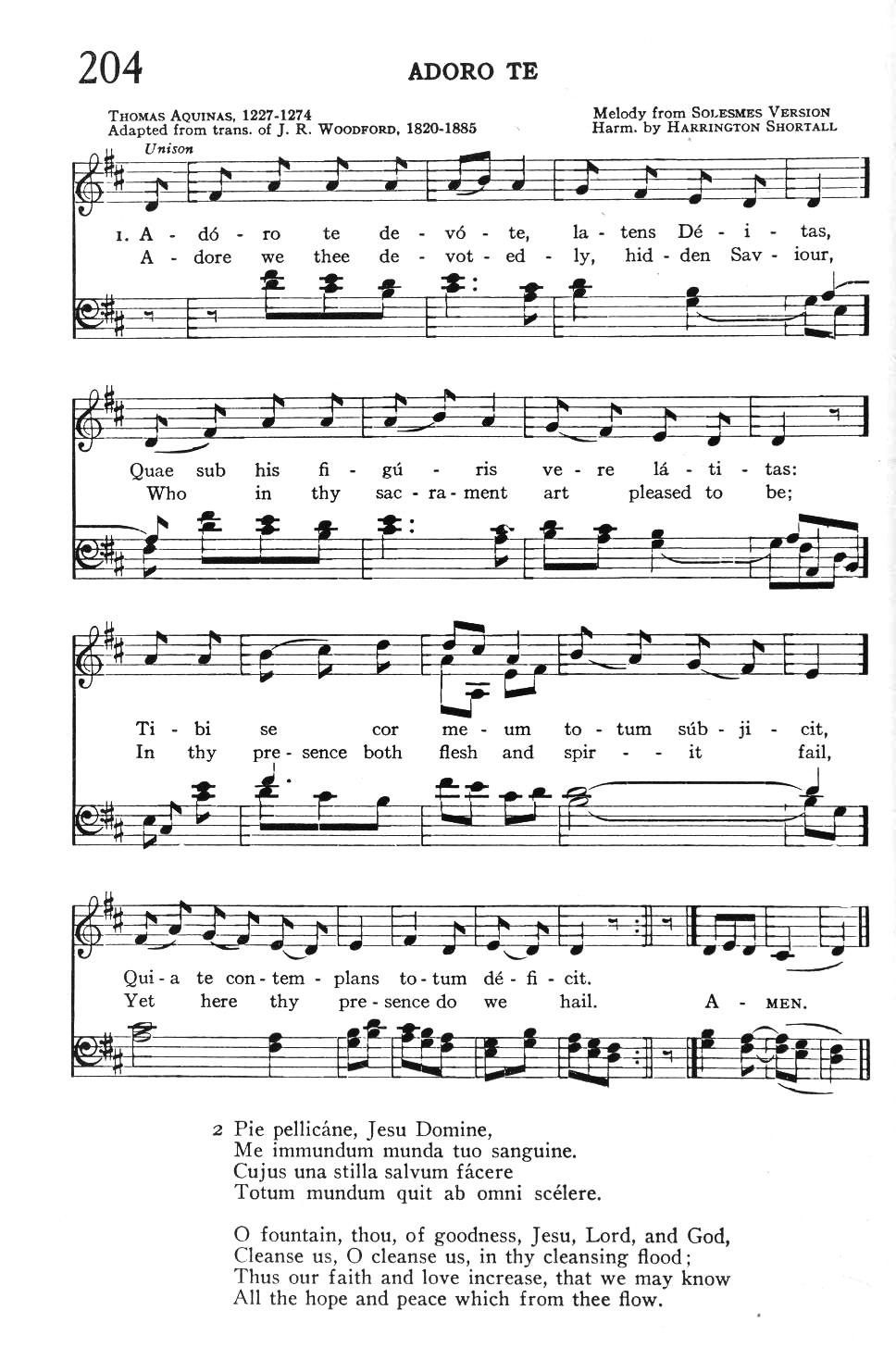

📬 Subscribe to Our Devotional Updates
Receive weekly hymns, devotionals, and website features directly in your inbox.
✅ Thank you! You'll start receiving our updates soon.
⭐ Recommend This Hymn
Share this beautiful hymn with others
This hymn is found in these hymnals
Open the hymnal that contains this hymn:
Hymns with the same subject
More hymns about Majesty of God, Obedience, Worship
- How Great Thou Art — Carl Boberg
- Holy, Holy, Holy! Lord God Almighty! — Reginald Heber
- As the Deer Panteth for the Waters — Martin Nystrom
- Jesus Calls Us; O'er The Tumult — Cecil Frances Alexander
- Lord, Whose Love in Humble Service — Albert F. Bayly
- Majesty, Worship His Majesty — Jack W. Hayford
- Speak, O Lord — Stuart Townend
- O Worship the Lord — John S. B. Monsell
More hymn subjects
Explore other themes across the library.
Hymns about Healing
Hymns about Adoration
Hymns about Harvest
Hymns about Assurance
Hymns about Christian Unity
Hymns about Anniversary
Hymns about Courage
Hymns about Praise
Browse all subjects →
Recently Added Hymns
-
 Let All Together Praise Our GodNikolaus Herman 1560
 -
 Holy, Holy, Holy, Lord, God of hosts, Eternal KingChristopher Wordsworth 1862
 -
 Hail, Redeemer, King DivinePatrick Brennan 1856
 -
 Father, We Thank Thee, Who Hast PlantedBland Tucker 1939
 -
 Father, See Thy Children Bending at Thy ThroneWilliam B. Trevelyan 1906
Latest Updated Hymnals
-
Open
 The People's HymnalUpdated 2 weeks, 2 days ago · 1961
 -
Open
 Book of Common Praise (BoCP1915)Updated 2 months, 3 weeks ago · 1915
 -
Open
 Our Great Redeemer's PraiseUpdated 4 months, 2 weeks ago · 2022
 -
Open
 The Parish Hymnal (1873)Updated 4 months, 3 weeks ago · 1873
 -
Open
 Book of Common Praise (BCP1998)Updated 5 months ago · 1998
Hymn Information

To view the author's biography, click their name above.
MIDI File
Ready to load
Download MIDI
More Hymns by Thomas Aquinas
Popular Hymns
Recent Blog Posts



Popular Blog Posts
-
 Lessons from the Book of Haggai: Putting God…4 months ago
 -
 Easter vs Passover: How a Biblical Feast Bec…6 months ago
 -
 The Full Story of the Birth of Jesus Christ:…9 months, 3 weeks ago
 -
 The 30 Most Famous Christmas Hymns and Carols1 year, 1 month ago
 -
 The Story Behind the Hymn “Amazing Grace”9 months, 2 weeks ago
Visit Us on Social Media
Latest from X (Twitter)
Tweets by HymnalLibraryLatest from Facebook
Latest on YouTube
Loading latest video...
Daily Bible Verse
Disclaimer
The hymns, sheet music, MIDI files, and related content on this website are provided for educational and research purposes only.
- Public Domain: Many of the hymns featured here are in the public domain and may be freely used.
- Copyrighted Works: Some hymns may still be under copyright protection. Where applicable, permission has either been requested from the copyright owner, or the content is shared under the principles of fair use for educational purposes.
⚠️ Important Notice: If you wish to reproduce, distribute, or use any copyrighted hymn beyond personal study or educational use, you must obtain permission directly from the copyright holder. This website does not grant any rights for commercial use yet.
If there is any other question please address it to us in our Contact Page, for further assistance. Thank you for using the site. May God Bless You.
Recently Added · Dictionary of Hymnology
Browse dictionary →- Jonathan Bush Atchinson 1 week, 6 days ago · Biography 107
- At Thy transfiguration, Lord 1 week, 6 days ago · Hymnology 107
- At Thy Feet, our God and Father 1 week, 6 days ago · Hymnology 99
- At Thy feet, O Christ, we lay 1 week, 6 days ago · Hymnology 90
- At Thy command, our dearest Lord 1 week, 6 days ago · Hymnology 107