

10 Doctrinally Accurate Christmas Carols and…
1 day, 4 hours ago
Pange, Lingua Gloriosi
By Thomas Aquinas ; para. Hymnal Library (1263)
Lyrics
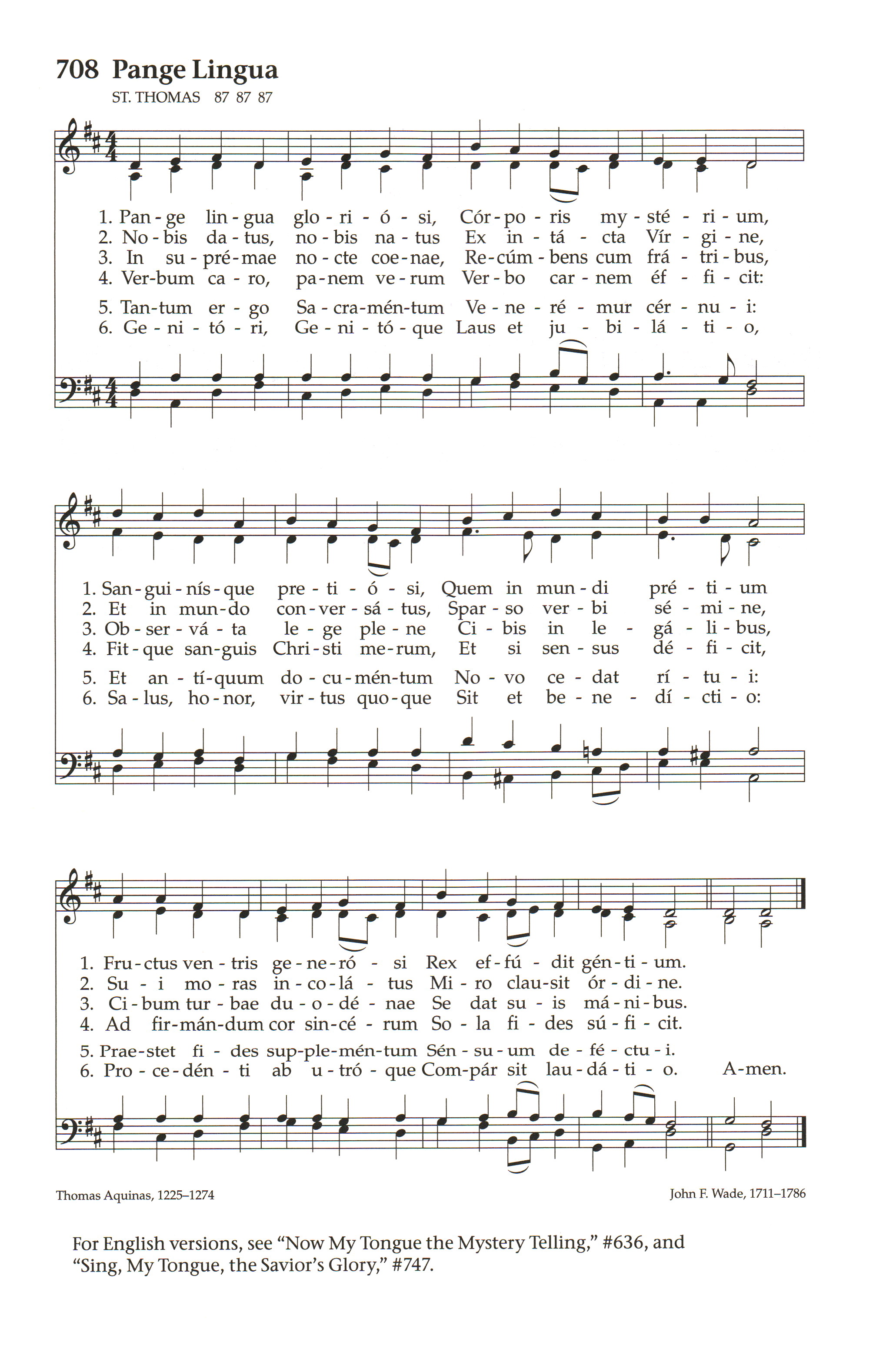
1. Pange, lingua, gloriosi
Corporis mysterium
Sanguinisque pretiosi,
Quem in mundi pretium
Fructus ventris generosi
Rex effudit gentium.
------------
Sing, my tongue, the mystery glorious
Of the body of our Lord,
And the precious blood so holy,
Which, to ransom all the world,
From a noble Virgin's body,
Christ the King of nations poured.
Corporis mysterium
Sanguinisque pretiosi,
Quem in mundi pretium
Fructus ventris generosi
Rex effudit gentium.
------------
Sing, my tongue, the mystery glorious
Of the body of our Lord,
And the precious blood so holy,
Which, to ransom all the world,
From a noble Virgin's body,
Christ the King of nations poured.
2. Nobis datus, nobis natus
Ex intacta Virgine,
Et in mundo conversatus,
Sparso verbi semine,
Sui moras incolatus
Miro clausit ordine.
-------------
Given for us, born among us,
Of a Virgin undefiled,
He lived here among His people,
Sowing forth His Word divine;
Then His earthly life He ended,
By a wondrous, ordered design.
Ex intacta Virgine,
Et in mundo conversatus,
Sparso verbi semine,
Sui moras incolatus
Miro clausit ordine.
-------------
Given for us, born among us,
Of a Virgin undefiled,
He lived here among His people,
Sowing forth His Word divine;
Then His earthly life He ended,
By a wondrous, ordered design.
3. In supremae nocte coenae,
Recumbens cum fratribus,
Observata lege plene
Cibis in legalibus,
Cibum turbae duodenae
Se dat suis manibus.
------------
On the night of His last supper,
Seated with His brethren there,
Having kept the law's requirements,
And partaken of its fare,
To the twelve He gave Himself,
With His own hands, as their share.
Recumbens cum fratribus,
Observata lege plene
Cibis in legalibus,
Cibum turbae duodenae
Se dat suis manibus.
------------
On the night of His last supper,
Seated with His brethren there,
Having kept the law's requirements,
And partaken of its fare,
To the twelve He gave Himself,
With His own hands, as their share.
4. Verbum caro, panem verum
Verbo carnem efficit:
Fitque sanguis Christi merum,
Et si sensus deficit,
Ad firmandum cor sincerum
Sola fides sufficit.
-----------
By His Word, the Word made flesh now
Makes the true bread flesh indeed;
And the wine becomes Christ's blood,
Though our senses fail to see.
Faith alone suffices fully
For the heart in sincerity.
Verbo carnem efficit:
Fitque sanguis Christi merum,
Et si sensus deficit,
Ad firmandum cor sincerum
Sola fides sufficit.
-----------
By His Word, the Word made flesh now
Makes the true bread flesh indeed;
And the wine becomes Christ's blood,
Though our senses fail to see.
Faith alone suffices fully
For the heart in sincerity.
5. Tantum ergo Sacramentum
Veneremur cernui:
Et antiquum documentum
Novo cedat ritui;
Praestet fides supplementum
Sensuum defectui.
-----------
So this great and holy Sacrament
Let us worship, bending low;
Let the ancient rites now yield
To the new that Christ bestows.
Let our faith supply the weakness
Of the senses that fall short.
Veneremur cernui:
Et antiquum documentum
Novo cedat ritui;
Praestet fides supplementum
Sensuum defectui.
-----------
So this great and holy Sacrament
Let us worship, bending low;
Let the ancient rites now yield
To the new that Christ bestows.
Let our faith supply the weakness
Of the senses that fall short.
6. Genitori, Genitoque
Laus et jubilatio,
Salus, honor, virtus quoque
Sit et benedictio:
Procedenti ab utroque
Compar sit laudatio
-----------
To the Father and the Son be
Praise and joyful jubilation;
Honor, glory, power, and blessing,
Health and strength and adoration.
To the Spirit, from them proceeding,
Equal praise be ever given.
Laus et jubilatio,
Salus, honor, virtus quoque
Sit et benedictio:
Procedenti ab utroque
Compar sit laudatio
-----------
To the Father and the Son be
Praise and joyful jubilation;
Honor, glory, power, and blessing,
Health and strength and adoration.
To the Spirit, from them proceeding,
Equal praise be ever given.
Bible Reference
Matthew 26:17-30; Mark 14:12-26; Luke 22:14-20; John 6:44-58; 1 Corinthians 10:16; 1 Corinthians 11:23-26
Lectionary & readings
Open today’s (or any date’s) assigned scriptures and find related hymns across church calendars. Useful when planning worship around this song’s themes or its Bible reference.
Hymn scripture: Matthew 26:17-30; Mark 14:12-26; Luke 22:14-20; John 6:44-58; 1 Corinthians 10:16; 1 Corinthians 11:23-26
About This Hymn
Note: This is a sense-based English translation of the Latin text from the lyrics, rather than a reproduction of a particular published translation. In stanza 4, “merum” refers to wine, and the stanza expresses the hymn's traditional Eucharistic teaching.
Pange, lingua, gloriosi, Corporis mysterium, is the opening line of a celebrated Latin hymn attributed to Thomas Aquinas, the medieval theologian and philosopher. The hymn is associated with the Feast of Corpus Christi, a Christian observance focused on the body and blood of Jesus Christ in the Eucharist. It is among the best-known Latin hymns of the medieval Church and combines devotional poetry with a carefully developed account of Christ's incarnation, sacrifice, institution of the Lord's Supper, and the mystery of the sacrament. The hymn is also known through its concluding stanzas, particularly Tantum ergo Sacramentum, which has frequently been used as a separate hymn during Eucharistic adoration and Benediction.
The opening stanza calls the Church to proclaim the mystery of Christ's body and precious blood, given for the redemption of the world. It directs attention to Jesus Christ as the King who offers Himself for humanity. The second stanza reflects on the incarnation, celebrating the coming of the Son of God through the Virgin Mary and His earthly ministry. The third stanza turns to the night of the Last Supper, when Christ gathered with His disciples and gave Himself to them. These stanzas connect the incarnation and earthly ministry of Jesus with the institution of the Eucharist.
The fourth stanza expresses the hymn's central sacramental teaching. It declares that Christ's word accomplishes what human senses cannot fully comprehend and that faith is sufficient to strengthen the sincere heart when understanding reaches its limits. The fifth stanza calls worshippers to bow in reverence before the sacrament, allowing faith to guide them beyond the limitations of sight and other senses. The final stanza offers praise to the Father, the Son, and the Holy Spirit, bringing the hymn to a Trinitarian conclusion.
The hymn is traditionally associated with the Corpus Christi liturgy prepared in the thirteenth century under Pope Urban IV. Its text has appeared in numerous hymnals and liturgical collections, both in Latin and in translation. Edward Caswall's English translation, “Sing, My Tongue, the Savior's Glory,” is one of the familiar English versions. The original Latin text is commonly sung to a traditional Gregorian chant melody known as PANGE LINGUA GLORIOSI. The hymn remains significant in Christian worship because of its themes of Christ's incarnation, self-giving sacrifice, the Lord's Supper, faith, reverence, and praise to the Triune God.
From the Dictionary of Hymnology
Related terms and concepts automatically matched to this hymn.
Adoro Te devote, latens Deitas History
Detailed history of St. Thomas Aquinas's famous Eucharistic hymn "Adoro Te devote," tracing its origins, liturgical use, manuscript traditions, and numerous English translations.
Read moreAlleluia Hymnology
Comprehensive history of the liturgical acclamation "Alleluia," detailing its biblical origins, early Christian traditions, liturgical usage, and hymnological developments.
Read moreAdversa mundi tolera History
Hymnological profile of Thomas à Kempis's "Adversa mundi tolera," a Latin hymn on Christian patience printed in his 1494 Opera.
Read moreStaff Visualizer
Open in MIDI StudioPowered by HTML MIDI PLAYER, MIDI FILE Made by Hymnal Library. · Study chords & lyrics in MIDI Studio
Want weekly hymns and devotionals?
⭐ Recommend This Hymn
Share this beautiful hymn with others
This hymn is found in these hymnals
Open the hymnal that contains this hymn:
Hymns with the same subject
More hymns about Adoration, Blood of Christ, Communion, Jesus Christ, Praise, Redemption, Worship
- How Great Thou Art - Carl Boberg
- How Deep the Father's Love for Us - Stuart Townend
- Blessed Assurance - Fanny Crosby
- O God Beyond All Praising - Michael A. Perry
- Fairest Lord Jesus - Friedrich von Spee
- Beautiful Savior - Joseph Augustus Seiss
- Give of Your Best to the Master - Howard B. Grose
- Majesty, Worship His Majesty - Jack W. Hayford
More hymn subjects
Latest Updated Hymnals
-
Open
 The People's HymnalUpdated 2 hours ago · 1961
 -
Open
 Book of Common Praise (BoCP1915)Updated 3 months ago · 1915
 -
Open
 Our Great Redeemer's PraiseUpdated 5 months ago · 2022
 -
Open
 The Parish Hymnal (1873)Updated 5 months ago · 1873
 -
Open
 Book of Common Praise (BCP1998)Updated 5 months, 2 weeks ago · 1998
Hymn Information

Click a linked name to open their biography.
MIDI File
More Hymns by Thomas Aquinas
Popular Hymns
Recent Blog Posts


Popular Blog Posts
-
 Lessons from the Book of Haggai: Putting God…4 months, 2 weeks ago
 -
 Easter vs Passover: How a Biblical Feast Bec…6 months, 2 weeks ago
 -
 The Full Story of the Birth of Jesus Christ:…10 months, 1 week ago
 -
 The 30 Most Famous Christmas Hymns and Carols1 year, 1 month ago
 -
 The Story Behind the Hymn “Amazing Grace”10 months ago
Visit Us on Social Media
Latest from X (Twitter)
Tweets by HymnalLibraryLatest from Facebook
Latest on YouTube
Loading latest video...
Daily Bible Verse
Disclaimer
The hymns, sheet music, MIDI files, and related content on this website are provided for educational and research purposes only.
- Public Domain: Many of the hymns featured here are in the public domain and may be freely used.
- Copyrighted Works: Some hymns may still be under copyright protection. Where applicable, permission has either been requested from the copyright owner, or the content is shared under the principles of fair use for educational purposes.
⚠️ Important Notice: If you wish to reproduce, distribute, or use any copyrighted hymn beyond personal study or educational use, you must obtain permission directly from the copyright holder. This website does not grant any rights for commercial use yet.
If there is any other question please address it to us in our Contact Page, for further assistance. Thank you for using the site. May God Bless You.
Recently Added · Dictionary of Hymnology
Browse dictionary →
Can’t find a hymn or lyric?
Leave your question in the forum for others to answer — requests, missing lines, writers, and worship ideas welcome.