


12 Ways to Deepen Your Relationship with God
1 week, 1 day ago
O Salutaris Hostia
By Thomas Aquinas (1258)
Mark it for others looking for a hymn like this.
New
Lyrics
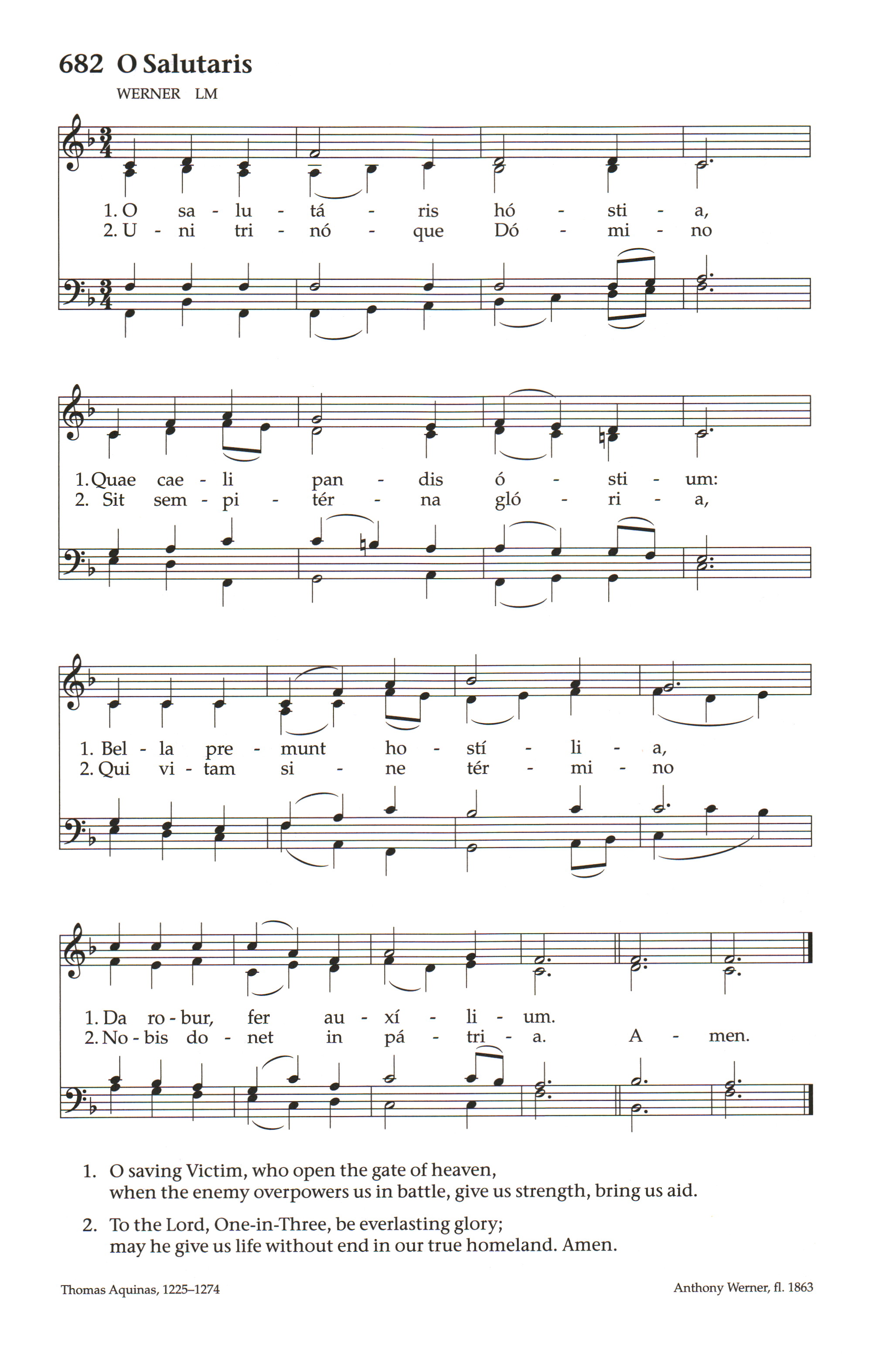
1. O Salutaris Hostia,
Quae coeli pandis ostium;
Bella premunt hostilia,
Da robur, fer auxilium.
2. Uni, trinoque Domino
Sit sempiterna gloria,
Qui vitam, sine termino,
Nobis donet in patria.
Bible Reference
John 6:35; John 6:51; John 6:54-56; 1 Corinthians 10:16-17; Hebrews 4:16
Lectionary & readings
Open today’s (or any date’s) assigned scriptures and find related hymns across church calendars. Useful when planning worship around this song’s themes or its Bible reference.
Hymn scripture: John 6:35; John 6:51; John 6:54-56; 1 Corinthians 10:16-17; Hebrews 4:16
About This Hymn
“O Salutaris Hostia” is a historic Latin Eucharistic hymn attributed to Thomas Aquinas. The text begins, “O salutaris Hostia, Quae coeli pandis ostium,” addressing Christ as the saving Victim who opens the gate of heaven. The hymn is a brief prayer for divine help in the midst of spiritual and earthly conflict. It asks Christ to give strength and assistance to His people and concludes with praise to the Triune God, asking Him to grant eternal life in the heavenly homeland. Hymnary identifies the text as being in the Latin language and records it in more than one hundred hymnals.
The first stanza presents Christ as the saving Victim and the One through whom the way to heaven is opened. The language is particularly appropriate to Eucharistic worship, where the Church remembers Christ's sacrificial work and looks to Him for salvation and help. The prayer, “Da robur, fer auxilium,” asks for strength and assistance because the worshiper recognizes the presence of spiritual opposition. The hymn therefore combines adoration of Christ with dependence upon Him for protection and strength.
The second stanza turns explicitly to the Trinity: “Uni, trinoque Domino,” giving everlasting glory to the one God who is threefold in person. The hymn then expresses the hope of receiving unending life in the heavenly homeland. Its movement is therefore from Christ's saving sacrifice, through present dependence upon divine strength, to eternal life with God. This makes the hymn both Eucharistic and eschatological, joining the worship of Christ in the present with the hope of heaven.
The tune WERNER is associated with Anthony Werner, who is listed by Hymnary as flourishing in the nineteenth century. Hymnary gives the tune a meter of 8.8.8.8, or Long Meter, and records it in several hymnals. The tune is also used with English translations and adaptations of the Latin text, including “O saving Victim, opening wide.”
“O Salutaris Hostia” remains a concise expression of Eucharistic devotion, Christian dependence, and hope in eternal life. Its prayer for strength, its confession of Christ as the saving Victim, its praise of the Holy Trinity, and its longing for the heavenly homeland give it a distinctly devotional character. The hymn directs the worshiper to Christ as the source of salvation, strength, help, and everlasting life.
From the Dictionary of Hymnology
Related terms and concepts automatically matched to this hymn.
Pange lingua gloriosi corporis mysterium Latin Hymn
St. Thomas Aquinas Corpus Christi hymn (1263, for Urban IV); metre from Fortunatus. Wide breviary use; “Tantum ergo” as separate Benediction hymn. Many English trs.; Neale on st. iv. crux.
Read moreAdoro Te devote, latens Deitas Latin Hymn
A Eucharistic hymn of St. Thomas Aquinas, dated c. 1260, added to many Missals for private devotion though never used in the public services. Caswall's translation "O Godhead hid, devoutly I adore Thee" is the best known in English.
Read moreNato nobis Salvatore Latin Hymn
Fine Christmas sequence attributed (very probably) to Adam of St. Victor; lines echoed in Aquinas’s Pange lingua. Dayman translation in the Hymnary (1871).
Read moreStaff Visualizer
Open in MIDI StudioPowered by HTML MIDI PLAYER, MIDI FILE Made by Hymnal Library. · Study chords & lyrics in MIDI Studio
Want weekly hymns and devotionals?
This hymn also appears in these hymnals
Click a spine to pull out the hymnal, then open it.
Hymns with the same subject
More hymns about Adoration, Church, Closing of Worship, Communion, Eternal Life, Jesus Christ, Prayer, Protection, Strength
- O Sanctissima - Traditional Latin Carol
- O Dearest Lord by All Adored - Maurice F. Bell
- Tantum Ergo Sacramentum - Thomas Aquinas
- Round the Lord in Glory Seated - Richard Mant
- As the Deer Panteth for the Waters - Martin Nystrom
- ’Tis the Blessed Hour of Prayer - Fanny Crosby
- Savior, Again to Thy Dear Name (Parting Hymn) - John Ellerton
- His Mighty Hand - Henry Ostrom
More hymn subjects
Explore other themes across the library.
Hymns about Praise
Hymns about Blessing
Hymns about Morning
Hymns about Redemption
Hymns about Heaven
Hymns about Lent
Hymns about Benediction
Hymns about Comfort
Browse all subjects →
Recently Added Hymns
-
 Holy Father, We Adore TheeE. F. Stewart circa. 1870s
-
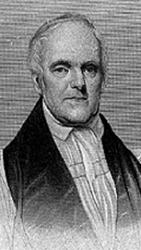 Holy Father, Great CreatorAlexander Viets Griswold 1837
-
Holy Father, cheer our way (Light at Evening Time)Richard H. Robinson 1869
-
 I Could Not Do Without Thee, O Savior of the LostFrances R. Havergal 1873
-
I Bow My Forehead to the DustJohn Greenleaf Whittier 1865
Latest Updated Hymnals
-
Open
 Book of Common Praise (BoCP1915)Updated 1 week, 2 days ago · 1915
-
Open
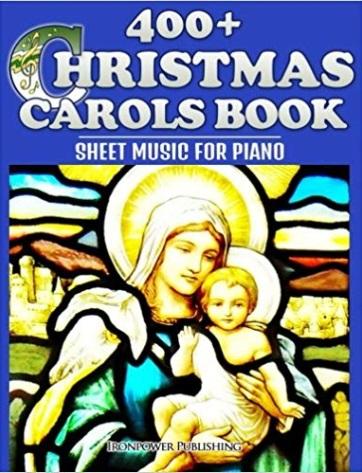 400+ Christmas Carols Book: Sheet Music for PianoUpdated 2 weeks, 1 day ago · 2014
-
Open
 Psalms of GraceUpdated 2 weeks, 2 days ago · 2022
-
Open
 Spurgeon's Own Hymn BookUpdated 2 weeks, 3 days ago · 1866
-
Open
 The New Apostolic Church HymnalUpdated 1 month, 1 week ago · 2008
Hymn Information

Click a linked name to open their biography.
MIDI File
More Hymns by Thomas Aquinas
Popular Hymns
Recent Blog Posts



Popular Blog Posts
-
 Lessons from the Book of Haggai: Putting God…6 months ago
-
 Easter vs Passover: How a Biblical Feast Bec…8 months ago
-
 The Full Story of the Birth of Jesus Christ:…11 months, 3 weeks ago
-
 The 30 Most Famous Christmas Hymns and Carols1 year, 3 months ago
-
 The Story Behind the Hymn “Amazing Grace”11 months, 2 weeks ago
Visit Us on Social Media
Latest from X (Twitter)
Tweets by HymnalLibraryLatest from Facebook
Latest on YouTube
Loading latest video...
Daily Bible Verse
Disclaimer
The hymns, sheet music, MIDI files, and related content on this website are provided for educational and research purposes only.
- Public Domain: Many of the hymns featured here are in the public domain and may be freely used.
- Copyrighted Works: Some hymns may still be under copyright protection. Where applicable, permission has either been requested from the copyright owner, or the content is shared under the principles of fair use for educational purposes.
⚠️ Important Notice: If you wish to reproduce, distribute, or use any copyrighted hymn beyond personal study or educational use, you must obtain permission directly from the copyright holder. This website does not grant any rights for commercial use yet.
If there is any other question please address it to us in our Contact Page, for further assistance. Thank you for using the site. May God Bless You.
Recently Added · Dictionary of Hymnology
Browse dictionary →- Index of Authors and Translators (H–Z) 6 days, 1 hour ago · History 1
- Index of First Lines (We–Z) / Index of Authors (A–Hincks) 6 days, 1 hour ago · History 2
- Work while it is to-day / Yet there is room / Yonge, Charlotte M. / Zyma vetus 6 days, 1 hour ago · Hymn 1
- Wordsworth, Elizabeth 6 days, 1 hour ago · Biography 0
- Wilton, Richard / Winks, William Edward / Wiseman, Card. Nicholas / Woodward, G. R. / Wordsworth, Bp. C. 6 days, 1 hour ago · Biography 1
Can’t find a hymn or lyric?
Leave your question in the forum for others to answer — requests, missing lines, writers, and worship ideas welcome.