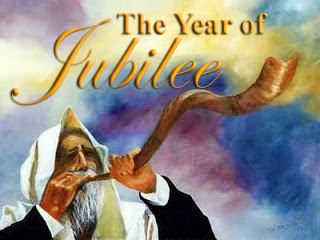
What Is a Jubilee in the Bible?
The word Jubilee may sound like a celebration, but in the Bible it was much more than a festival. It was a God-ordained year of release, restoration, and liberty given to Israel under the Law of Moses. The instructions are found primarily in Leviticus 25, where God established a special cycle of seven sabbatical years.
God told Israel to count seven weeks of years, seven times seven years, making forty-nine years. Then, on the tenth day of the seventh month, the trumpet was to sound throughout the land. The fiftieth year was to be proclaimed as a jubilee:
“And ye shall hallow the fiftieth year, and proclaim liberty throughout all the land unto all the inhabitants thereof.” — Leviticus 25:10, KJV
That phrase: “proclaim liberty” captures the heart of the Jubilee.
A Year of Release
During the Jubilee, Israelites who had become servants because of poverty were to be released. Land that had been sold because of financial hardship was also to return to its original family possession.
This was important because God did not want Israel to permanently lose its inheritance. The land ultimately belonged to Him:
“The land shall not be sold for ever: for the land is mine; for ye are strangers and sojourners with me.” — Leviticus 25:23, KJV
Israel therefore had to remember that they were not the absolute owners of everything they possessed. They were stewards of what God had entrusted to them.
The Jubilee also placed limits on economic exploitation. A person might fall into poverty, lose his land, or become a servant because of debt, but his situation was not supposed to become an irreversible life sentence.
The Trumpet of Jubilee
The Jubilee was announced with the sound of a trumpet. This was not merely ceremonial. The trumpet represented the public declaration that freedom had arrived.
Imagine an Israelite who had lost his inheritance and spent years serving another man. Then came the appointed year when the trumpet sounded throughout the land. His debt-related servitude had an endpoint. His family inheritance was restored.
The Jubilee was therefore a powerful picture of liberty after bondage and restoration after loss.
But Was Jubilee About Money?
Not exactly.
Modern discussions sometimes turn Jubilee into a political or economic program for cancelling everyone's debts or redistributing wealth. But the biblical Jubilee was specifically part of the Mosaic covenant given to the nation of Israel.
It was tied directly to Israel's inheritance of the land God had given them. It was not simply a universal economic policy that God commanded every nation to practice.
The Jubilee had a particular place within Israel's covenant relationship with God.
The Greater Jubilee Pointing to Christ
There is something even more profound about the Jubilee.
When Jesus began His public ministry, He entered the synagogue and read from the prophet Isaiah:
“The Spirit of the Lord is upon me, because he hath anointed me to preach the gospel to the poor; he hath sent me to heal the brokenhearted, to preach deliverance to the captives, and recovering of sight to the blind, to set at liberty them that are bruised.” — Luke 4:18, KJV
Jesus then declared:
“This day is this scripture fulfilled in your ears.” — Luke 4:21, KJV
The language of liberty, release, and restoration immediately brings the Jubilee principle to mind.
The Old Testament Jubilee provided temporary freedom from certain forms of bondage. Christ provides something infinitely greater: freedom from the bondage of sin.
A man could have his land restored and still remain a sinner. A servant could be released from his master and still remain spiritually condemned. Israel could experience economic restoration while still needing reconciliation with God.
Jesus came to deal with the deepest bondage of all.
The Jubilee and Salvation
Sin makes man a slave.
Jesus said:
“Whosoever committeth sin is the servant of sin.” — John 8:34, KJV
But He also said:
“If the Son therefore shall make you free, ye shall be free indeed.” — John 8:36, KJV
That is the greater Jubilee.
The Old Testament announced liberty with a trumpet. The Gospel announces liberty through the finished work of Jesus Christ.
The Old Testament dealt with the restoration of an earthly inheritance. The Gospel brings the sinner into an eternal inheritance.
The Old Testament servant could be released in the fiftieth year. The sinner who comes to Christ receives eternal redemption.
“If the Son therefore shall make you free, ye shall be free indeed.”
Jubilee Is About God's Ownership and Grace
Ultimately, Jubilee reminds us that God owns the land, God establishes the rules, and God provides the way of restoration.
It teaches that poverty, debt, servitude, and loss were not to become reasons for permanent hopelessness among God's covenant people. There was a God-appointed time of release.
And that points us toward the Gospel.
The greatest bondage is not financial. It is spiritual. The greatest debt is not monetary. It is our guilt before a holy God. And the greatest freedom is not merely getting property back, it is being delivered from the power and penalty of sin.
The Jubilee trumpet proclaimed liberty to Israel.
The Gospel proclaims liberty to the sinner.
And unlike the Old Testament Jubilee, Christ's salvation is not temporary. It is eternal.
“If the Son therefore shall make you free, ye shall be free indeed.” — John 8:36, KJV



















No comments yet. Be the first to share your thoughts!