


10 Doctrinally Accurate Christmas Carols and…
2 days, 20 hours ago
Vexilla regis prodeunt
By Venantius Honorius Clementianus Fortunatus ; tr. Hymnal Library (circa. 560s)
Lyrics
1. Confixa clavis viscera
Tendens manus, vestigia
Redemptionis gratia
Hic immolata est hostia.
---------
Pierced by nails, His flesh is torn,
His hands are stretched, His feet are worn;
For our redemption, grace divine,
Here was offered the Victim benign.
Tendens manus, vestigia
Redemptionis gratia
Hic immolata est hostia.
---------
Pierced by nails, His flesh is torn,
His hands are stretched, His feet are worn;
For our redemption, grace divine,
Here was offered the Victim benign.
2. Fundis aroma cortice,
Vincis sapore nectare,
Iucunda fructu fertili
Plaudis triumpho nobili.
----------
You pour forth fragrance from your bark,
You surpass the nectar's sweetness;
With fruitful joy you flourish bright,
And celebrate a noble triumph.
Vincis sapore nectare,
Iucunda fructu fertili
Plaudis triumpho nobili.
----------
You pour forth fragrance from your bark,
You surpass the nectar's sweetness;
With fruitful joy you flourish bright,
And celebrate a noble triumph.
3. Salve ara, salve victima
De passionis gloria
Qua vita mortem pertulit
Et morte vitam reddidit.
--------
Hail, altar! Hail, O Victim blest,
Glory through suffering expressed;
Here Life endured the stroke of death,
And by His death restored life's breath.
De passionis gloria
Qua vita mortem pertulit
Et morte vitam reddidit.
--------
Hail, altar! Hail, O Victim blest,
Glory through suffering expressed;
Here Life endured the stroke of death,
And by His death restored life's breath.
Bible Reference
John 19:16-37; Galatians 6:14; Colossians 2:14-15; Philippians 2:8-11
Lectionary & readings
Open today’s (or any date’s) assigned scriptures and find related hymns across church calendars. Useful when planning worship around this song’s themes or its Bible reference.
Hymn scripture: John 19:16-37; Galatians 6:14; Colossians 2:14-15; Philippians 2:8-11
About This Hymn
Note: This is a poetic translation rather than a strict word-for-word rendering. The Latin imagery in the second stanza is unusual, particularly the references to fragrance, nectar, and fruitful triumph, so the English aims to preserve the sense and devotional tone.
“Vexilla regis prodeunt” is a historic Latin Christian hymn written by Venantius Honorius Clementianus Fortunatus, a sixth-century Christian poet who later became bishop of Poitiers in Gaul. The Latin title is commonly translated as “The royal banners forward go.” The hymn is traditionally associated with the celebration of Christ's cross and the events of His Passion. Historical accounts connect its first use with a procession held in Poitiers on November 19, 569, when a relic of the cross was brought to the monastery of Sainte-Croix. This association places the hymn within the early medieval tradition of singing about the cross during the church year.
The hymn presents the cross as the royal standard of Jesus Christ. Its imagery draws on the language of victory and kingship, declaring that Christ's suffering and death are not a defeat but the means through which God accomplishes redemption. This theme is consistent with Galatians 6:14, where Paul writes in the King James Version, “But God forbid that I should glory, save in the cross of our Lord Jesus Christ.” The cross stands at the centre of the Christian message because Jesus willingly suffered and died for sinners.
The hymn is especially associated with Passiontide, Holy Week, and Good Friday. It invites worshippers to reflect on the crucifixion, the fulfilment of God's redemptive purpose, and the victory of Christ over sin and death. Its language of royal banners also recalls the biblical portrayal of Christ as King, whose glory is revealed through His obedience unto death. Philippians 2:8 declares that Christ “humbled himself, and became obedient unto death, even the death of the cross.” The hymn's enduring significance lies in its joining of the sorrow of the Passion with the triumph of the Saviour.
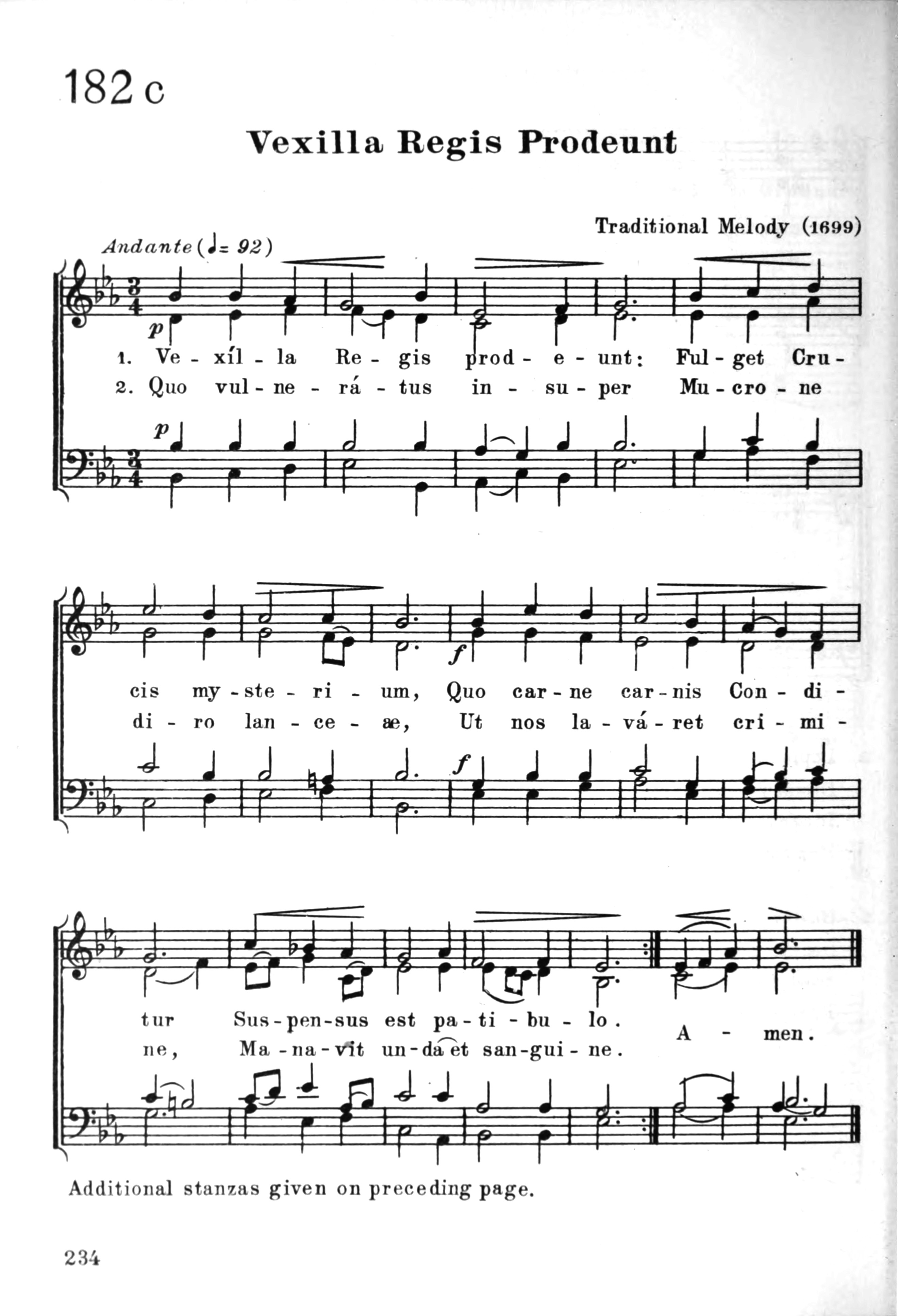
The traditional tune VEXILLA REGIS PRODEUNT is a plainsong melody associated with the Latin text. It is recorded with a meter of 8.8.8.8, also known as Long Meter, and is identified as a public-domain melody in hymn references. English translations include John Mason Neale's “The Royal Banners Forward Go,” as well as other renderings. These English versions should be entered as separate texts if the library catalogs them individually, with their respective translators credited. The original Latin hymn remains an important example of early Christian hymnody centred on the cross of Christ.
From the Dictionary of Hymnology
Related terms and concepts automatically matched to this hymn.
Gaude, Mater Ecclesia Hymnology
A text-critical and publication history of the Latin hymn Gaude, Mater Ecclesia, tracing its origin in the Senlis Breviary for St. Louis and its English translation for the festival of St. Edward the…
Read moreAgnoscat omne saeculum History
Hymnological record of Venantius Fortunatus's sixth-century Christmas hymn "Agnoscat omne saeculum," detailing its medieval manuscript transmission, liturgical division, and English translations.
Read moreAd laudes Salvatoris Hymnology
A structural registry of the late medieval Latin sequence "Ad laudes Salvatoris," tracking its manuscript preservation in Germany and Austria and its English translation by Sister Miriam.
Read moreStaff Visualizer
Open in MIDI StudioPowered by HTML MIDI PLAYER, MIDI FILE Made by Hymnal Library. · Study chords & lyrics in MIDI Studio
Want weekly hymns and devotionals?
⭐ Recommend This Hymn
Share this beautiful hymn with others
This hymn is found in these hymnals
Open the hymnal that contains this hymn:
You might also like
-
See the Destined Day AriseVenantius Honorius Clementianus Fortunatus · 569
-
Sing, My Tongue, the Glorious BattleVenantius Honorius Clementianus Fortunatus · 600
-
How Deep the Father's Love for UsStuart Townend · 1995
-
As the Deer Panteth for the WatersMartin Nystrom · 1984
-
In the GardenC. Austin Miles · 1912
Hymns with the same subject
More hymns about Cross, Jesus Christ, Praise, Redemption, Salvation
- Sunset to Sunrise Changes Now - Clement of Alexandria
- Because He Lives - Bill & Gloria Gaither
- Salvation Has Been Brought Down - Albert E. Brumley
- Blessed Assurance - Fanny Crosby
- Heaven Came Down and Glory Filled my Soul - John W. Peterson
- In Christ alone (my hope is found) - Stuart Townend
- Look and Live - William A. Ogden
- Alas! and Did My Savior Bleed - Isaac Watts
More hymn subjects
Latest Updated Hymnals
-
Open
 Book of Common Praise (BoCP1915)Updated 32 minutes ago · 1915
 -
Open
 The People's HymnalUpdated 52 minutes ago · 1961
 -
Open
 Our Great Redeemer's PraiseUpdated 5 months ago · 2022
 -
Open
 The Parish Hymnal (1873)Updated 5 months, 1 week ago · 1873
 -
Open
 Book of Common Praise (BCP1998)Updated 5 months, 2 weeks ago · 1998
Hymn Information
Click a linked name to open their biography.
MIDI File
More Hymns by Venantius Honorius Clementianus Fortunatus
Hymns from circa. 560s
Popular Hymns
Recent Blog Posts



Popular Blog Posts
-
 Lessons from the Book of Haggai: Putting God…4 months, 2 weeks ago
 -
 Easter vs Passover: How a Biblical Feast Bec…6 months, 2 weeks ago
 -
 The Full Story of the Birth of Jesus Christ:…10 months, 1 week ago
 -
 The 30 Most Famous Christmas Hymns and Carols1 year, 1 month ago
 -
 The Story Behind the Hymn “Amazing Grace”10 months ago
Visit Us on Social Media
Latest from X (Twitter)
Tweets by HymnalLibraryLatest from Facebook
Latest on YouTube
Loading latest video...
Daily Bible Verse
Disclaimer
The hymns, sheet music, MIDI files, and related content on this website are provided for educational and research purposes only.
- Public Domain: Many of the hymns featured here are in the public domain and may be freely used.
- Copyrighted Works: Some hymns may still be under copyright protection. Where applicable, permission has either been requested from the copyright owner, or the content is shared under the principles of fair use for educational purposes.
⚠️ Important Notice: If you wish to reproduce, distribute, or use any copyrighted hymn beyond personal study or educational use, you must obtain permission directly from the copyright holder. This website does not grant any rights for commercial use yet.
If there is any other question please address it to us in our Contact Page, for further assistance. Thank you for using the site. May God Bless You.
Recently Added · Dictionary of Hymnology
Browse dictionary →- Behold the angel flies 1 day, 21 hours ago · History 3
- Behold the amazing sight 1 day, 21 hours ago · History 1
- Behold my Servant! see Him rise 1 day, 21 hours ago · History 0
- Behold, how good a thing it is, And how, &c. 1 day, 21 hours ago · History 0
- Behold! how glorious is yon sky 1 day, 21 hours ago · History 0
Can’t find a hymn or lyric?
Leave your question in the forum for others to answer — requests, missing lines, writers, and worship ideas welcome.