





10 Doctrinally Accurate Christmas Carols and…
1 day, 15 hours ago
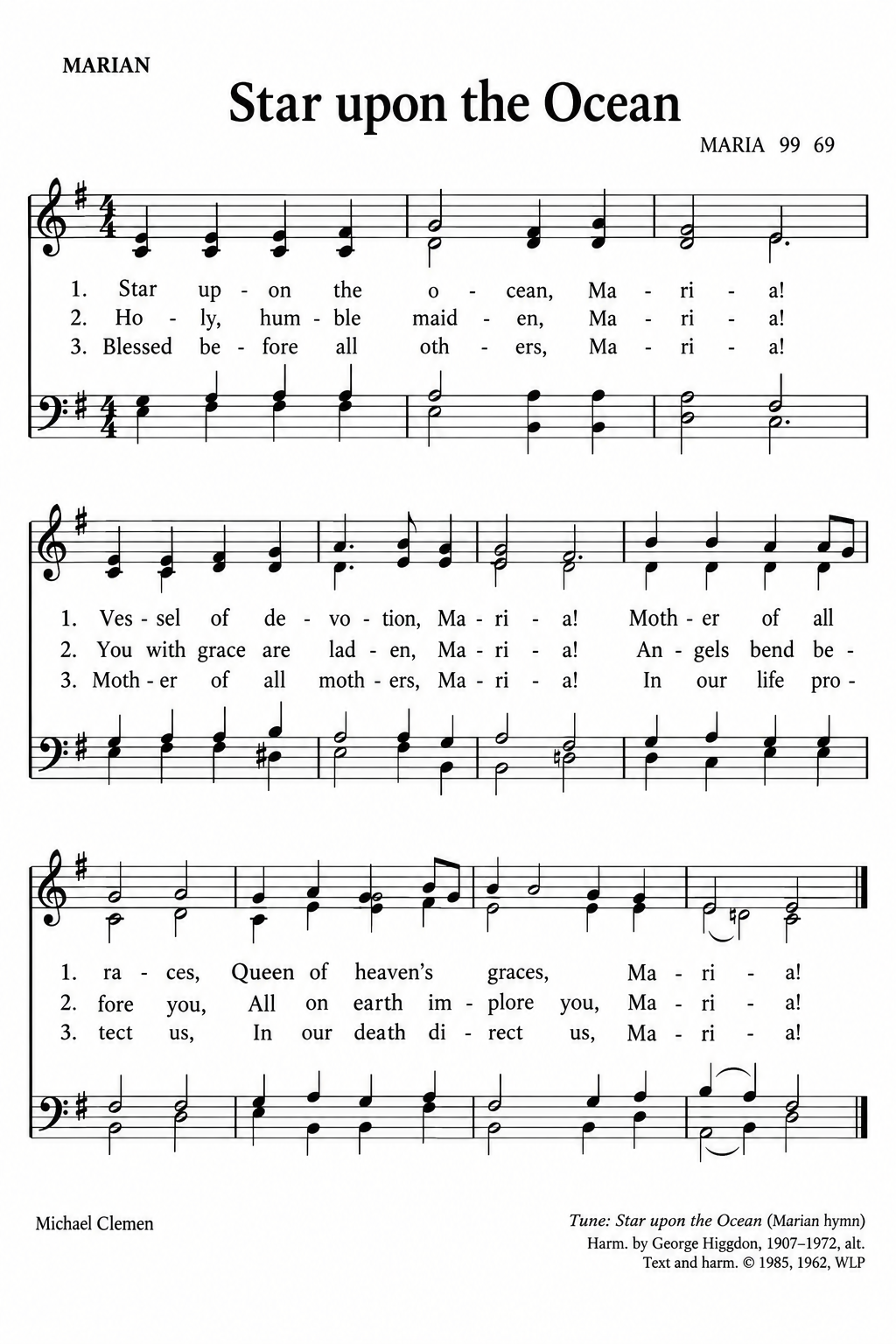
Star upon the Ocean
By Michael Gannon (1955)
Lyrics
1. Star upon the ocean, Maria!
Vessel of devotion, Maria!
Mother of all races, Queen of heaven’s graces, Maria!
Vessel of devotion, Maria!
Mother of all races, Queen of heaven’s graces, Maria!
2. My holy, humble maiden, Maria!
You with grace are laden, Maria!
Angels bend before you, All on earth implore you, Maria!
You with grace are laden, Maria!
Angels bend before you, All on earth implore you, Maria!
3. Blessed be for all others, Maria!
Mother of all mothers, Maria!
In our life protect us, In our death direct us, Maria!
Mother of all mothers, Maria!
In our life protect us, In our death direct us, Maria!
Bible Reference
Luke 1:26-38; Luke 1:46-49; John 2:1-11
Lectionary & readings
Open today’s (or any date’s) assigned scriptures and find related hymns across church calendars. Useful when planning worship around this song’s themes or its Bible reference.
Hymn scripture: Luke 1:26-38; Luke 1:46-49; John 2:1-11
About This Hymn
“Star upon the Ocean” is a Marian hymn written by Michael Gannon and copyrighted in 1955 by World Library Publications. The hymn addresses Mary through several devotional titles, calling her a star upon the ocean, a vessel of devotion, the mother of all races, and the queen of heaven's graces. It also asks her to protect believers during life and direct them at death. Although the hymn expresses reverence for Mary, its language raises important biblical and theological questions concerning the identity of the true guide of humanity, the unique mediation of Jesus Christ, and the biblical authority for assigning Mary titles and spiritual functions not explicitly given to her in Scripture.
The opening line, “Star upon the ocean, Maria,” presents Mary as a guiding star. However, the biblical account of the wise men directs attention to a different star and, ultimately, to Jesus Christ. Matthew 2:1-11 records that the wise men saw Christ's star, followed its leading, and rejoiced when it brought them to the place where the young child was. The star did not represent Mary, nor does the passage teach that she guides people to Christ from heaven. The narrative culminates in the wise men's worship of Jesus. Furthermore, Jesus declared, “I am the light of the world: he that followeth me shall not walk in darkness, but shall have the light of life” (John 8:12, KJV). Scripture consistently identifies Christ as the source of spiritual light and the one whom people must follow. Therefore, presenting Mary as the guiding star introduces a spiritual role that the biblical account does not assign to her.
The expression “Vessel of devotion” and the description of Mary as a “holy, humble maiden” may be understood as poetic references to her obedience and her role in the incarnation. Luke 1:38 records her willingness to receive God's message, and Luke 1:28 describes her as highly favoured. These passages rightly establish that Mary was blessed by God and chosen to bear the Saviour. Nevertheless, being favoured by God does not establish that she possesses divine authority, serves as a channel through whom believers must obtain grace, or should receive petitions for spiritual assistance. Mary herself declared, “My soul doth magnify the Lord, And my spirit hath rejoiced in God my Saviour” (Luke 1:46-47, KJV). Her words direct attention to the Lord as her Saviour. The biblical account honours Mary's place in God's purpose without assigning her the mediatorial functions that belong to Jesus Christ.
The line “Mother of all races, Queen of heaven's graces” makes claims that require particular scrutiny. Mary is the mother of Jesus according to His human birth, but Scripture does not identify her as the mother of all nations or races in a universal spiritual sense. Nor does the Bible establish her as the queen who governs or distributes heavenly grace. Revelation 19:16 identifies Jesus Christ as “KING OF KINGS, AND LORD OF LORDS” (KJV), while Ephesians 1:3 declares that God has blessed believers “with all spiritual blessings in heavenly places in Christ” (KJV). The New Testament places spiritual blessing under God's authority and directs believers to Christ. The title “Queen of Heaven” also appears in Jeremiah 7:18 and Jeremiah 44:17-25, where it refers to a figure worshipped in the idolatrous practices condemned by God. Those passages do not directly identify that ancient figure with Mary, so they should not be used to claim that the hymn deliberately invokes the same deity. Nevertheless, Scripture provides no clear basis for assigning Mary the title or authority expressed in this hymn. Such claims should not be treated as biblical doctrine merely because they occur in devotional poetry.
The words “Angels bend before you, All on earth implore you” also raise questions about the direction of religious devotion. Scripture does not teach that angels bow before Mary as their queen or instruct believers throughout the earth to invoke her. In Revelation 22:8-9, John fell before an angel in an act of reverence, but the angel refused and commanded him, “Worship God” (KJV). This passage establishes an important principle: even heavenly beings must not receive the worship that belongs to God. The New Testament instead directs believers to approach God through Jesus Christ. First Timothy 2:5 states plainly, “For there is one God, and one mediator between God and men, the man Christ Jesus” (KJV). Christ's unique mediation is grounded in His identity and saving work. Scripture does not present Mary as another mediator or command Christians to invoke her for access to God's help.
The final petition, “In our life protect us, In our death direct us,” asks Mary to perform functions for which the hymn provides no explicit biblical foundation. Scripture teaches that the Lord is the keeper and protector of His people. Psalm 121:7 declares, “The LORD shall preserve thee from all evil: he shall preserve thy soul” (KJV). Likewise, believers are invited to approach the throne of grace through Jesus Christ, their great High Priest, to obtain mercy and find grace in time of need (Hebrews 4:14-16). The Christian's hope in death also rests in Christ. Jesus declared, “I am the resurrection, and the life: he that believeth in me, though he were dead, yet shall he live” (John 11:25, KJV). The New Testament gives believers grounds to trust God for protection, salvation, and eternal life through His Son, but it does not command them to ask Mary to protect them in life or direct them at death.
A careful biblical assessment should distinguish Mary's genuine place in the history of redemption from claims that extend beyond the scriptural record. The hymn may be understood by its defenders as expressing symbolic language and asking for Mary's intercession rather than attributing divinity to her. However, the question remains whether these titles and petitions are taught or authorized by Scripture. The New Testament identifies Jesus Christ as the light of the world, the Saviour, the great High Priest, and the one mediator between God and humanity. It records Mary's faith and obedience, but it does not call her the star that guides the nations, the mother of all races, or the queen who distributes heavenly grace. Nor does it instruct believers to seek her protection or direction at death.
For these reasons, the hymn's devotional language should be examined in the light of Scripture rather than accepted as biblical teaching simply because it belongs to a longstanding tradition. Mary can be recognized as the blessed mother of Jesus without assigning her titles and spiritual offices that the Bible does not establish. The central question is not whether Mary deserves historical recognition or respect, but whether the hymn directs spiritual trust and petitions in ways consistent with God's revealed Word. The biblical testimony directs the believer to Christ, who alone is the appointed mediator between God and men, and to God as the ultimate source of grace, protection, salvation, and eternal life.
From the Dictionary of Hymnology
Related terms and concepts automatically matched to this hymn.
A beautiful land by faith I see Hymn
A popular nineteenth-century Sunday School hymn about Heaven, first published anonymously in 1862 and later attributed to J. Hall.
Read moreAlone! to land alone upon that shore Hymnology
Summary of Frederick William Faber's hymn on death, "Alone! to land alone upon that shore."
Read moreAway, thou dying saint, away History
Thomas Kelly's 1809 hymn on the death of a believer, based on Ecclesiastes 12:7.
Read moreStaff Visualizer
Open in MIDI StudioPowered by HTML MIDI PLAYER, MIDI FILE Made by Hymnal Library. · Study chords & lyrics in MIDI Studio
Want weekly hymns and devotionals?
⭐ Recommend This Hymn
Share this beautiful hymn with others
This hymn is found in these hymnals
Open the hymnal that contains this hymn:
Hymns with the same subject
More hymns about Guidance, Hope, Prayer, Protection, Worship
- Befiehl du deine Wege - Paul Gerhardt
- His Eye Is on the Sparrow - Civilla D. Martin
- As the Deer Panteth for the Waters - Martin Nystrom
- Precious Lord, Take My Hand - Thomas Andrew Dorsey
- 10,000 Reasons (Bless the Lord) - Matt Redman and Jonas Myrin
- Praise to the Lord the Almighty - Joachim Neander
- O Worship the King - Robert Grant
- ’Tis the Blessed Hour of Prayer - Fanny Crosby
More hymn subjects
Explore other themes across the library.
Hymns about Ministry
Hymns about Creation
Hymns about Benediction
Hymns about Peace
Hymns about Praise
Hymns about Redemption
Hymns about Trials
Hymns about Anniversary
Browse all subjects →
Latest Updated Hymnals
-
Open
 The People's HymnalUpdated 58 minutes ago · 1961
 -
Open
 Book of Common Praise (BoCP1915)Updated 3 months ago · 1915
 -
Open
 Our Great Redeemer's PraiseUpdated 5 months ago · 2022
 -
Open
 The Parish Hymnal (1873)Updated 5 months ago · 1873
 -
Open
 Book of Common Praise (BCP1998)Updated 5 months, 2 weeks ago · 1998
Hymn Information

Click a linked name to open their biography.
MIDI File
Popular Hymns
Recent Blog Posts


Popular Blog Posts
-
 Lessons from the Book of Haggai: Putting God…4 months, 2 weeks ago
 -
 Easter vs Passover: How a Biblical Feast Bec…6 months, 2 weeks ago
 -
 The Full Story of the Birth of Jesus Christ:…10 months, 1 week ago
 -
 The 30 Most Famous Christmas Hymns and Carols1 year, 1 month ago
 -
 The Story Behind the Hymn “Amazing Grace”10 months ago
Visit Us on Social Media
Latest from X (Twitter)
Tweets by HymnalLibraryLatest from Facebook
Latest on YouTube
Loading latest video...
Daily Bible Verse
Disclaimer
The hymns, sheet music, MIDI files, and related content on this website are provided for educational and research purposes only.
- Public Domain: Many of the hymns featured here are in the public domain and may be freely used.
- Copyrighted Works: Some hymns may still be under copyright protection. Where applicable, permission has either been requested from the copyright owner, or the content is shared under the principles of fair use for educational purposes.
⚠️ Important Notice: If you wish to reproduce, distribute, or use any copyrighted hymn beyond personal study or educational use, you must obtain permission directly from the copyright holder. This website does not grant any rights for commercial use yet.
If there is any other question please address it to us in our Contact Page, for further assistance. Thank you for using the site. May God Bless You.
Recently Added · Dictionary of Hymnology
Browse dictionary →
Can’t find a hymn or lyric?
Leave your question in the forum for others to answer — requests, missing lines, writers, and worship ideas welcome.