




How Many of the Psalms Did David Write? And …
3 hours ago
Hail! Sacred Day of Earthly Rest
By Godfrey Thring (1858)
Lyrics
1. Hail! sacred day of earthly rest,
From toil and trouble free:
Hail! day of light, that bringest light
And joy to me.
2 A holy stillness, breathing calm
On all the world around,
Uplifts my soul, O God, to Thee,
Where rest is found.
3 On all I think, or say, or do,
A ray of light divine
Is shed, O God, this day by Thee,
For it is Thine.
4 No sound of jarring strife is heard,
As weekly labors cease;
No voice, but those that sweetly sing
Sweet songs of peace.
5 For those who sing with saints below
Glad songs of heavenly love,
Shall sing—when songs on earth have ceased—
With saints above.
6 Accept, O God, my hymn of praise,
That Thou, this day, hast given
Sweet foretaste of that endless day
Of rest in Heaven.
Bible Reference
Genesis 2:2-3; Exodus 20:8-11; Psalm 92:1-2; Mark 2:27-28; Hebrews 4:9-10
Lectionary & readings
Open today’s (or any date’s) assigned scriptures and find related hymns across church calendars. Useful when planning worship around this song’s themes or its Bible reference.
Hymn scripture: Genesis 2:2-3; Exodus 20:8-11; Psalm 92:1-2; Mark 2:27-28; Hebrews 4:9-10
About This Hymn
Hail! Sacred Day of Earthly Rest is a Sunday hymn by Godfrey Thring, written in 1863 and first published in his collection Hymns Congregational and Others in 1866. The hymn celebrates the Lord's Day as a sacred time of worship, spiritual refreshment, and rest from ordinary labour. Thring presents Sunday as more than a welcome interruption to the demands of the working week. It is a day set apart for the worship of God, the renewal of the soul, and the contemplation of divine goodness. The hymn invites Christians to approach the day with reverence and thanksgiving, recognizing the spiritual blessing of gathering for worship.
The opening stanza describes the sacred day as a time of earthly rest, free from the usual burdens and distractions of daily life. Its language emphasizes the peace and quietness associated with the Lord's Day. The worshipper is encouraged to lift the heart toward God and receive the spiritual calm that comes through communion with Him. This theme connects with the biblical account of creation, where God blessed and sanctified the seventh day, and with the commandment calling His people to remember the Sabbath day and keep it holy.
The hymn also reflects upon the relationship between physical rest and spiritual renewal. Rest is not presented merely as inactivity, but as an opportunity to turn the mind and heart toward the Lord. The day provides time for prayer, praise, instruction from Scripture, and fellowship with other believers. In this respect, the hymn reminds Christians that worship should not be confined to a particular building or hour, but should shape the spirit with which they approach the whole day. Its emphasis on sacred stillness encourages worshippers to set aside unnecessary distractions and give attention to the things of God.
Thring originally wrote the hymn in thirteen four-line stanzas. Later hymnals sometimes shortened or altered the text. Bishop William Walsham How revised the third line of the first stanza for an 1869 hymnal, and that altered form became widely used. The hymn is therefore an example of how nineteenth-century hymns were adapted for congregational worship while retaining their original devotional purpose.
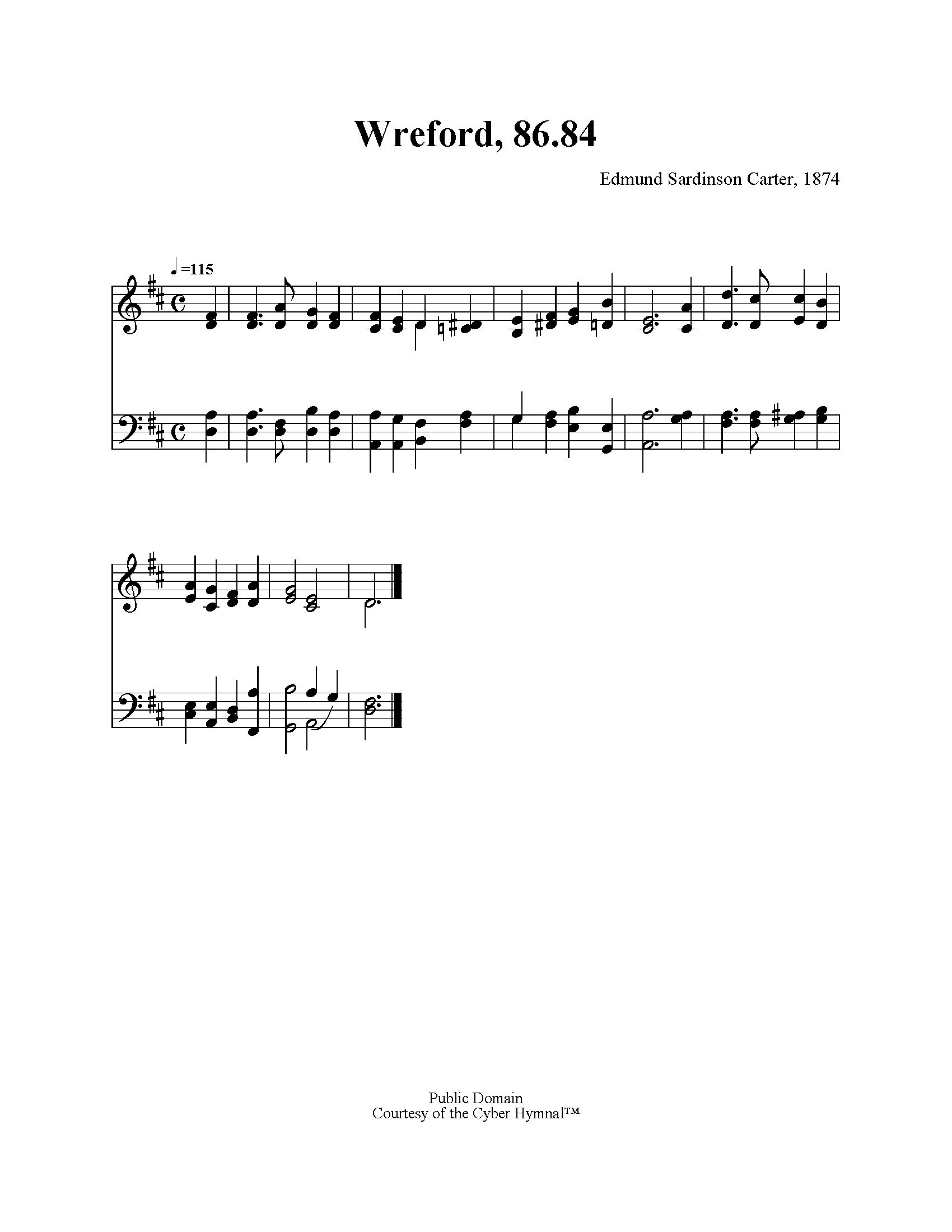
The tune WREFORD, composed by Edmund Sardinson Carter, is the musical setting associated with this text in numerous hymnals. Its meter of 8.6.8.4 corresponds to the structure of the hymn and provides a suitable setting for its reflective and reverent character. Hail! Sacred Day of Earthly Rest remains appropriate for Sunday morning worship and services emphasizing the Lord's Day, the blessing of rest, and the privilege of gathering before God.
From the Dictionary of Hymnology
Related terms and concepts automatically matched to this hymn.
Ein' feste Burg ist unser Gott Hymn
Luther’s Psalm 46 battle-hymn, first published in Klug’s Gesangbuch (Wittenberg, 1529), not in 1521 or 1530 as popular stories claim. Carlyle’s and Thring’s English versions lead common use.
Read moreCrown Him with many crowns Hymn
Four congregational forms open with this stanza: Matthew Bridges’s 1851 original; S.P.C.K. appendix and Church Hymns centos; and Godfrey Thring’s largely new text adopting Bridges’s first stanza.
Read moreAll ye who seek a rest above Hymn
A Holy Communion hymn by Godfrey Thring, written in 1863 and first published in 1866. It was repeated in his Hymns and Lyrics, 1874, and in the first edition of his Collection, 1880.
Read moreStaff Visualizer
Open in MIDI StudioPowered by HTML MIDI PLAYER, MIDI FILE Made by Hymnal Library. · Study chords & lyrics in MIDI Studio
Want weekly hymns and devotionals?
⭐ Recommend This Hymn
Share this beautiful hymn with others
This hymn also appears in these hymnals
Click a spine to pull out the hymnal, then open it.
Hymns with the same subject
More hymns about Lord's Day, Worship
- Don't Forget the Sabbath - Fanny J. Crosby
- Dear Lord, we come at set of sun - Mary Speidel
- Thou, who at Thy first Eucharist didst pray - W. H. Turton
- How Great Thou Art - Carl Boberg
- Holy, Holy, Holy! Lord God Almighty! - Reginald Heber
- As the Deer Panteth for the Waters - Martin Nystrom
- 10,000 Reasons (Bless the Lord) - Matt Redman and Jonas Myrin
- Here I Am to Worship - Tim Hughes
More hymn subjects
Explore other themes across the library.
Hymns about Judgment
Hymns about Refuge
Hymns about Fellowship
Hymns about Eternal Life
Hymns about Thanksgiving
Hymns about Rest
Hymns about Pilgrimage
Hymns about Lent
Browse all subjects →
Recently Added Hymns
Latest Updated Hymnals
-
Open
 Book of Common Praise (BoCP1915)Updated 20 hours ago · 1915
-
Open
 The New Apostolic Church HymnalUpdated 2 weeks ago · 2008
-
Open
 400+ Christmas Carols Book: Sheet Music for PianoUpdated 2 weeks, 1 day ago · 2014
-
Open
 The Temple HymnalUpdated 2 weeks, 2 days ago · 1918
-
Open
 The Popular HymnalUpdated 2 weeks, 2 days ago · 1918
Hymn Information

Click a linked name to open their biography.
MIDI File
More Hymns by Godfrey Thring
Popular Hymns
Recent Blog Posts


Popular Blog Posts
-
 Lessons from the Book of Haggai: Putting God…5 months, 1 week ago
-
 Easter vs Passover: How a Biblical Feast Bec…7 months, 1 week ago
-
 The Full Story of the Birth of Jesus Christ:…11 months ago
-
 The 30 Most Famous Christmas Hymns and Carols1 year, 2 months ago
-
 The Story Behind the Hymn “Amazing Grace”10 months, 3 weeks ago
Visit Us on Social Media
Latest from X (Twitter)
Tweets by HymnalLibraryLatest from Facebook
Latest on YouTube
Loading latest video...
Daily Bible Verse
Disclaimer
The hymns, sheet music, MIDI files, and related content on this website are provided for educational and research purposes only.
- Public Domain: Many of the hymns featured here are in the public domain and may be freely used.
- Copyrighted Works: Some hymns may still be under copyright protection. Where applicable, permission has either been requested from the copyright owner, or the content is shared under the principles of fair use for educational purposes.
⚠️ Important Notice: If you wish to reproduce, distribute, or use any copyrighted hymn beyond personal study or educational use, you must obtain permission directly from the copyright holder. This website does not grant any rights for commercial use yet.
If there is any other question please address it to us in our Contact Page, for further assistance. Thank you for using the site. May God Bless You.
Recently Added · Dictionary of Hymnology
Browse dictionary →
Can’t find a hymn or lyric?
Leave your question in the forum for others to answer — requests, missing lines, writers, and worship ideas welcome.