



What Is the Difference Between Psalms, Hymns…
1 day, 23 hours ago
Gracious Spirit, Holy Ghost
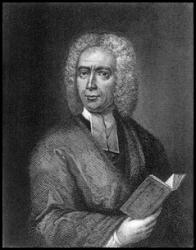
By Christopher Wordsworth (1862)
Lyrics
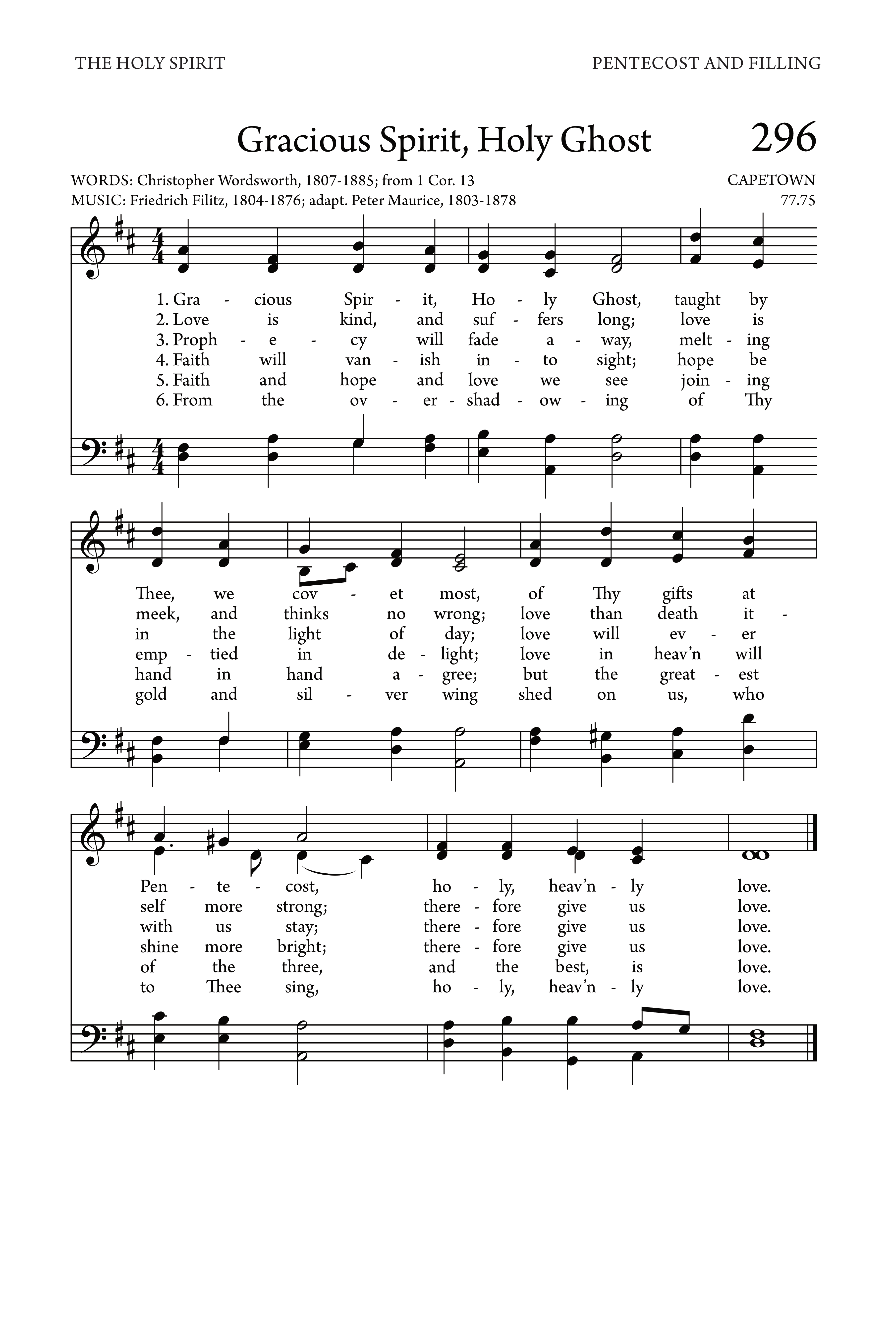
1. Gracious Spirit, Holy Ghost,
taught by Thee, we covet most,
of Thy gifts at Pentecost,
holy, heav'nly love.
taught by Thee, we covet most,
of Thy gifts at Pentecost,
holy, heav'nly love.
2. Love is kind, and suffers long;
love is meek, and thinks no wrong;
love than death itself more strong;
therefore give us love.
love is meek, and thinks no wrong;
love than death itself more strong;
therefore give us love.
3. Prophecy will fade away,
melting in the light of day;
love will ever with us stay;
therefore give us love.
melting in the light of day;
love will ever with us stay;
therefore give us love.
4. Faith will vanish into sight;
hope be emptied in delight;
love in heav'n will shine more bright;
therefore give us love.
hope be emptied in delight;
love in heav'n will shine more bright;
therefore give us love.
5. Faith and hope and love we see
joining hand in hand agree;
but the greatest of the three,
and the best, is love.
joining hand in hand agree;
but the greatest of the three,
and the best, is love.
6. From the overshadowing
of Thy gold and silver wing
shed on us, who to Thee sing,
holy, heav'nly love.
of Thy gold and silver wing
shed on us, who to Thee sing,
holy, heav'nly love.
Bible Reference
1 Corinthians 12:31; 1 Corinthians 13:1-13; 1 Corinthians 13:13; Acts 2:1-4
Lectionary & readings
Open today’s (or any date’s) assigned scriptures and find related hymns across church calendars. Useful when planning worship around this song’s themes or its Bible reference.
Hymn scripture: 1 Corinthians 12:31; 1 Corinthians 13:1-13; 1 Corinthians 13:13; Acts 2:1-4
About This Hymn
Gracious Spirit, Holy Ghost is a hymn by Christopher Wordsworth, first published in the first edition of his collection The Holy Year in 1862. It was written for Quinquagesima, the Sunday immediately preceding the beginning of Lent in the traditional church calendar. Wordsworth based the hymn on the teaching about love found in 1 Corinthians 13, presenting it as a prayer for the Holy Spirit to cultivate genuine Christian love in the hearts of believers. The hymn is not simply a general appeal for kindness or affection. It asks God to give His people the kind of love that belongs to the life of the Spirit and reflects the character of Christ.
The opening stanza addresses the Holy Ghost and asks for the gift of holy, heavenly love. The reference to Pentecost recalls the outpouring of the Holy Spirit upon the early Church, while the request for love directs attention to the spiritual fruit that should characterize Christian life. The following stanzas draw heavily upon Paul's teaching in 1 Corinthians 13. Love is patient, kind, meek, enduring, and greater than outward religious accomplishments. Prophecy, knowledge, and other spiritual gifts have their place, but they cannot replace love. Even impressive acts of sacrifice are spiritually empty when they are not accompanied by genuine love.
The hymn also considers the lasting nature of Christian love. Prophecy and partial knowledge will pass away, and faith and hope will reach their fulfillment when believers enter the presence of God. Love, however, belongs to the eternal life of God's kingdom. Wordsworth therefore emphasizes Paul's conclusion that faith, hope, and love abide, but the greatest of these is love. The hymn encourages Christians to seek more than outward religious activity, asking instead for hearts shaped by the Holy Spirit and governed by the love revealed in Scripture.
The final stanza returns to the language of prayer, asking the Spirit to shed holy and heavenly love upon the worshipping congregation. This makes the hymn particularly appropriate for Pentecost services, worship focused on the Holy Spirit, and occasions emphasizing Christian fellowship and spiritual maturity. Its two associated tunes offer different musical settings. CHARITY was composed by John Stainer for this text in Hymns Ancient and Modern. CAPETOWN was composed by Friedrich Filitz and was originally associated with the German hymn text "Morgenglanz der Ewigkeit." Both tunes share the hymn's 7.7.7.5 meter. The enduring message of Gracious Spirit, Holy Ghost is that Christian faith must be expressed through love, a gift believers should continually seek from the Holy Spirit.
From the Dictionary of Hymnology
Related terms and concepts automatically matched to this hymn.
Gracious Spirit, Holy Ghost Hymn
Bishop Christopher Wordsworth’s Quinquagesima paraphrase of 1 Corinthians 13 (Holy Year, 1862); the same column defines the Gradual sung between Epistle and Gospel, with a Sarum metrical specimen.
Read moreFrom Jesus' eyes, beside the grave Hymn
Bishop C. Wordsworth’s consecration-of-burial-ground hymn from The Holy Year (1862), thirteen stanzas; later split into two parts. Skinner used stanza iii., “Faith, looking on this hallow’d ground.”
Read moreDown from the mountain Jesus came Hymn
Bishop Christopher Wordsworth’s Epiphany hymn from The Holy Year (1862). Stanzas iii.–vi. appear as “O God, made manifest in flesh” in the New Congregational supplement.
Read moreStaff Visualizer
Open in MIDI StudioPowered by HTML MIDI PLAYER, MIDI FILE Made by Hymnal Library. · Study chords & lyrics in MIDI Studio
Want weekly hymns and devotionals?
⭐ Recommend This Hymn
Share this beautiful hymn with others
This hymn also appears in these hymnals
Click a spine to pull out the hymnal, then open it.
You might also like
Hymns with the same subject
More hymns about Holy Spirit, Pentecost
- Come, Holy Spirit - John R. Rice
- Come Down, O Love Divine - Bianco da Siena
- Hail Thee, Festival Day - Venantius Honorius Clementianus Fortunatus
- Creator Spirit, by whose aid - Rabanus Maurus
- Doxology (Praise God From Whom All Blessings Flow) - Thomas Ken
- I Surrender All - Judson W. Van DeVenter
- Sweet, Sweet Spirit - Doris Akers
- Spirit Of The Living God, Fall Fresh On Me - Daniel Iverson
More hymn subjects
Explore other themes across the library.
Hymns about Teaching of Christ
Hymns about Hope
Hymns about Easter
Hymns about Blood of Christ
Hymns about Trials
Hymns about Family
Hymns about Christmas
Hymns about Redemption
Browse all subjects →
Latest Updated Hymnals
-
Open
 Book of Common Praise (BoCP1915)Updated 5 hours ago · 1915
-
Open
 The New Apostolic Church HymnalUpdated 2 weeks ago · 2008
-
Open
 400+ Christmas Carols Book: Sheet Music for PianoUpdated 2 weeks, 1 day ago · 2014
-
Open
 The Temple HymnalUpdated 2 weeks, 1 day ago · 1918
-
Open
 The Popular HymnalUpdated 2 weeks, 1 day ago · 1918
Hymn Information
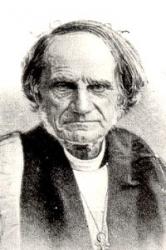
Click a linked name to open their biography.
MIDI File
Popular Hymns
Recent Blog Posts



Popular Blog Posts
-
 Lessons from the Book of Haggai: Putting God…5 months, 1 week ago
-
 Easter vs Passover: How a Biblical Feast Bec…7 months, 1 week ago
-
 The Full Story of the Birth of Jesus Christ:…10 months, 4 weeks ago
-
 The 30 Most Famous Christmas Hymns and Carols1 year, 2 months ago
-
 The Story Behind the Hymn “Amazing Grace”10 months, 3 weeks ago
Visit Us on Social Media
Latest from X (Twitter)
Tweets by HymnalLibraryLatest from Facebook
Latest on YouTube
Loading latest video...
Daily Bible Verse
Disclaimer
The hymns, sheet music, MIDI files, and related content on this website are provided for educational and research purposes only.
- Public Domain: Many of the hymns featured here are in the public domain and may be freely used.
- Copyrighted Works: Some hymns may still be under copyright protection. Where applicable, permission has either been requested from the copyright owner, or the content is shared under the principles of fair use for educational purposes.
⚠️ Important Notice: If you wish to reproduce, distribute, or use any copyrighted hymn beyond personal study or educational use, you must obtain permission directly from the copyright holder. This website does not grant any rights for commercial use yet.
If there is any other question please address it to us in our Contact Page, for further assistance. Thank you for using the site. May God Bless You.
Recently Added · Dictionary of Hymnology
Browse dictionary →
Can’t find a hymn or lyric?
Leave your question in the forum for others to answer — requests, missing lines, writers, and worship ideas welcome.