
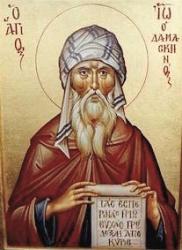

Anastaseose hemera ("'Tis the day of Resurrection") forms the first of eight odes comprising the celebrated Easter hymn known as "The Golden Canon" or "The Queen of Canons," composed by St. John of Damascus around the middle of the eighth century. Appointed in the Pentecostarion for the Greek Office for Easter Day, its odes alternate with those of St. Cosmas. Designed to proclaim the Resurrection, the sequence illustrates the fulfillment of ancient types and prophecies through a thematic progression:
-
Ode I: Proclaims the Resurrection as the new Passover.
-
Ode III: Presents Christ as the New River from the Rock and the New Light.
-
Ode IV: Recalls Habakkuk's vision, pointing to the yearling Lamb and the Antitype of the Ark.
-
Ode V: Calls believers to rise early to meet the Bridegroom with praise rather than ointments.
-
Ode VI: Celebrates Christ breaking from Hades to bring freedom to humanity.
-
Ode VII: Recalls the rescue of the Holy Three from the fiery furnace as the Holy Women find the Risen Lord.
-
Ode VIII: Invites the faithful to taste the new fruit of the vine on this hallowed morning.
-
Ode IX: Exhorts the New Jerusalem to arise and shine in praise of Christ our Pascha.
While a complete Greek canon traditionally contains nine odes patterned after nine scriptural canticles, the second ode is omitted from festival canons due to the severe, penitential nature of the second canticle.
The complete Easter Office was published with a literal translation by Richard Frederick Littledale in his Offices from the Service Books of the Holy Eastern Church (1863), and the text is preserved in Migne's Patrologia Graeca (vol. xciv). In Hymns of the Eastern Church, John Mason Neale famously introduced his translation with a vivid eyewitness account of an Athenian Easter celebration. Hymnologist Stephen Georgeson Hatherley later clarified in his 1882 annotated edition that the sudden exultant shout described in that account refers to the traditional single-stanza troparion Christos anesti ("Christ is risen from the dead"), which precedes the solemn chanting of St. John's Canon.
English translations of the individual odes were produced in metrical form by John Mason Neale (Hymns of the Eastern Church, 1862) and in blank verse by Richard Frederick Littledale (1863):
-
Ode I (Anastaseose hemera): Translated by Neale as "'Tis the day of Resurrection." It entered congregational use via The Parish Hymn Book (1863) as "The Day of Resurrection," becoming widely adopted throughout English-speaking hymnody.
-
Ode III (Deute poma piomen kainon): Rendered by Neale as "Come and let us drink of that New River."
-
Ode IV (Epi tes theias phylakes): Rendered by Neale as "Stand on thy watch-tower, Habakkuk the Seer."
-
Ode V (Orthrisomen orthrou batheos): Rendered by Neale as "Let us rise in early morning." Stanzas 1–3 were included in Willing's Book of Common Praise (1872).
-
Ode VI (Katelthes en tois katotatois): Rendered by Neale as "Into the dim earth's lowest parts descending."
Related Authors
Writers connected to this dictionary topic.
Keywords
Related terms for this dictionary entry.
Recent Dictionary Entries
Newly added terms from the Dictionary of Hymnology.
If you notice any mistake or have suggestions, please contact us on our contact page.