About John of Damascus
St. John of Damascus (c. 675 – c. 754)
St. John of Damascus, also known as John Damascene, was a monumental figure in the history of the Eastern Church, serving as its last great Father and arguably its greatest poet. Born into a wealthy Christian family in Damascus, he initially followed in the footsteps of his father by serving as a high-ranking official in the court of the Muslim Caliph. However, around the age of forty, John experienced a profound spiritual awakening. He relinquished his status and riches, freed his slaves, and retreated to the desert monastery of St. Sabas near Jerusalem. It was within these limestone caves and quiet cloisters that he composed the theological and poetic works that would earn him the titles Chrysorrhous ("Golden-flowing") and the "Thomas Aquinas of the East."
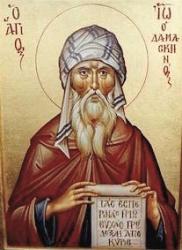
As a theologian, John is best known for his vigorous defense of Icons during the Iconoclastic Controversy, arguing that because God took on human flesh in the Incarnation, the divine could be depicted in art. This earned him a reputation as the "Doctor of Christian Art." His prose masterpiece, The Fount of Knowledge, codified the Orthodox faith and provided a systematic summary of philosophy and theology that influenced both the East and the West for centuries.
In the realm of hymnody, John's influence was revolutionary. He is credited with the arrangement of the Octoechos, the system of "Eight Tones" (modes) that still governs Byzantine chant today. He pioneered the Canon, a complex poetic form consisting of nine odes based on biblical canticles. His canons for the great festivals—especially Easter, Christmas, and Pentecost—are considered the highest achievements of Greek hymnography. These works are noted for their "dogmatic cast," weaving intricate Christological doctrine into soaring verses of praise.
The English-speaking world is most familiar with St. John of Damascus through the translations of John Mason Neale, who brought his ancient Greek texts into 19th-century hymnals. The most famous of these is the Easter hymn "The Day of Resurrection," taken from the first ode of his Golden Canon for Easter. Another staple is "Come, Ye Faithful, Raise the Strain," which celebrates the crossing of the Red Sea as a type of the Resurrection. These hymns remain central to Easter celebrations worldwide, serving as a bridge between the 8th-century desert monastery and the modern congregational experience.
From the Dictionary of Hymnology
Related terms and topics automatically matched to this author.
Anastaseose Hemera Hymnology
An entry on the Golden Canon of St. John of Damascus, detailing its eight Easter odes, liturgical context in the Pentecostarion, and English translations.
Read moreO paidas ek kaminou Hymnology
An entry on Ode VII of the Easter Canon of St. John of Damascus and its English translations.
Read morePhotizou, photizou, he nea Ierousalem Hymnology
An entry on Ode IX of the Easter Canon of St. John of Damascus and general notes on English translations of the Canon.
Read more