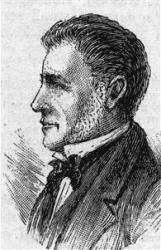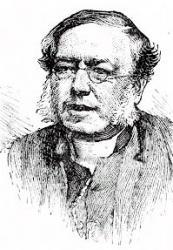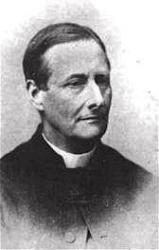
Rabanus Maurus
Biography
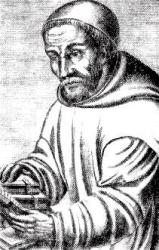
Rabanus Maurus (c. 776-856), also known as Hrabanus Magnentius Maurus, was a Carolingian theologian, scholar, poet, and church leader associated with Mainz and the Benedictine Abbey of Fulda. He was born probably at Mainz to noble parents, the son of Ruthard, and was sent at an early age to the Monastery of Fulda for his religious education. In 801 he was ordained a deacon, and in 802 he went to the monastic school of St. Martin at Tours, where he studied under Alcuin, one of the leading teachers of the period. Alcuin is traditionally said to have given him the surname Maurus, after Saint Maurus. On returning to Fulda in 804, Rabanus became head of the school connected with the monastery. His work in education became an important part of his career, although his tenure was interrupted by conflict with Ratgar, the abbot of Fulda. Rabanus was ordained a priest in 814 and eventually returned to Fulda after Ratgar's deposition.
In 822, following the death of Abbot Egil, Rabanus was appointed abbot of Fulda. He held the position for a number of years before eventually leaving the abbey. In 847, after the death of Archbishop Otgar, Rabanus became Archbishop of Mainz, then the metropolitan see of Germany. He remained in that office until his death on February 4, 856. He was initially buried at St. Alban's in Mainz and was later transferred to St. Maurice in Halle during the early period of the Reformation. His writings were extensive and included biblical commentaries, De Universo, and De Institutione Clericorum. His works circulated widely during the Middle Ages. German historians have regarded him as an important figure in the development of education, and his scholarly influence extended beyond his ecclesiastical office.
Rabanus Maurus has also been associated with several Latin hymns. The Hymnal 1940 Companion identifies him as the author of hymns represented in English by titles such as "O Come, Creator Spirit, Come," "Christ, the Fair Glory of the Holy Angels," "Come, Holy Ghost, Our Souls Inspire," "Come, Holy Ghost, Creator Blest," and "Creator Spirit, by Whose Aid." However, the attribution of these hymns is not certain. John Julian, writing in the Dictionary of Hymnology, notes that the ascriptions of "Christe sanctorum decus Angelorum," "Tibi Christe, splendor Patris," and "Veni Creator Spiritus" to Rabanus Maurus are doubtful. Julian further observes that these hymns were not accepted as works of Rabanus in Dümmler's 1884 edition of his Carmina. Therefore, while Rabanus Maurus has long been associated with these hymns in hymnological tradition, the authorship should be presented cautiously rather than as an established fact. His secure historical importance rests especially upon his extensive theological and educational writings and his prominent role in the Carolingian church.
Dictionary of Hymnology
Christe, sanctorum decus angelorum Latin Hymn
St. Michael hymn ascribed to Rabanus Maurus, in original, Textus Receptus, Roman Breviary, and Raphael appendix forms. Mant and Copeland supply the chief English versions in use.
ReadHymns by Rabanus Maurus
Includes hymns they wrote and hymns where they are credited as co-author, translator, paraphraser, or adapter.
| # | Title | Year | Views | |
|---|---|---|---|---|
| 1 | Come, Holy Ghost, Creator Blest | 809 | 356 | View |
| 2 | Creator Spirit, by whose aid | 1693 | 38 | View |
Recently added hymns
Suggestions or corrections: contact us.
Leave it in the forum for others to answer — hymn requests, lyrics help, writers, worship planning, and more.