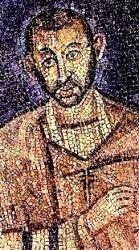
St. Ambrose (Ambrosius) was born in 340 AD at Lyons, Arles, or Treves, likely Treves, as the second son and third child of Ambrosius, Prefect of the Gauls. Following his father's death in 353, his mother moved the family to Rome. Ambrose completed his education, gaining fluency in Greek, before entering the legal profession alongside his elder brother Satyrus. His distinguished service in the court of Probus, Praetorian Prefect of Italy, led to his appointment in 374 as Consular of Liguria and Aemilia, based in Milan. Later that year, following the death of the Arian bishop Auxentius, Ambrose intervened during a tense episcopal election to maintain order. Acclaimed by the crowd, he was compelled to accept the bishopric despite being only a catechumen. He was rapidly baptized and consecrated as Bishop of Milan on December 7, 374.
His episcopate was marked by intense political and theological struggle. Following the death of Emperor Valentinian I in 375, Ambrose clashed with the Arian empress regent Justina, though he was supported by Emperor Gratian and later Theodosius I. In 387, Ambrose baptized his famous scholar Augustine, who had previously been a Manichaean heretic. In 390, after news reached Milan of a brutal massacre ordered by Theodosius at Thessalonica, Ambrose famously barred the emperor from entering the church until he performed public penance. Ambrose remained a steadfast champion of Western Catholic orthodoxy against Arianism until his death on Easter Eve, April 4, 397.
Widely recognized as the "father of Church song," Ambrose introduced antiphonal chanting from the East and laid early foundations for systematizing liturgical music. As a writer of sacred poetry, his hymns are noted for their solemnity, depth, and structural severity. Although dozens of hymns have historically been attributed to him, modern scholarship and Benedictine editors recognize twelve core hymns as genuine, including "Aeterna Christi munera," "Aeterne rerum Conditor," "Splendor Paternae gloriae," and "Veni Redemptor gentium." A popular tradition also attributes the composition of the "Te Deum laudamus" to Ambrose and Augustine at Augustine's baptism, though the hymn is now known to be a fifth-century compilation.
Related Authors
Writers connected to this dictionary topic.
Keywords
Related terms for this dictionary entry.
Recent Dictionary Entries
Newly added terms from the Dictionary of Hymnology.
If you notice any mistake or have suggestions, please contact us on our contact page.