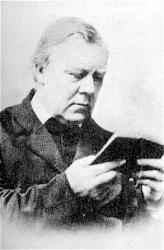



Aeterni Festi gaudia
"Aeterni Festi gaudia" is a twelfth-century sequence written by Adam of St. Victor for the Feast of St. Augustine.
A textual variation exists in the opening line across early manuscript sources:
-
Textual Forms: A thirteenth-century Rheinau manuscript cited by Morel reads Interni festi gaudia, a variation adopted by Hermann Adalbert Daniel (Thesaurus Hymnologicus, Vol. II, p. 250) and Joseph Kehrein (Lateinische Sequenzen, No. 502). However, Léon Gautier printed the text as Aeterni festi gaudia from a fourteenth-century Paris manuscript in Œuvres Poétiques d'Adam de St.-Victor (1859, Vol. II, pp. 150–160), a reading republished by D. S. Wrangham in The Liturgical Poetry of Adam of St. Victor (1881, Vol. II, pp. 186–191).
-
Theological Meaning: John Mason Neale favored Interni, remarking that the external celebration of the festival is the outspoken expression of the heart's internal joy (Mediaeval Hymns, 3rd ed., 1867, p. 133). Jodocus Clichtoveus (1516) similarly noted that the title of internal feast refers to the interior joy and peace of conscience experienced by the devout soul when separated from worldly cares and intent solely on divine contemplation.
The sequence entered English literature through complete translations and compiled centos:
-
Full Text Translations: John Mason Neale translated the complete thirteen-stanza text as "Our festal strains to-day reveal" (Mediaeval Hymns, 1862). D. S. Wrangham translated Gautier's text as "Our tuneful strains let us upraise" (1881). Neither version entered general hymnal usage.
-
Centos in Common Use:
-
"Our festal strains to-day reveal": A cento by John Mason Neale comprising stanzas I–V, VIII, and IX, published in the enlarged Hymnal Noted (1854).
-
"The praises that the Blessed know": A second cento by Neale, beginning at line Harum laudum praeconia and rearranging stanzas X, XI, VII, VI, and XIII. It appeared in the Hymnal Noted and passed into The People's Hymnal (1867, No. 277) with stanza XII replacing stanza VI.
-
"Blessed souls in heaven rejoice": A cento translated by Henrietta Mary Chester for The Hymnary (1872, No. 380, signed "H. M. C."), arranging stanzas X, XI, V, VI–XIII, and a doxology.
-
Aeterni Patris Unice
"Aeterni Patris Unice" is an anonymous Latin hymn for the Feast of St. Mary Magdalene, sometimes ascribed to Saint Odo of Cluny.
The text is preserved in an eleventh-century British Museum manuscript (Vesp. D. xii, f. 153b), added in a later hand as a continuation to "Lauda Mater ecclesia." Hermann Adalbert Daniel reprinted Cardinal Newman's text in Thesaurus Hymnologicus (Vol. I, No. 348), changing the opening word from Eterne to Aeterni. Franz Joseph Mone published a fourteenth-century text (Lateinische Hymnen, Vol. III, p. 424) with manuscript variants. The York Breviary text was included in Newman's Hymni Ecclesiae (1838). In the revised Roman Breviary, the text was altered to Summi Parentis Unice and printed in Daniel (Vol. IV, p. 244) as well as Louis Biggs's Annotated Hymns Ancient and Modern.
The hymn became known in English through translations of both textual forms:
-
Original Text (Aeterni Patris Unice):
-
"Son of the Eternal Sire on high": Translated by John David Chambers in Lauda Syon (1866, Pt. II, p. 91), appearing in the Hymnal Noted Appendix (1862) as "Thou Only Son of God on high."
-
"Son of Eternal God most high": Translated by Richard Frederick Littledale for The People's Hymnal (1867, No. 265, signed "F. R.").
-
An unadopted translation, "Son of the Sire, the Eternal One," was published by W. J. Blew (1852).
-
-
Roman Breviary Form (Summi Parentis Unice):
-
"Son of the Highest, deign to cast": Translated by Edward Caswall in Lyra Catholica (1849, p. 164) and Hymns and Poems (1873, p. 89). Altered versions appeared in Hymns Ancient and Modern (1861, 1875) and St. John's Hymnal, Aberdeen (1870, No. 75).
-
"O Jesu, Son of God, look down": An altered adaptation of Caswall's translation by the compilers of The Hymnary (1872, No. 576).
-
Related Authors
Writers connected to this dictionary topic.
Keywords
Related terms for this dictionary entry.
Recent Dictionary Entries
Newly added terms from the Dictionary of Hymnology.
If you notice any mistake or have suggestions, please contact us on our contact page.