
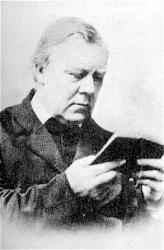

"Aeterne rerum conditor" is a classic Sunday morning hymn authored by Saint Ambrose and universally accepted as genuine by the Benedictine editors of his works.
Two key historical pieces of evidence confirm its Ambrosian authorship:
-
Patristic Testimony: In Retractationes (Book I, Chapter 21), Saint Augustine explicitly quotes the line "Hoc ipsa petra ecclesiae / Canente, culpam diluit" ("Lo, e'en the very Church's Rock / Melts at the crowing of the cock"), attributing it directly to the verses sung by the mouth of multitudes from the most Blessed Ambrose.
-
Patristic Context: The Venerable Bede, in De arte metrica, notes that the substance of the hymn corresponds directly to Saint Ambrose's Hexaemeron (Book V, Chapter 24), written around the year 389. Hymnologists note that the concise hymn may have been composed first and later expanded into the prose treatise, or vice versa.
The liturgical use of "Aeterne rerum conditor" has been widespread throughout Western Christendom. In the Mozarabic Breviary (1502), it served as the Matins hymn for the first Sunday in Advent and for general Sundays in Advent, Lent, Palm Sunday, and Whitsunday. In the Sarum, York, Evesham, Hereford, and St. Alban's Breviaries, it was appointed for Sunday Lauds from the Octave of the Epiphany to Lent and from the first Sunday in October to Advent. The Worcester Breviary and several ancient Benedictine uses appointed it for Matins. In the Roman Breviary, it is used at Sunday Lauds from the Octave of the Epiphany to the first Sunday in Lent and from the Sunday nearest October 1 to Advent.
The text is preserved in early manuscript traditions, including the eighth-century Junius Manuscript (No. 25) and two eleventh-century manuscripts in the British Museum (Harl. 2961 and Jul. A. vi). It was also printed from an eleventh-century Durham manuscript in The Latin Hymns of the Anglo-Saxon Church (Surtees Society, 1851). Critical editions and extensive commentary appear in the Paris edition of Ambrose's works (1836), Hermann Adalbert Daniel's Thesaurus Hymnologicus (Vol. I and IV), Archbishop Trench's Sacred Latin Poetry (1864), and John Henry Newman's Hymni Ecclesiae (1838).
The hymn entered common English hymnal usage through two primary translations:
-
"Maker of all, Eternal King": Translated by W. J. Copeland from the Roman Breviary text in his Hymns for the Week (1848). It subsequently passed into The People's Hymnal (1867) and other collections.
-
"Framer of the earth and sky": Translated by John Henry Newman between 1836 and 1838. Its earliest known print appeared in Robert Campbell's St. Andrew's Hymnal (1850), followed by publication in Newman's Verses (1853) and Verses on Various Occasions (1868). An adapted text was included in The Hymnary (1872).
Thirteen additional English translations were produced for non-congregational or private devotional works: the Primer (1706), Bishop Richard Mant (1837), Isaac Williams (1844), Hymnarium Anglicanum (1844), Bishop Isaac Williams (1845), Edward Caswall (1849), J. Banks (1854), J. D. Chambers (1857), Elizabeth Charles (1858), J. W. Hewett (1859), E. Kynaston (1862), J. Wallace (1874), and H. M. Macgill (1876).
Related Hymns
Hymns in the library connected to this dictionary topic.
Related Hymn Sheets
3 shown at a time — use the arrows to browse all 3 sheets.
Related Authors
Writers connected to this dictionary topic.
Keywords
Related terms for this dictionary entry.
Recent Dictionary Entries
Newly added terms from the Dictionary of Hymnology.
If you notice any mistake or have suggestions, please contact us on our contact page.