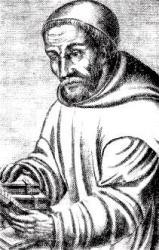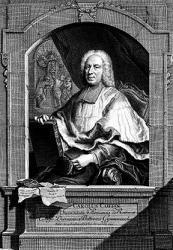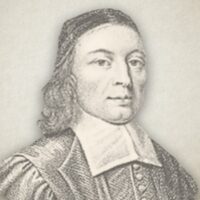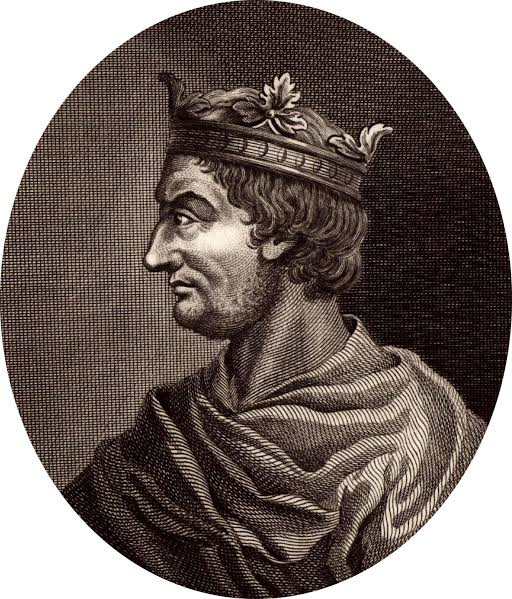
The Venerable Bede
Biography
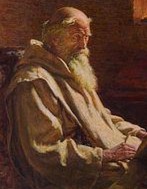
Bede (c. 672–735), universally known as The Venerable Bede, was an English monk, theologian, chronologist, and polymath who spent his entire life at the joint monastery of Saint Peter and Saint Paul at Wearmouth-Jarrow in the Kingdom of Northumbria. Widely considered the "Father of English History," Bede was the most prominent scholar of the Anglo-Saxon period, producing a massive corpus of Latin literature that kept the flame of classical learning alive in Western Europe during the early Middle Ages.
A Life of Monastic Devotion and Scholarship
Almost everything known about Bede’s life comes from a brief autobiographical sketch he appended to his final historical masterpiece. Born on lands belonging to the monastery in modern-day Sunderland, he was handed over by his family at the age of seven to Benedict Biscop, the noble founder of the Wearmouth monastery, to be educated.
When the sister monastery at Jarrow was founded under Abbot Ceolfrith, Bede relocated there. Around 686, a catastrophic plague struck Jarrow, killing almost every monk who could read or sing the liturgy except for Abbot Ceolfrith and the young Bede. Together, the man and boy kept the daily cycle of monastic prayer going alone until new monks could be trained.
Bede was ordained a deacon at the uncanonical young age of nineteen—a testament to his exceptional intellect—and became a priest at thirty. He rarely traveled, declaring:
"I have spent the whole of my life in the surroundings of that monastery, devoting myself entirely to the study of the Scriptures; and amid the observance of monastic discipline and the daily task of singing in the church, it has ever been my delight to learn, or teach, or write."
The Father of English History
Bede wrote on an astonishing array of subjects, including grammar, natural science, poetry, and biblical commentary. However, his enduring monument is the Historia Ecclesiastica Gentis Anglorum (Ecclesiastical History of the English People), completed around 731.
The work chronicles the arrival of Christianity in Britain, the Anglo-Saxon invasions, and the slow, fractured unification of the various English kingdoms under a shared Christian identity. Bede’s historical method was centuries ahead of its time:
-
Rigorous Sourcing: He explicitly cited his sources, cross-examined eyewitnesses, and corresponded with priests and bishops across Britain and Rome to gather official documents.
-
The BC/AD Dating System: While he did not invent it, Bede was the first major historian to popularize dating events relative to the birth of Christ (Anno Domini). His widespread adoption of AD dating established it as the standard chronological framework for Western civilization.
Contributions to Hymnology and Chronology
Beyond narrative history, Bede made foundational contributions to early medieval church worship, music, and science.
1. Computus and the Easter Controversy
In the early medieval church, calculating the precise calendar date of Easter (computus) was a massive theological battleground. The Celtic and Roman churches used different lunar cycles, threatening church unity. Bede wrote two definitive scientific treaties, De Temporibus (703) and De Temporum Ratione (725), which mastered the mathematics of the calendar. His calculations successfully harmonized the solar and lunar years, providing the definitive astronomical defense for the Roman calculation of Easter that the English church adopted.
2. Sacred Poetry and Hymns
Bede was an accomplished poet who viewed hymnody as a critical teaching tool. He compiled a Book of Hymns in various meters and rhythms. Several of his Latin hymns were later translated into English and adopted into modern church hymnals, noted for their strict scriptural imagery and clear, unpretentious theology.
| Hymn Title (English Translation) | Liturgical Theme | Focus and Style |
| The hymn of glory sing we (Hymnum canamus gloriae) | Ascension Day | A majestic, triumphant narrative hymn celebrating Christ’s return to heaven. |
| A type of those things we behold | The Transfiguration | Explores the mystical revelation of Christ's divinity to the Apostles on the mount. |
| As the sun o'er trackless courses | Saints' Days / Martyrs | Uses vivid solar and natural metaphors to describe the spiritual legacy of early saints. |
The Final Act: The Gospel of John
Bede’s death on May 25, 735, is famously documented in a letter by his disciple, Cuthbert. Though suffering from a severe respiratory illness that left him struggling for breath, Bede spent his final weeks working furiously to translate the Gospel of John into the Old English vernacular so that common people could understand it.
On Ascension Eve, his young scribe noted that one chapter remained unwritten, but feared the dying monk was too weak to dictate. Bede replied, "Take your pen and write quickly." As twilight fell, the boy said, "There is yet one sentence unwritten, dear master." Bede dictated the final words. The boy announced, "It is finished."
Bede replied, "You have spoken the truth; it is finished." Seated upon the floor of his cell, he sang the Gloria Patri and passed away peacefully as the final words left his lips.
Bede was buried at Jarrow, but his remains were later moved to Durham Cathedral, where they rest today in the Galilee Chapel. He was formally canonized and declared a Doctor of the Church by Pope Leo XIII in 1899, the only native of Great Britain to receive this specific theological honor.
Hymns by The Venerable Bede
Includes hymns they wrote and hymns where they are credited as co-author, translator, paraphraser, or adapter.
| # | Title | Year | Views | |
|---|---|---|---|---|
| 1 | A Hymn of Glory Let Us Sing | 673 | 1475 | View |
Recently added hymns
Suggestions or corrections: contact us.
Leave it in the forum for others to answer — hymn requests, lyrics help, writers, worship planning, and more.