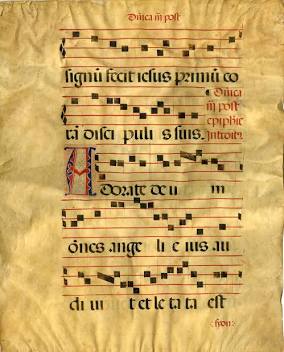



"A Patre Unigenitus" is an ancient Latin hymn of anonymous authorship written for the Feast of the Epiphany. While early scholars originally estimated its date of composition to be somewhere between the tenth and thirteenth centuries, the discovery of older source materials firmly pushed its timeline back to at least the early eleventh century.
A fascinating literary feature of the original text is that it was composed as an alphabetical acrostic, with successive lines or stanzas beginning with the letters from A to T inclusive. The closing Gloria, being a later standard liturgical addition, does not follow this alphabetical pattern.
The hymn is remarkably well-preserved across several significant medieval texts:
-
British Museum Manuscripts: The text appears in three distinct eleventh-century manuscripts within the Harleian and Cottonian collections (specifically Harl. 2961, f. 230; Julius A. vi. f. 366; and Vespa. D. xii. f. 436).
-
The Anglo-Saxon Church: In 1851, the Surtees Society published the full text in Latin Hymns of the Anglo-Saxon Church, transcribed directly from an eleventh-century Durham manuscript.
-
The Sarum and York Uses: The text features prominently in the Hymnarium Sarisburiense (London, 1851) as a designated hymn for Lauds during the Epiphany and its octave. This compilation also details the distinct textual variations used during Matins in the York liturgy, as well as variations found in Worcester and Evesham.
In the mid-nineteenth century, the hymn received rigorous academic evaluation by prominent German hymnologists. Franz Joseph Mone published the complete text in six stanzas of four lines in his Lateinische Hymnen des Mittelalters (1853, vol. i., No. 59), adding an extensive commentary based on a fifteenth-century Stuttgart manuscript and the writings of Cardinal Giovanni Maria Thomasius.
Hymnologist Hermann Adalbert Daniel initially printed only the first four lines of the hymn in his first volume in 1841. However, in his fourth volume published in 1855, Daniel reprinted Mone’s complete text and expanded the notes by including cross-references to an eleventh-century manuscript from the monastery of Rheinau.
The historical piece was also preserved in Gotthard Viktor Lechler's and Philipp Wackernagel's early collections, and it was brought into the nineteenth-century Catholic revival when Cardinal John Henry Newman included it in his Hymni Ecclesiae.
Related Hymns
Hymns in the library connected to this dictionary topic.
Related Hymn Sheets
3 shown at a time — use the arrows to browse all 5 sheets.
Related Authors
Writers connected to this dictionary topic.
Keywords
Related terms for this dictionary entry.
Recent Dictionary Entries
Newly added terms from the Dictionary of Hymnology.
If you notice any mistake or have suggestions, please contact us on our contact page.