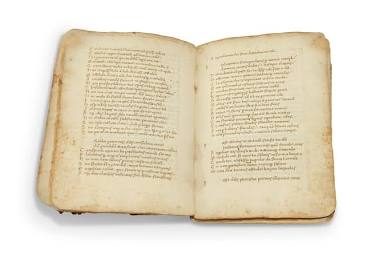
"A solis ortus cardine" is a highly influential fifth-century Latin hymn composed by the Christian poet Coelius Sedulius. Originally written as an alphabetical acrostic poem titled Paean Alphabeticus de Christo ("A triumphal song concerning Christ, arranged according to the letters of the alphabet"), the work consists of 23 stanzas of four lines providing a poetic chronicle of the life of Christ.
While the complete text survives in an eighth-century manuscript preserved in the British Museum (MSS. Reg. 2 A. xx. f. 50), the church historically divided the grand poem into two distinct liturgical hymns for seasonal use:
-
The Christmas Section: Comprising the first 28 lines of the poem (stanzas starting with letters A through G). This segment retains the original title, "A solis ortus cardine."
-
The Epiphany Section: Comprising the later stanzas, widely known as "Hostis Herodes impie" (or in its revised Roman Breviary form, "Crudelis Herodes, Deum").
To distinguish the Christmas hymn from other similarly titled works, scholars point to the opening lines of its second stanza: Beatus auctor saeculi / Servile corpus induit / Ut carne carnem liberans / Ne perderet quos condidit.
The Christmas portion of the hymn achieved widespread liturgical status across Western Christendom. In the Roman Breviary, it serves as the assigned hymn at Lauds on Christmas Day, the Octave of Christmas, the Feast of the Circumcision, and the Vigil of the Epiphany. Hermann Adalbert Daniel’s Thesaurus Hymnologicus (vol. i., No. 119) displays the original text alongside the revised Roman Breviary version in parallel columns to showcase historical textual edits.
The hymn was exceptionally popular across England prior to the Reformation, appearing in eleventh-century manuscripts (such as Harl. 2961 and Jul. A. vi) and the Latin Hymns of the Anglo-Saxon Church (1851). Under the Hymnarium Sarisburiense, it was sung at Lauds on Christmas Day, while the York and Worcester uses extended its performance to include Vespers and the Feast of the Purification. Additionally, an expanded version featuring the "H" strophe was adopted by the Mozarabic Breviary for Vespers on the Feast of the Annunciation.
Keywords
Related terms for this dictionary entry.
Recent Dictionary Entries
Newly added terms from the Dictionary of Hymnology.
If you notice any mistake or have suggestions, please contact us on our contact page.