

What Is the Difference Between Psalms, Hymns…
5 minutes ago
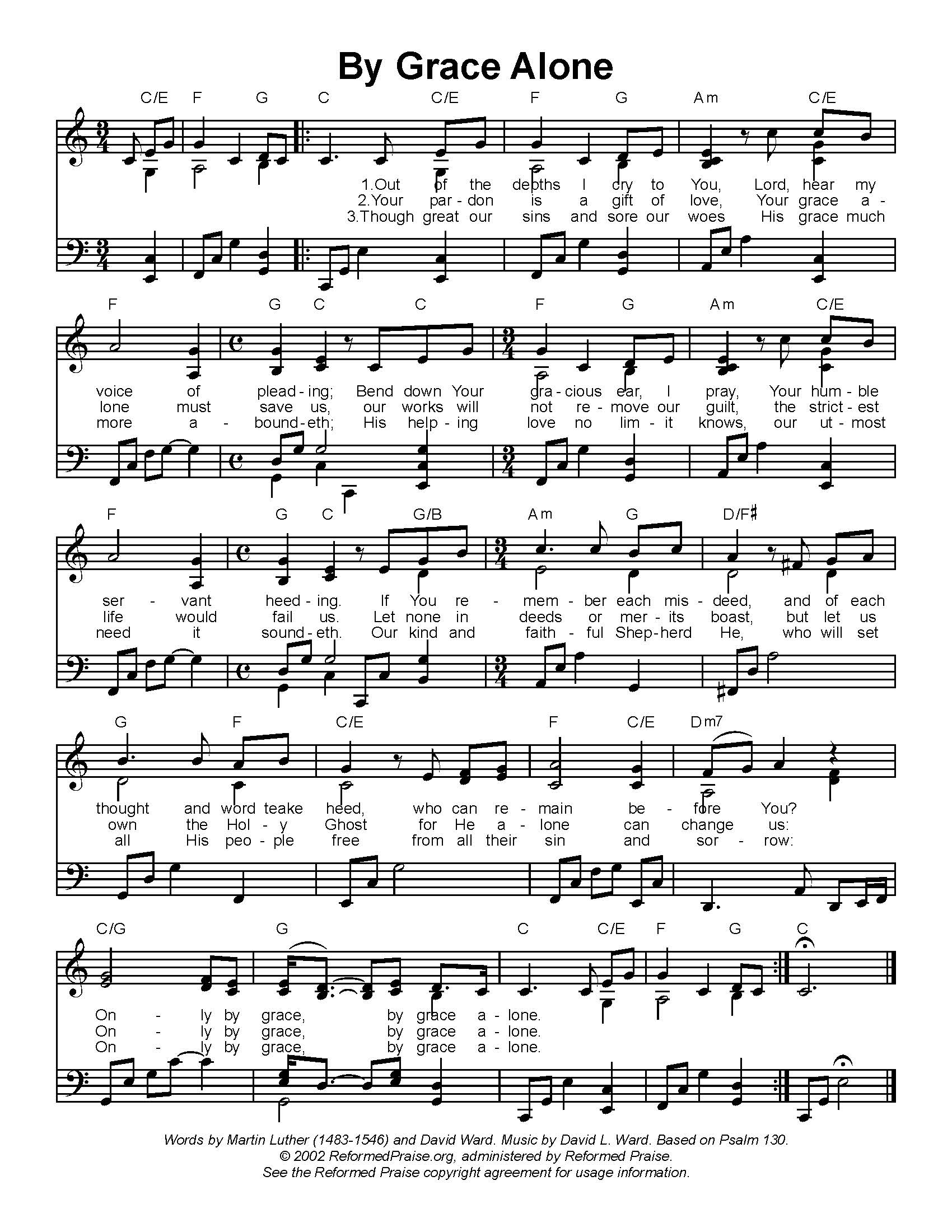
By Grace Alone
By Martin Luther (1524)
Lyrics
1. Out of the depths I cry to You,
Lord, hear my voice of pleading;
Bend down Your gracious ear, I pray,
Your humble servant heeding.
If You remember each misdeed,
And of each thought and word take heed,
Who can remain before You?
Only by grace, by grace alone.
Lord, hear my voice of pleading;
Bend down Your gracious ear, I pray,
Your humble servant heeding.
If You remember each misdeed,
And of each thought and word take heed,
Who can remain before You?
Only by grace, by grace alone.
2. Your pardon is a gift of love,
Your grace alone must save us,
Our works will not remove our guilt,
The strictest life would fail us.
Let none in deeds or merits boast,
But let us own the Holy Ghost
for He alone can change us:
Only by grace, by grace alone.
Your grace alone must save us,
Our works will not remove our guilt,
The strictest life would fail us.
Let none in deeds or merits boast,
But let us own the Holy Ghost
for He alone can change us:
Only by grace, by grace alone.
3. Though great our sins and sore our woes
His grace much more aboundeth;
His helping love no limit knows,
Our utmost need it soundeth.
Our kind and faithful Shepherd He,
Who will set all His people free
From all their sin and sorrow:
Only by grace, by grace alone.
His grace much more aboundeth;
His helping love no limit knows,
Our utmost need it soundeth.
Our kind and faithful Shepherd He,
Who will set all His people free
From all their sin and sorrow:
Only by grace, by grace alone.
Bible Reference
Romans 3:24-28; Ephesians 2:8-9; Galatians 2:16; Titus 3:5; Romans 11:6
Lectionary & readings
Open today’s (or any date’s) assigned scriptures and find related hymns across church calendars. Useful when planning worship around this song’s themes or its Bible reference.
Hymn scripture: Romans 3:24-28; Ephesians 2:8-9; Galatians 2:16; Titus 3:5; Romans 11:6
About This Hymn
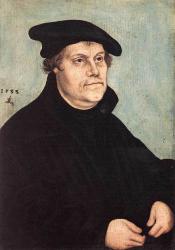
By Grace Alone is the English title commonly given to Martin Luther’s great Reformation hymn Es ist das Heil uns kommen her, written in 1524. This hymn stands as one of the clearest poetic expressions of the doctrine of justification by grace alone through faith alone, a truth that lay at the very heart of the Protestant Reformation. Luther did not write this hymn merely for personal devotion, but as a teaching hymn for the church, intended to put gospel doctrine directly onto the lips of ordinary believers.
The hymn boldly declares that salvation comes entirely from God and not from human effort, merit, or obedience to the law. Luther carefully contrasts grace and works, insisting that the law reveals sin but cannot save. This reflects the apostle Paul’s teaching that a man is justified freely by God’s grace apart from the works of the law. In Luther’s theology, the law drives the sinner to despair of self righteousness so that Christ alone may be trusted for salvation.
Christ is presented as the sole ground of hope. The hymn emphasizes that Jesus fulfilled the law perfectly and bore sin’s punishment on behalf of sinners. Faith does not earn salvation, but simply receives Christ and His righteousness as a gift. This makes the hymn both doctrinally precise and deeply pastoral, offering assurance to troubled consciences weighed down by guilt or fear of judgment.
Another important theme is assurance. Because salvation rests on God’s grace rather than human performance, the believer may have confidence before God. Luther underscores that works follow faith as fruit, not as the basis of acceptance. Good works are the result of salvation, not the cause of it. This distinction was crucial in Luther’s reforming message and remains central to evangelical theology today.
By Grace Alone has endured for centuries as a confession of faith sung by the church. It continues to serve as a powerful reminder that the gospel is not advice about how to save oneself, but good news about what God has done in Christ. The hymn invites believers to rest fully in God’s mercy, rejoice in the sufficiency of Christ’s work, and give all glory to God alone for salvation.
From the Dictionary of Hymnology
Related terms and concepts automatically matched to this hymn.
Ein' feste Burg ist unser Gott Hymn
Luther’s Psalm 46 battle-hymn, first published in Klug’s Gesangbuch (Wittenberg, 1529), not in 1521 or 1530 as popular stories claim. Carlyle’s and Thring’s English versions lead common use.
Read moreEin neues Lied wir heben an Hymn
Luther’s first hymn-like piece (1523), a narrative ballad on the Brussels martyrdom of Voes and Esch. Messenger’s paraphrase “Flung to the heedless winds” is the main English congregational form.
Read moreJesus Christus, unser Heiland, Der den Tod überwand / Jesus, exalted far on high Hymn
Luther’s Easter hymn from Eyn Enchiridion (1524), each stanza ending “Kyrieleyson”; and T. Cotterill’s Circumcision hymn “Jesus, exalted far on high” (Uttoxeter, 1805; Selection, 1810).
Read moreStaff Visualizer
Open in MIDI StudioPowered by HTML MIDI PLAYER, MIDI FILE Made by Hymnal Library. · Study chords & lyrics in MIDI Studio
Want weekly hymns and devotionals?
⭐ Recommend This Hymn
Share this beautiful hymn with others
This hymn also appears in these hymnals
Click a spine to pull out the hymnal, then open it.
Hymns with the same subject
More hymns about Blessing, Forgiveness, Grace, Holy Spirit, Humility
- Grace Greater than Our Sin - Julia H. Johnston
- Amazing grace! (how sweet the sound) - John Newton
- My Chains are Gone (Amazing Grace) - Chris Tomlin
- Come Unto Me ( Hear the blessed Savior) - Charles Price Jones
- A New Name in Glory - C. Austin Miles
- Wonderful Grace Of Jesus - Haldor Lillenas
- A Child of the King - Harriet E. Buell
- Come, Holy Spirit - John R. Rice
More hymn subjects
Explore other themes across the library.
Hymns about Baptism
Hymns about Pentecost
Hymns about Courage
Hymns about Opening of Worship
Hymns about Funeral
Hymns about Judgment
Hymns about Harvest
Hymns about Jesus Christ
Browse all subjects →
Recently Added Hymns
Latest Updated Hymnals
-
Open
 Book of Common Praise (BoCP1915)Updated 6 days, 12 hours ago · 1915
-
Open
 The New Apostolic Church HymnalUpdated 1 week, 5 days ago · 2008
-
Open
 400+ Christmas Carols Book: Sheet Music for PianoUpdated 1 week, 6 days ago · 2014
-
Open
 The Temple HymnalUpdated 1 week, 6 days ago · 1918
-
Open
 The Popular HymnalUpdated 1 week, 6 days ago · 1918
Hymn Information
Click a linked name to open their biography.
MIDI File
Popular Hymns
Recent Blog Posts



Popular Blog Posts
-
 Lessons from the Book of Haggai: Putting God…5 months, 1 week ago
-
 Easter vs Passover: How a Biblical Feast Bec…7 months ago
-
 The Full Story of the Birth of Jesus Christ:…10 months, 4 weeks ago
-
 The 30 Most Famous Christmas Hymns and Carols1 year, 2 months ago
-
 The Story Behind the Hymn “Amazing Grace”10 months, 3 weeks ago
Visit Us on Social Media
Latest from X (Twitter)
Tweets by HymnalLibraryLatest from Facebook
Latest on YouTube
Loading latest video...
Daily Bible Verse
Disclaimer
The hymns, sheet music, MIDI files, and related content on this website are provided for educational and research purposes only.
- Public Domain: Many of the hymns featured here are in the public domain and may be freely used.
- Copyrighted Works: Some hymns may still be under copyright protection. Where applicable, permission has either been requested from the copyright owner, or the content is shared under the principles of fair use for educational purposes.
⚠️ Important Notice: If you wish to reproduce, distribute, or use any copyrighted hymn beyond personal study or educational use, you must obtain permission directly from the copyright holder. This website does not grant any rights for commercial use yet.
If there is any other question please address it to us in our Contact Page, for further assistance. Thank you for using the site. May God Bless You.
Recently Added · Dictionary of Hymnology
Browse dictionary →- Light of life, seraphic Fire 2 days, 9 hours ago · Hymn 0
- Lift up your heads, ye gates of brass 2 days, 9 hours ago · Hymn 2
- Lift the strain of high thanksgiving 2 days, 9 hours ago · Hymn 1
- Lift it gently to the steeple 2 days, 9 hours ago · Hymn 1
- Life nor death shall us dissever 2 days, 9 hours ago · Hymn 0
Can’t find a hymn or lyric?
Leave your question in the forum for others to answer — requests, missing lines, writers, and worship ideas welcome.