

What Is the Difference Between Psalms, Hymns…
an hour ago
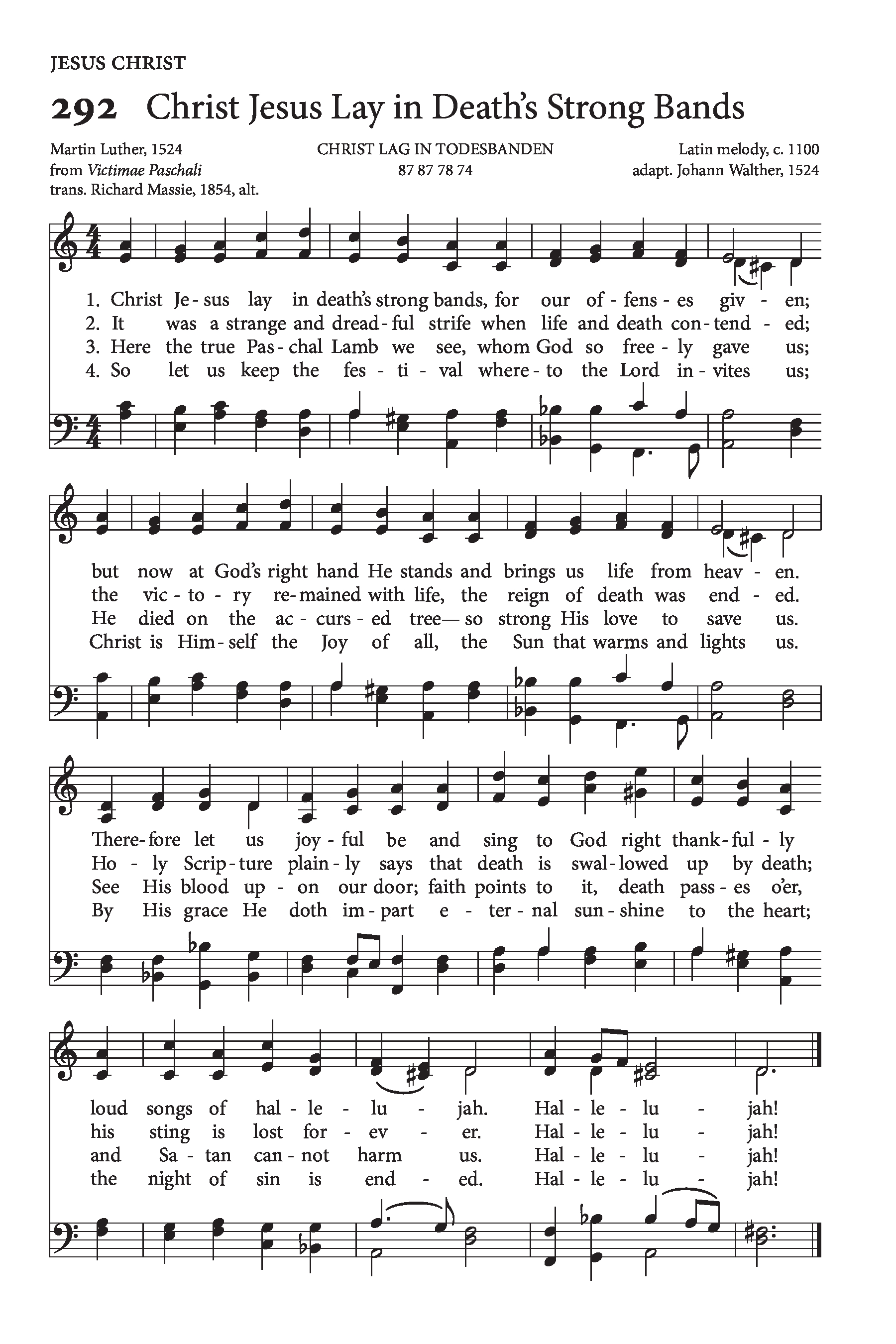
Christ Jesus Lay in Death's Strong Bands
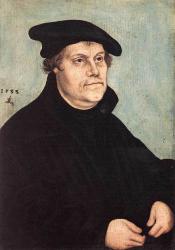
By Martin Luther (1524)
Lyrics
1. Christ Jesus lay in death’s strong bands,
for our offenses given;
but now at God’s right hand He stands
and brings us light from heaven.
Therefore let us joyful be
and sing to God right thankfully
loud songs of hallelujah.
Hallelujah!
for our offenses given;
but now at God’s right hand He stands
and brings us light from heaven.
Therefore let us joyful be
and sing to God right thankfully
loud songs of hallelujah.
Hallelujah!
2. It was a strange and dreadful strife
when life and death contended;
the victory remained with life,
the reign of death was ended.
Holy Scripture plainly saith
that death is swallowed up by death;
his sting is lost forever.
Hallelujah!
when life and death contended;
the victory remained with life,
the reign of death was ended.
Holy Scripture plainly saith
that death is swallowed up by death;
his sting is lost forever.
Hallelujah!
3. Here the true Paschal Lamb we see,
whom God so freely gave us;
He died on the accursed tree-
so strong His love to save us.
See His blood upon our door;
faith points to it, death passes o'er,
and Satan cannot harm us.
Hallelujah!
whom God so freely gave us;
He died on the accursed tree-
so strong His love to save us.
See His blood upon our door;
faith points to it, death passes o'er,
and Satan cannot harm us.
Hallelujah!
4. So let us keep the festival
whereto the Lord invites us;
Christ is Himself the Joy of all,
the Sun that warms and lights us.
By His grace He doth impart
eternal sunshine to the heart;
the night of sin is ended.
Hallelujah!
whereto the Lord invites us;
Christ is Himself the Joy of all,
the Sun that warms and lights us.
By His grace He doth impart
eternal sunshine to the heart;
the night of sin is ended.
Hallelujah!
Bible Reference
1 Corinthians 15:54-57; Romans 6:9-10; Hebrews 2:14-15; 1 Corinthians 5:7
Lectionary & readings
Open today’s (or any date’s) assigned scriptures and find related hymns across church calendars. Useful when planning worship around this song’s themes or its Bible reference.
Hymn scripture: 1 Corinthians 15:54-57; Romans 6:9-10; Hebrews 2:14-15; 1 Corinthians 5:7
About This Hymn
“Christ Jesus Lay in Death’s Strong Bands” was written in 1524 by Martin Luther as one of the earliest Lutheran chorales. The hymn is based on the Latin Easter sequence “Victimae Paschali Laudes” and reflects Luther’s commitment to restoring congregational singing grounded in Scripture and clear doctrine. It is a powerful proclamation of Christ’s victory over sin, death, and the devil.
The hymn closely follows 1 Corinthians 15:54-57, which declares, “Death is swallowed up in victory… thanks be to God, which giveth us the victory through our Lord Jesus Christ” (KJV). Luther vividly portrays death as a tyrant that once held humanity captive because of sin. Yet through His atoning death and triumphant resurrection, Christ broke those strong bands and conquered the grave.
Romans 6:9-10 teaches that Christ, being raised from the dead, dieth no more. Death hath no more dominion over Him. Luther emphasizes that Christ’s resurrection is decisive and final. The power of death has been shattered, and believers now share in that victory through faith. The hymn does not present resurrection as a vague hope, but as a completed triumph secured in history.
Hebrews 2:14-15 explains that through death Christ destroyed him that had the power of death, that is, the devil, and delivered them who through fear of death were subject to bondage. Luther’s text echoes this liberation theme. Christ enters the battle, defeats the enemy, and frees His people from fear and condemnation.
The hymn also reflects 1 Corinthians 5:7, “For even Christ our passover is sacrificed for us.” Luther connects the resurrection with the imagery of the Passover lamb, portraying Christ as the true Lamb whose blood delivers from judgment. This rich biblical symbolism highlights both substitution and victory.
“Christ Jesus Lay in Death’s Strong Bands” remains a central Easter hymn in Lutheran and other Protestant traditions. Its theology is direct and scriptural, emphasizing substitutionary atonement and triumphant resurrection. Through strong poetic imagery and clear biblical grounding, Luther calls the church to rejoice in Christ’s conquest of death and to live in the freedom purchased by His redeeming work.
From the Dictionary of Hymnology
Related terms and concepts automatically matched to this hymn.
Christ lag in Todesbanden Hymn
Luther’s Easter hymn (Erfurt Enchiridion, 1524), “improved” from “Christ ist erstanden,” with echoes of “Victimae paschali”; major English versions by Russell, Massie, and Winkworth.
Read moreEin' feste Burg ist unser Gott Hymn
Luther’s Psalm 46 battle-hymn, first published in Klug’s Gesangbuch (Wittenberg, 1529), not in 1521 or 1530 as popular stories claim. Carlyle’s and Thring’s English versions lead common use.
Read moreEin neues Lied wir heben an Hymn
Luther’s first hymn-like piece (1523), a narrative ballad on the Brussels martyrdom of Voes and Esch. Messenger’s paraphrase “Flung to the heedless winds” is the main English congregational form.
Read moreStaff Visualizer
Open in MIDI StudioPowered by HTML MIDI PLAYER, MIDI FILE Made by Hymnal Library. · Study chords & lyrics in MIDI Studio
Want weekly hymns and devotionals?
⭐ Recommend This Hymn
Share this beautiful hymn with others
This hymn also appears in these hymnals
Click a spine to pull out the hymnal, then open it.
Hymns with the same subject
More hymns about Battle, Funeral, Jesus Christ, Scripture
- Because He Lives - Bill & Gloria Gaither
- Standing on the Promises - Russell Kelso Carter
- May The Mind Of Christ My Saviour - Kate Barclay Wilkinson
- Savior of the Nations, Come - St. Ambrose
- Salvation Has Been Brought Down - Albert E. Brumley
- Victory in Jesus - (I Heard an Old, Old Story) - E. M. Bartlett
- In Christ alone (my hope is found) - Stuart Townend
- O Come, O Come, Emmanuel - J. M. Neale
More hymn subjects
Recently Added Hymns
Latest Updated Hymnals
-
Open
 Book of Common Praise (BoCP1915)Updated 32 minutes ago · 1915
-
Open
 The New Apostolic Church HymnalUpdated 1 week, 5 days ago · 2008
-
Open
 400+ Christmas Carols Book: Sheet Music for PianoUpdated 1 week, 6 days ago · 2014
-
Open
 The Temple HymnalUpdated 1 week, 6 days ago · 1918
-
Open
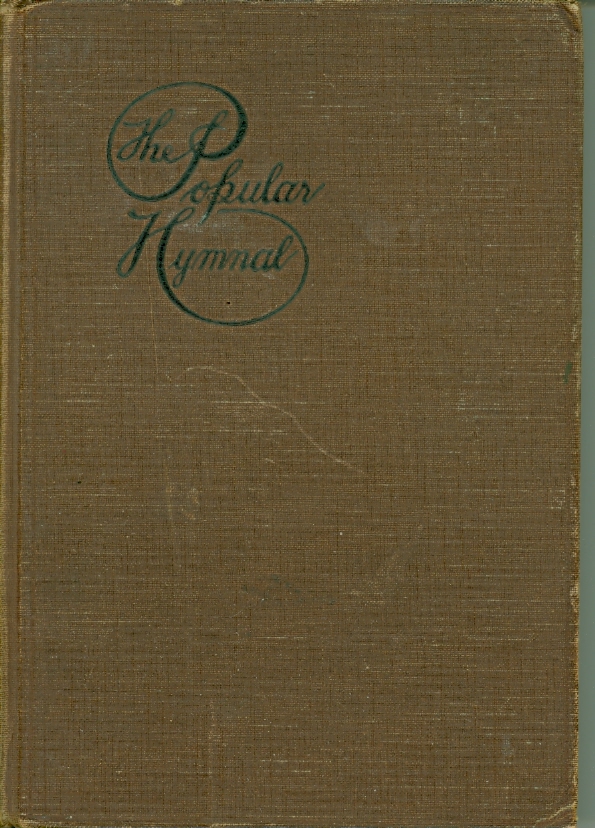 The Popular HymnalUpdated 1 week, 6 days ago · 1918
Hymn Information
Click a linked name to open their biography.
MIDI File
Popular Hymns
Recent Blog Posts



Popular Blog Posts
-
 Lessons from the Book of Haggai: Putting God…5 months, 1 week ago
-
 Easter vs Passover: How a Biblical Feast Bec…7 months ago
-
 The Full Story of the Birth of Jesus Christ:…10 months, 4 weeks ago
-
 The 30 Most Famous Christmas Hymns and Carols1 year, 2 months ago
-
 The Story Behind the Hymn “Amazing Grace”10 months, 3 weeks ago
Visit Us on Social Media
Latest from X (Twitter)
Tweets by HymnalLibraryLatest from Facebook
Latest on YouTube
Loading latest video...
Daily Bible Verse
Disclaimer
The hymns, sheet music, MIDI files, and related content on this website are provided for educational and research purposes only.
- Public Domain: Many of the hymns featured here are in the public domain and may be freely used.
- Copyrighted Works: Some hymns may still be under copyright protection. Where applicable, permission has either been requested from the copyright owner, or the content is shared under the principles of fair use for educational purposes.
⚠️ Important Notice: If you wish to reproduce, distribute, or use any copyrighted hymn beyond personal study or educational use, you must obtain permission directly from the copyright holder. This website does not grant any rights for commercial use yet.
If there is any other question please address it to us in our Contact Page, for further assistance. Thank you for using the site. May God Bless You.
Recently Added · Dictionary of Hymnology
Browse dictionary →
Can’t find a hymn or lyric?
Leave your question in the forum for others to answer — requests, missing lines, writers, and worship ideas welcome.