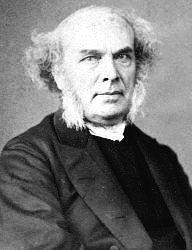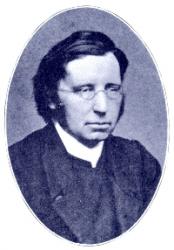
Thomas Helmore
Biography
Thomas Helmore was a prominent 19th-century English Anglican priest, choir director, and musical scholar who played a foundational role in the revival of plainchant and medieval hymnody within the Anglican Church. Born in Kidderminster, Worcestershire, on May 7, 1811, he pursued his higher education at Magdalen College, Oxford, where he earned his Bachelor of Arts in 1840 and his Master of Arts in 1845. Following his graduation, he was ordained into the ministry of the Church of England, serving his early curacy at St. Michael's Church in Lichfield, where he also served as a priest-vicar in the cathedral choir. His exceptional musical talents soon led him to prioritize musical ministry and liturgical education over conventional parish work.
In 1842, Helmore moved to London to become the Vice-Principal and Precentor of St. Mark’s College, Chelsea—a teacher training institution where he served for thirty-five years until 1877. At St. Mark's, he introduced daily choral services rendered entirely without instrumental accompaniment, training generations of schoolteachers in sight-singing and plainchant. His success caught the attention of the royal household, leading to his appointment in 1846 as Master of the Children of the Chapel Royal at St. James's, a post he held until his death. In this capacity, he trained many of the era's finest choristers and musicians, cultivating a rigorous standard of unaccompanied choral singing and liturgical decorum.
Helmore’s most lasting impact on global hymnody came through his close collaboration with the renowned translator and scholar John Mason Neale. Together, they sought to restore historic Latin hymns, sequences, and carols to congregational use in English. Their joint effort produced The Hymnal Noted (published in two parts, 1851 and 1854), with Neale translating the original Latin texts into English verse and Helmore adapting, arranging, and harmonizing the accompanying medieval plainchant melodies. Among their most famous joint achievements was the adapted carol collection Carols for Christmas-tide (1853), through which Helmore arranged the 13th-century spring melody TEMPUS ADEST FLORIDUM into the iconic Christmas carol "Good King Wenceslas." He also arranged the plainchant melody VENI EMMANUEL for Neale's translation of "O come, O come, Emmanuel," establishing a tune that remains a cornerstone of global Advent observance.
Beyond his joint work with Neale, Helmore was an influential editor and author who sought to make Gregorian chant accessible to parish choirs. His major publications include A Manual of Plainsong (1850), The Psalter Noted (1849), and A Catechism of Music (1878). As a prominent figure in the Oxford Movement and the Ecclesiological Society, Helmore helped shift Anglican musical culture back toward its ancient, sacramental roots. He died in Westminster, London, on July 6, 1890, leaving behind a legacy as one of the chief architects of modern church music and plainchant performance.
Hymns by Thomas Helmore
Includes hymns they wrote and hymns where they are credited as co-author, translator, paraphraser, or adapter.
| # | Title | Year | Views | |
|---|---|---|---|---|
| 1 | O Come, O Come, Emmanuel (adapter) | 1851 | 11307 | View |
Recently added hymns
Suggestions or corrections: contact us.
Leave it in the forum for others to answer — hymn requests, lyrics help, writers, worship planning, and more.