John Cennick
Biography
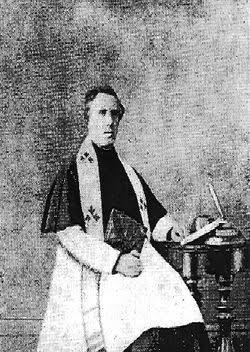
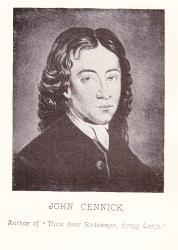
John Cennick (1718–1755) was a central figure in the 18th-century Evangelical Revival, serving as a vital link between the Wesleys, George Whitefield, and the Moravian Church. Born in Reading, Berkshire, Cennick spent his early youth as a land surveyor before experiencing a profound spiritual awakening. In 1739, he met John Wesley, who appointed him as a teacher for the colliers' children at Kingswood. However, the theological tensions of the era, specifically the debate over Calvinism versus Arminianism, led to a sharp parting of ways with Wesley in 1740. Cennick subsequently aligned himself with Whitefield’s "Calvinistic Methodists" before ultimately finding his spiritual home with the Moravians in 1745.
Cennick’s contribution to hymnody is immense, characterized by a fervent, personal, and often ecstatic devotion to Christ. He was a prolific writer, publishing several major collections including Sacred Hymns for the Children of God in the Days of their Pilgrimage (1741) and Hymns to the Honour of Jesus Christ (1754). While critics, including John Julian, noted that his work could be "most unequal" in quality, his best stanzas possess a rhythmic strength and emotional clarity that have secured them a permanent place in Christian worship.
Several of his hymns remain foundational to the English choral tradition:
-
"Children of the Heavenly King": Perhaps his most famous hymn, it encourages believers on their journey with a sense of joy and communal strength.
-
"Jesus, My All, to Heaven Is Gone": A deeply personal testimony of faith and the simplicity of following "the way" to God.
-
"Lo! He Cometh, Countless Trumpets": A powerful advent hymn that contributed significantly to the development of the more famous "Lo! He Comes with Clouds Descending."
-
The "Table Graces": Cennick is the author of the ubiquitous graces "Be present at our table, Lord" and "We thank Thee, Lord, for this our food," which have been spoken and sung in households for over two centuries.
Cennick's ministry eventually took him to Germany to study Moravian doctrine and extensively through the North of Ireland, where he was a highly effective and popular preacher. He was ordained a Moravian deacon in 1749 and spent his final years ministering in London. He died at the young age of 37 and was buried in the Moravian Cemetery in Chelsea, known as "God's Acre." His legacy is that of a man who traversed the various streams of the Great Awakening, leaving behind a body of work that emphasizes the "Pilgrim Life" and the overarching majesty of the Redeemer.
Dictionary of Hymnology
Ere I [we] sleep, for every favour Hymn
John Cennick’s evening hymn (1741), seven stanzas of four lines; widely reprinted from Whitefield and Madan onward, often abbreviated, and sometimes begun “Ere we sleep.”
ReadA good High Priest is come Hymn
John Cennick's hymn on the priesthood of Christ, first published in 1744 in nine six-line stanzas and later shortened by Whitefield and Rippon.
ReadCome, let us adore the Lord's gracious hand Hymn
John Cennick’s 1743 morning hymn was taken into Whitefield’s 1753 collection; the full form is rare today, but Americans sometimes use stanzas ii.–iv. as a separate piece.
ReadHymns by John Cennick
Includes hymns they wrote and hymns where they are credited as co-author, translator, paraphraser, or adapter.
| # | Title | Year | Views | |
|---|---|---|---|---|
| 1 | Be Present at Our Table, Lord | 1741 | 1523 | View |
| 2 | Brethren, Let Us Join to Bless | 1743 | 1458 | View |
| 3 | Children of the Heavenly King (The Pilgrim's Song) | 1743 | 1377 | View |
Recently added hymns
Suggestions or corrections: contact us.
Leave it in the forum for others to answer — hymn requests, lyrics help, writers, worship planning, and more.