Claudia Frances Hernaman
Biography
Claudia Frances Hernaman (née Ibotson) was a prolific 19th-century English hymnwriter, translator, and editor whose contributions left a lasting mark on Victorian hymnody, particularly within the Anglo-Catholic movement and the realm of children's religious education. Born on October 19, 1838, in Addlestone, Surrey, she was the daughter of the Reverend W. H. Ibotson, who served as Vicar of Edwinstowe in Nottinghamshire. Raised in a devout clerical household, she developed a deep familiarity with the liturgical calendar, classical theology, and sacred poetry from an early age. In September 1858, she married the Reverend J. W. D. Hernaman, one of Her Majesty’s Inspectors of Schools. Her husband’s profession and her own pastoral instincts fueled a lifelong commitment to improving religious pedagogy and devotional literature for young people across the United Kingdom.
Over the course of her literary career, Hernaman authored more than 150 original hymns and produced numerous translations of ancient and medieval Latin texts into English verse. Her writing was distinctly influenced by the Oxford Movement (Tractarianism), emphasizing the sacramental life of the church, liturgical discipline, rich symbolism, and careful alignment with the seasons of the Church Year. Recognizing a distinct lack of reverent yet accessible devotional materials for children, she devoted much of her creative energy to writing for Sunday schools and juvenile choristers. Her major published works and compilations include The Child’s Book of Praise: A Manual of Devotion in Simple Verse (1873, edited by Rev. James Skinner), The Story of the Resurrection (1879), Christmas Story (1881), Christmas Carols for Children (published in two series, 1884 and 1885), The Way of the Cross: A Metrical Litany (1885), Hymns for the Seven Words from the Cross (1885), and The Crown of Life: A Volume of Verses for the Seasons of the Church (1886).
In addition to her standalone collections, Hernaman was a primary contributor to many influential Victorian hymnals. She contributed 22 hymns to Hymns for the Children of the Church (1878), 10 hymns to Hymns for the Little Ones in Sunday Schools (1884), and numerous pieces to Mrs. Carey Brock’s Children’s Hymn Book (1881) and the Reverend M. Woodward’s Children’s Service Book (1883). Her editorial crowning achievement came in 1884 with The Altar Hymnal, a landmark High Church collection for which she served as principal editor. She enriched this volume with several of her own Latin translations, sacramental hymns for the Eucharist, and processional texts.
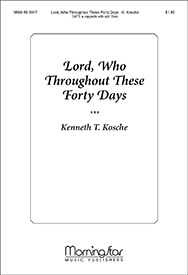
Hernaman’s most enduring legacy in world hymnody is her classic Lenten text, "Lord, Who Throughout These Forty Days," first published in The Child's Book of Praise (1873). The hymn draws a direct parallel between Jesus’ forty-day fast in the wilderness and the Christian’s observance of Lent, pleading for divine strength to overcome temptation, master the flesh, and ultimately share in Christ's Easter triumph. Paired frequently with the historic tune ST. FLAVIAN, it remains a cornerstone Lenten hymn across Anglican, Lutheran, Roman Catholic, Presbyterian, and Methodist traditions worldwide, featured in nearly one hundred major hymnals and translated into languages such as Spanish ("En tu cuaresma, ¡oh, Salvador!").
Her broader body of work encompasses a wide range of liturgical and thematic applications, including:
-
Advent & Incarnation: "Behold, behold He cometh," "Hosanna, they were crying," and the cheerful Christmas carols "Angels singing, Church bells ringing" and "Now to Bethlehem haste we."
-
Passiontide & Penitence: Her extensive devotional sequence "The Way of the Cross" and the deeply penitential "Lord, I have sinned, but pardon me."
-
Eucharist & Worship: High Church sacramental hymns such as "Hail to Thee, O Jesu," "This healthful Mystery," "Jesus, in loving worship," and "Gracious Father, we beseech Thee."
-
Pastoral & Children’s Devotions: The beloved Good Shepherd sequence (divided into "Faithful Shepherd of Thine own," "Faithful Shepherd, hear our cry," and "Shepherd, who Thy life didst give") and the widely used prayer "Holy Spirit, hear us, On this sacred day."
-
Special Services: "How can we serve Thee, Lord" (written specifically for church choristers) and "It is a day of gladness" (composed for the Girls' Friendly Society).
Claudia Frances Hernaman died on October 10, 1898, just days shy of her sixtieth birthday. Her ability to translate complex High Church sacramental theology into simple, elegant, and deeply memorable verse ensured her standing as one of the preeminent female hymn writers of the 19th-century Anglican Church.
Hymns by Claudia Frances Hernaman
Includes hymns they wrote and hymns where they are credited as co-author, translator, paraphraser, or adapter.
| # | Title | Year | Views | |
|---|---|---|---|---|
| 1 | Lord, Who Throughout These Forty Days | 1869 | 82 | View |
Recently added hymns
Suggestions or corrections: contact us.
Leave it in the forum for others to answer — hymn requests, lyrics help, writers, worship planning, and more.