The history of Latin hymnody is deeply intertwined with the development of Western Christianity. While a single, complete history spanning all eras is vast enough to fill multiple volumes, the evolution of this sacred art form can be traced through its foundational definitions, scriptural roots, and early structural shifts.
Ancient Definitions of a Hymn
To understand early Christian hymnody, scholars look to classical definitions that separated public liturgical song from private devotional poetry. St. Augustine, in his commentary on the 148th Psalm, established a strict threefold criterion that influenced the Western Church for centuries:
"Know ye what a hymn is? It is a song with praise of God. If thou praisest God and singest not, thou utterest no hymn. If thou singest and praisest not God, thou utterest no hymn. A hymn, then, containeth these three things: song (canticum), and praise (laudem), and that of God."
This view was echoed across early Christendom. St. Gregory of Nazianzus defined it concisely as modulata laus ("modulated praise"). Centuries later, an eleventh-century scribe writing on the flyleaf of an Anglo-Saxon Hymnary (Vespasian D. xii) summarized the historical consensus: David and the Old Testament prophets pioneered the form, which was later perfected in verse by Hilary of Poitiers and Ambrose of Milan. Under these definitions, prose anthems, purely didactic verses, and private historical poems were excluded from the category of true hymns, which required a metrical structure, an orientation toward divine praise, and the capacity to be sung corporately.
Scriptural Foundations and Eastern Influence
The Greek root hymnos ($\upsilon\mu\nu\text{o}\varsigma$) and its verb form appear frequently throughout the Septuagint translation of the Old Testament, particularly in the Psalms and Chronicles, to denote a song of praise to God. This usage passed directly into the New Testament accounts of the Last Supper, where Christ and his disciples "had hymned" ($\upsilon\mu\nu\eta\sigma\alpha\nu\tau\varepsilon\varsigma$) before departing for the Mount of Olives, a reference to the traditional Passover Hallel (Psalms 113–118).
St. Paul later explicitly distinguished the genre from other forms of sacred vocal expression in his epistles to the Ephesians and Colossians, urging the early church to speak in "psalms and hymns and spiritual songs." Early theologians like Hippolytus maintained this precise structural three-part division.
Historically, Christian metrical hymnody originated in the East before migrating westward. Pliny the Younger noted in the second century that Christians assembled before dawn to sing responsively to Christ as God. Early Greek writers like Caius and Eusebius documented the "cantica fratrum"—hymns written from the earliest days by the faithful to celebrate Christ as the Word of God.
Philo described the first-century ascetics in Egypt composing new hymns in various classical meters, utilizing alternating male and female choirs. This Eastern model of communal melody spread across the Mediterranean to Rome, North Africa, and Spain, carried by Greek-speaking Christian communities.
The Rise of the Earliest Latin Hymns
No verified, surviving hymn text composed originally in the Latin language predates the fourth century. Church historians identify Hilary of Poitiers (died 368) as the pioneer of Latin versified hymns, drawing inspiration from the Greek hymns he encountered during his exile in the East. Several early morning and seasonal texts preserved in the Mozarabic rite are traditionally attributed to him, alongside the trochaic piece "Hymnum dicat turba fratrum," which the Venerable Bede praised as exceptionally beautiful. Pope Damasus I (A.D. 366) also contributed early Latin verses, including an unrhymed, non-metrical piece dedicated to St. Agatha.
St. Ambrose and the Ambrosian School
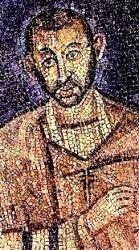
The true architectural foundation of western congregational song was established by St. Ambrose, Bishop of Milan (340–397). To comfort his flock during times of ecclesiastical conflict, Ambrose introduced the Eastern practice of alternate, antiphonal psalmody and congregational singing to the West. St. Augustine recorded the profound emotional impact of these compositions, noting that the singing kept the congregation from growing weary.
Ambrose and his immediate successors revolutionized hymnody by abandoning complex classical meters and strict prosody. Instead, they favored accentuation over vowel quantity, adapting the Iambic dimeter (stanzas of eight-syllable lines) as the structural standard best suited for corporate, untrained singing. This accessible form became the dominant model for Western office books, defining the hymnody of the early English, German, French, and Spanish churches until the dawn of the Reformation.
Early Ritual and Monastic Adaptation
The formal organization of these hymns into daily and seasonal cycles was accelerated by the rise of monasticism, particularly through the Rule of St. Benedict in the early sixth century. Benedict integrated the hymns of Ambrose and his imitators directly into the Canonical Hours.
Nineteenth-century manuscript discoveries such as the eleventh-century Benedictine office book from Worcester (Corpus Christi College MS. 391) explicitly label their hymn collections as Hymni Ambrosiani to be sung according to the rule of the monastic fathers. These organized cycles remained remarkably stable, forming the baseline of Western liturgical song through the medieval era.
Related Authors
Writers connected to this dictionary topic.
Keywords
Related terms for this dictionary entry.
Recent Dictionary Entries
Newly added terms from the Dictionary of Hymnology.
If you notice any mistake or have suggestions, please contact us on our contact page.