

Ave maris stella. Anon. [B. V. M.] This famous Latin hymn to the Blessed Virgin Mary is of uncertain authorship. Although it has been attributed by some tradition to St. Bernard of Clairvaux, this assignment is untenable because the text appears in a Saint Gall manuscript (No. 95) dating from the 9th century, centuries before St. Bernard lived. It was also ascribed to Venantius Fortunatus by M. A. Luchi in 1789, but on insufficient historical evidence. The text appears in Daniel, volume i, No. 171, accompanied by various manuscript readings. Mone recorded five distinct medieval paraphrases (Nos. 496 through 500), where each line of the original is followed by versified explanations and simplifications, testifying to its immense popularity.
The text was treated with such deep liturgical respect that it remained virtually unaltered during the Roman Breviary revision of 1632, and it was likewise retained in the revised French diocesan breviaries of Paris, Lyons, and Le Mans as one of the very few ancient hymns not supplanted by modern revisions. In liturgical usage, it is appointed for Vespers in the Little Office of the Blessed Virgin (Officium parvum beatae Mariae) across various French uses, as well as in the Saturday Office of the Blessed Virgin (Officium beatae Mariae in Sabbato) and on Marian feasts lacking proper hymns. In the Roman Breviary, it serves as the hymn for First and Second Vespers on Feasts of the Blessed Virgin Mary, as well as in the Saturday Office and at First Vespers in the Little Office.
Manuscript sources in the British Museum include three 11th-century codices (Harleian 2961, f. 241; Vespasian D. xii, f. 63; and Julius A. vi, f. 56), and it is printed from an 11th-century Durham manuscript in Latin Hymns of the Anglo-Saxon Church (1851, page 76). It is also included in collections by Bässler, Königsfeld, Simrock, and Wackernagel (vol. i, No. 85), along with numerous modern Roman Catholic collections.
Translations in Common Use:
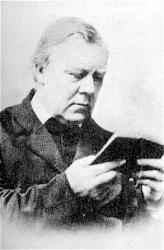
- Hail, thou Star of Ocean. By Edward Caswall, first published in his Lyra Catholica (1849, page 197) as "Gentle Star of Ocean," and in an altered 7-stanza form in Hymns & Poems (1873, page 105). Widely adopted in Roman Catholic hymnals in Great Britain and America, sometimes opening as "Hail, bright star of ocean."
- Hail, Sea Star, we bless thee. By J. R. Beste in his Church Hymns (1849), though not in extensive use.
- Hail, thou resplendent Star. Published anonymously in A Selection of Catholic Hymns (Glasgow, 1861, No. 41) and St. Patrick's Catholic Hymn Book (1862, No. 60), based directly on Caswall's translation.
Translations not in Common Use:
- Hail, Ocean Star. By Edward Caswall (1873).
- The Star which o'er the sea. By J. W. Hewett (1859).
- Hail! Star of Ocean, Mary. By J. D. Chambers (1866).
- Hail! Star of the sea, &c. A prose translation by Mrs. Elizabeth Charles (1858).
Related Hymns
Hymns in the library connected to this dictionary topic.
Related Hymn Sheets
3 shown at a time — use the arrows to browse all 4 sheets.
Related Authors
Writers connected to this dictionary topic.
Keywords
Related terms for this dictionary entry.
Recent Dictionary Entries
Newly added terms from the Dictionary of Hymnology.
If you notice any mistake or have suggestions, please contact us on our contact page.