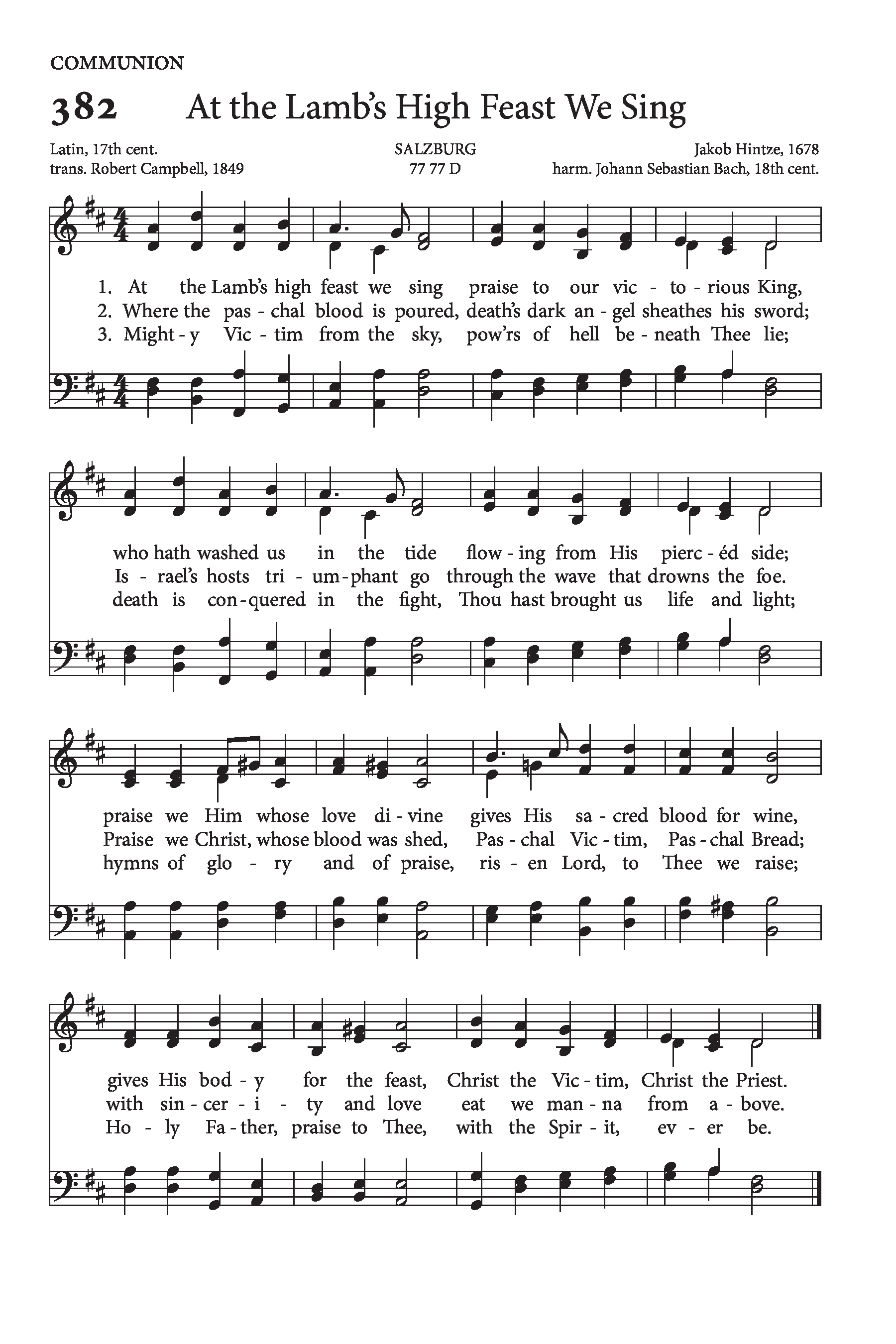




The Latin hymn "Ad regias Agni dapes" is the classicized recension of the ancient Ambrosian Easter Vesper hymn, Ad coenam Agni providi. This variant was prepared during the seventeenth-century liturgical revisions under Pope Urban VIII for integration into the revised Roman Breviary.
Within the post-Renaissance Roman rite, it was assigned as the proper hymn at Vespers on Sabbato in Albis (the Saturday of Easter Week, when the newly baptized laid aside their white robes). It maintained its place at Vespers on subsequent Sundays and week-days throughout the Easter season whenever the ferial office was said, concluding at the first Vespers of the Ascension. Outside of standard editions of the breviary, the text was featured in notable nineteenth-century scholarly collections, including Cardinal John Henry Newman's Hymni Ecclesiae (1838–1865) and Hermann Adalbert Daniel's Thesaurus Hymnologicus.
Translations in Common Use
The altered classical text inspired a large number of English translations, several of which achieved widespread denominational prominence:
The first version, "In garments dight of virgin white," was prepared by William John Copeland for his Hymns for the Week in 1848. While its original form saw very little use, it was thoroughly recast for Robert Murray's Hymnal (1852) as "Now at the Lamb's high royal feast," borrowing its modified opening line from Edward Caswall.
Edward Caswall published his own direct translation, "Now at the Lamb's high royal feast," in his Lyra Catholica (1849) and later reissued it in his Hymns and Poems (1873) in 7 stanzas of 4 lines. This text became the standard version adopted by modern Roman Catholic hymnals. An altered 4-stanza variant beginning "Guests at the banquet of the Lamb" was included in the Irvingite collection Hymns for the Use of the Churches in 1864.
The most widely circulated translation of all was written by Robert Campbell in 1849. It was first printed in his St. Andrew's Hymnal in 1850 as "At the Lamb's High Feast we sing," arranged in 4 stanzas of 8 lines. Campbell's original manuscript featured the first two lines repeated as a refrain after each verse, though this was omitted in print.
William Cooke and William Denton brought Campbell's text into prominent notice by including a heavily altered version in their 1853 Hymnal. This modified arrangement was subsequently adopted by the compilers of Hymns Ancient and Modern, Church Hymns, and Godfrey Thring's Collection, outstripping the usage of all other translations combined. Another variation of Campbell's text, "To the Lamb's High Feast we press," was edited by the Reverend Francis Pott for his 1861 collection.
John Alexander Johnston published an imitation of Campbell's double-common-meter style, titled "At the Lamb's right royal feast," in the second edition of his English Hymnal (1856). This piece replaced Johnston's own earlier long-meter translation, "Now at the banquet of the Lamb," which had appeared in the 1st edition in 1852.
Robert Charles Singleton contributed a version titled "The Banquet of the Lamb is laid" for his Anglican Hymn Book in 1868.
Alexander Ramsay Thompson contributed a translation opening with "We keep the Festival" to Philip Schaff’s international anthology Christ in Song in 1869.
Francis Trappes published an 8-stanza long-meter version, "Come, join the Kingly Banquet free," in his Liturgical Hymns (1865). Six stanzas of this text were later rearranged into double common meter for the Hymns and Carols of the Church Sisters' Home in 1871.
Historical and Supplemental Translations
A significant group of translations were published in historical manuals or independent literary collections without gaining admission into common church hymnals:
-
1686: "At the Lamb's regal banquet where" — Published anonymously in the Manual of Prayers and Litanies.
-
1706: "From purple seas and land of toil" — Printed in the Catholic Primer.
-
1837: "Now at the Lamb's imperial Feast" — Translated by Bishop Richard Mant in his Ancient Hymns.
-
1845: "Passed the Red and angry sea" — Rendered by Bishop Isaac Williams.
-
1849: "The Red Sea now is passed" — Published by John Richard Beste.
-
1851: "In garments bright of saintly white" — Included by Gilbert Rorison in his local collection.
-
1867: "Sing, for the dark Red Sea is past" — Contributed by Henry Nutcombe Oxenham.
-
1874: "Come to the Lamb's right royal feast" — Published by James Allanson Wallace.
Related Hymns
Hymns in the library connected to this dictionary topic.
Related Hymn Sheets
3 shown at a time — use the arrows to browse all 5 sheets.
Related Authors
Writers connected to this dictionary topic.
Keywords
Related terms for this dictionary entry.
Recent Dictionary Entries
Newly added terms from the Dictionary of Hymnology.
If you notice any mistake or have suggestions, please contact us on our contact page.