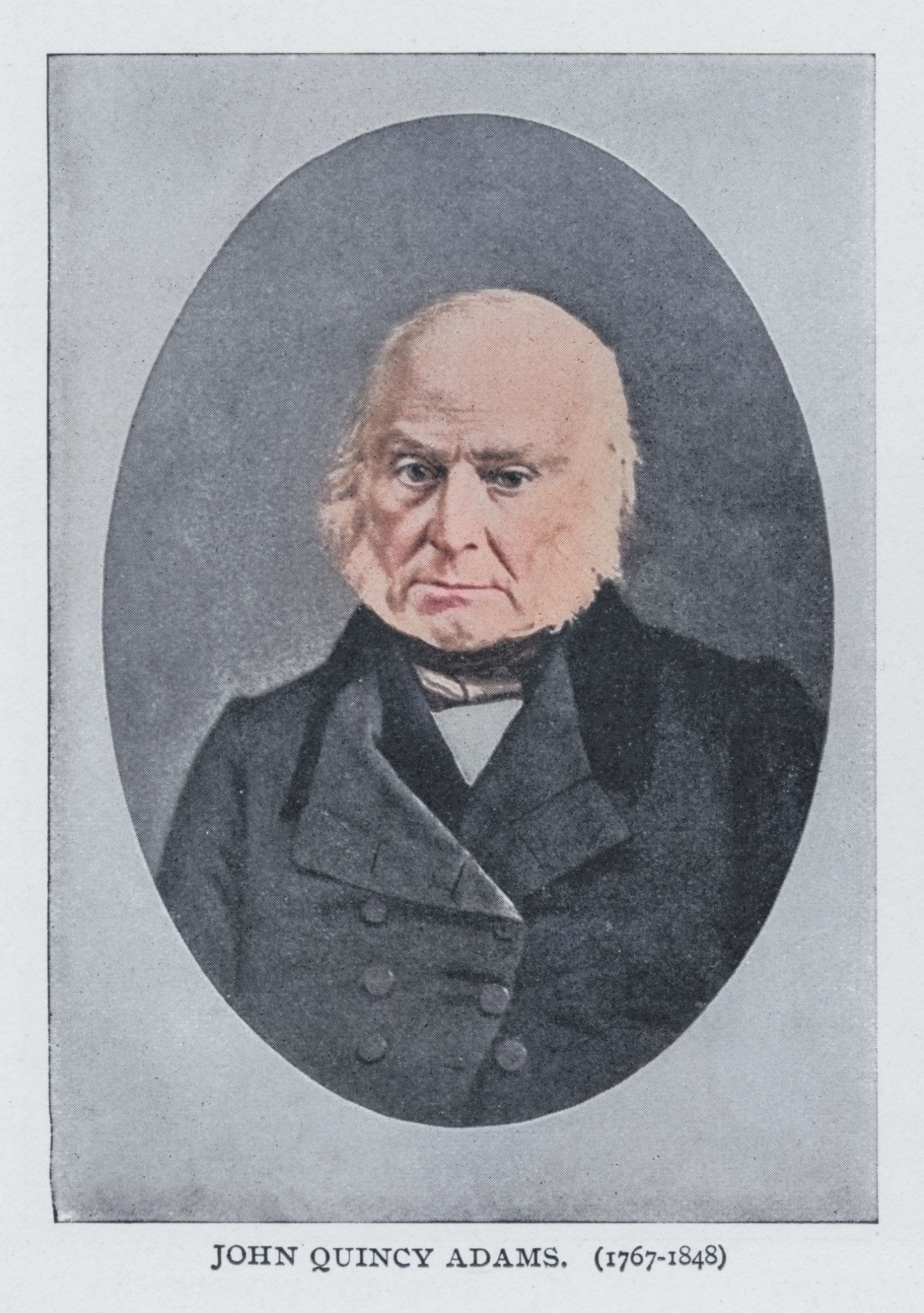
John Quincy Adams, sixth President of the United States and son of President John Adams, was born at Braintree, Massachusetts, in 1767. After graduating from Harvard College, he embarked on a distinguished diplomatic and political career, serving as minister to the Netherlands, England, and Prussia between 1794 and 1801, Professor of Rhetoric at Harvard in 1806, minister to Russia in 1809, Secretary of State in 1817, and President from 1824 to 1829. He later returned to public service in 1831 as a Member of the House of Representatives, serving until his sudden death on February 21, 1848. A lifelong member of the Unitarian body, his religious devotion found expression in extensive sacred poetry alongside his political achievements. His memoir by Josiah Quincy appeared shortly after his death, followed by his Poems of Religion and Society in 1848. Though he completed a full metrical version of the Psalms that remained unpublished in its entirety, his pastor, Dr. William Parsons Lunt, selected seventeen of his psalms and five hymns for inclusion in The Christian Psalmist in 1841. Among his most notable contributions to congregational hymnody is "Sure to the mansions of the blest," a burial piece derived from a twenty-stanza poem published in the Monthly Anthology and Boston Review in January 1807. His hymn "Alas! how swift the moments fly" was written for the bicentennial anniversary of the First Congregational Church of Quincy in 1839, while "Hark! 'tis the holy temple bell" served as a Sabbath hymn, both later gaining wider distribution through collections such as Lyra Sacra Americana and Alfred P. Putnam's Singers and Songs of the Liberal Faith.
Related Authors
Writers connected to this dictionary topic.
Keywords
Related terms for this dictionary entry.
Recent Dictionary Entries
Newly added terms from the Dictionary of Hymnology.
If you notice any mistake or have suggestions, please contact us on our contact page.