



10 Famous Hymns That Were Published Posthumo…
17 hours ago
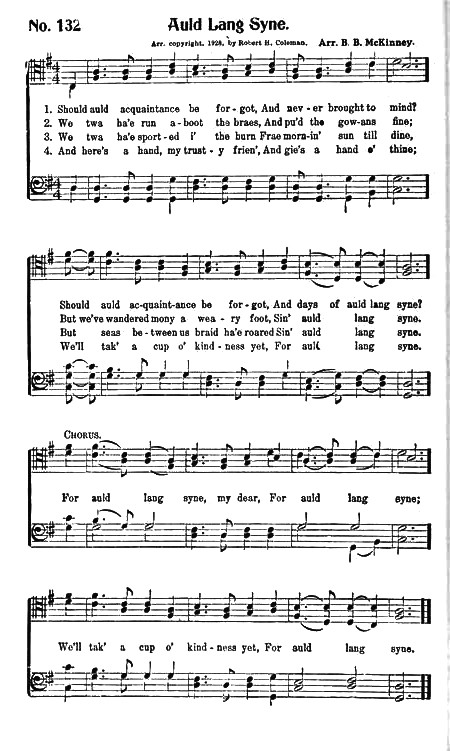
Auld Lang Syne
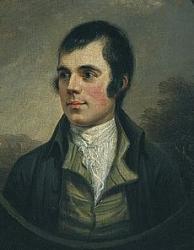
By Robert Burns (1788)
Lyrics
1. Should auld acquaintance be forgot,
And never bro't to mind?
Should auld acquaintance be forgot,
And days of auld lang syne?
And never bro't to mind?
Should auld acquaintance be forgot,
And days of auld lang syne?
Refrain:
For auld lang syne, my dear,
For auld lang syne;
We’ll tak' a cup o’ kindness yet
For auld lang syne.
For auld lang syne, my dear,
For auld lang syne;
We’ll tak' a cup o’ kindness yet
For auld lang syne.
2. We twa ha'e ran aboot the braes,
And pu’d the gowans fine,
We’ve wander’d mony a weary foot
Sin' auld lang syne. [Refrain]
And pu’d the gowans fine,
We’ve wander’d mony a weary foot
Sin' auld lang syne. [Refrain]
3. And here’s a hand, my trusty frien',
And gie's a hand o’ thine;
We’ll tak' a cup o' kindness yet,
for auld lang syne. [Refrain]
And gie's a hand o’ thine;
We’ll tak' a cup o' kindness yet,
for auld lang syne. [Refrain]
Bible Reference
Psalm 77:11, Deuteronomy 8:2
Lectionary & readings
Open today’s (or any date’s) assigned scriptures and find related hymns across church calendars. Useful when planning worship around this song’s themes or its Bible reference.
Hymn scripture: Psalm 77:11, Deuteronomy 8:2
About This Hymn
“Auld Lang Syne” is a celebrated Scottish song associated with the poet Robert Burns, who recorded a version of the traditional song in 1788. The title is a Scots expression commonly understood as “for old times’ sake” or “days gone by.” Although Burns is widely credited with the familiar text, he acknowledged that he had collected an old song that had previously circulated orally. The extent to which he adapted existing material remains uncertain, so the song is best understood as a traditional Scottish song preserved and shaped by Burns rather than an entirely original composition.
The song reflects on friendship, shared experiences, and the passage of time. Its opening question asks whether old friendships and memories should simply be forgotten. The verses recall walking through the countryside, gathering flowers, travelling together, and sharing experiences that remain meaningful even after many years apart. The familiar refrain expresses a desire to preserve goodwill and remember old companions with affection. Its emotional strength comes from its simple recognition that relationships and memories remain valuable despite distance, change, and the passing of time.
The song has become especially associated with New Year's Eve, when people gather to mark the end of one year and the beginning of another. It is also sung at farewells, reunions, memorial occasions, and other gatherings where people reflect on shared history. Its message is not limited to nostalgia. It encourages people to acknowledge the friendships and experiences that have shaped their lives and to approach old companions with renewed kindness. The song's enduring popularity across different countries reflects its ability to express common human feelings about remembrance, loyalty, separation, and fellowship.
The familiar melody is a traditional Scottish tune. Hymnary identifies the tune as AULD LANG SYNE and gives its meter as 8.6.8.6, while musical references also describe the complete song as Common Meter Doubled with a refrain. The melody's composer is unknown, and it should not be attributed to Robert Burns as a musical composition without specific evidence. The text and melody have circulated in different forms, and the version now commonly sung became firmly established through printed Scottish song collections.
Although “Auld Lang Syne” is not primarily a Christian hymn and has no established biblical reference, its themes of friendship, gratitude, and remembrance can be compatible with Christian fellowship. Congregations and church communities may use it at year-end gatherings, farewells, anniversaries, or community events. If included in a hymn library, it is best categorized as a traditional song while retaining its historical association with Robert Burns and Scottish musical culture.
Staff Visualizer
Open in MIDI StudioPowered by HTML MIDI PLAYER, MIDI FILE Made by Hymnal Library. · Study chords & lyrics in MIDI Studio
Want weekly hymns and devotionals?
⭐ Recommend This Hymn
Share this beautiful hymn with others
This hymn also appears in these hymnals
Click a spine to pull out the hymnal, then open it.
Hymns with the same subject
More hymns about Christmas, Fellowship
- Deck the Hall With Holly - Traditional Welsh Song
- In the Garden - C. Austin Miles
- Calypso Carol (See him lying on a bed of straw) - Michael Perry
- Mary, Did You Know? - Mark Lowry
- O Come, O Come, Emmanuel - J. M. Neale
- Jingle Bells - James Lord Pierpont
- Sweet Little Jesus Boy - Robert MacGimsey
- Carol of the Bells - Mykola Leontovych
More hymn subjects
Explore other themes across the library.
Hymns about Trials
Hymns about Good Friday
Hymns about Family
Hymns about Communion
Hymns about Peace
Hymns about Rest
Hymns about Assurance
Hymns about Justification
Browse all subjects →
Latest Updated Hymnals
-
Open
 400+ Christmas Carols Book: Sheet Music for PianoUpdated 7 seconds ago · 2014
-
Open
 The Temple HymnalUpdated 8 hours ago · 1918
-
Open
 The Popular HymnalUpdated 8 hours ago · 1918
-
Open
 The Highway HymnalUpdated 8 hours ago · 1886
-
Open
 Book of Common Praise (BoCP1915)Updated 8 hours ago · 1915
Hymn Information
Click a linked name to open their biography.
MIDI File
Popular Hymns
Recent Blog Posts


Popular Blog Posts
-
 Lessons from the Book of Haggai: Putting God…4 months, 3 weeks ago
-
 Easter vs Passover: How a Biblical Feast Bec…6 months, 3 weeks ago
-
 The Full Story of the Birth of Jesus Christ:…10 months, 2 weeks ago
-
 The 30 Most Famous Christmas Hymns and Carols1 year, 1 month ago
-
 The Story Behind the Hymn “Amazing Grace”10 months, 1 week ago
Visit Us on Social Media
Latest from X (Twitter)
Tweets by HymnalLibraryLatest from Facebook
Latest on YouTube
Loading latest video...
Daily Bible Verse
Disclaimer
The hymns, sheet music, MIDI files, and related content on this website are provided for educational and research purposes only.
- Public Domain: Many of the hymns featured here are in the public domain and may be freely used.
- Copyrighted Works: Some hymns may still be under copyright protection. Where applicable, permission has either been requested from the copyright owner, or the content is shared under the principles of fair use for educational purposes.
⚠️ Important Notice: If you wish to reproduce, distribute, or use any copyrighted hymn beyond personal study or educational use, you must obtain permission directly from the copyright holder. This website does not grant any rights for commercial use yet.
If there is any other question please address it to us in our Contact Page, for further assistance. Thank you for using the site. May God Bless You.
Recently Added · Dictionary of Hymnology
Browse dictionary →
Can’t find a hymn or lyric?
Leave your question in the forum for others to answer — requests, missing lines, writers, and worship ideas welcome.