


What Is Godliness?
1 week, 4 days ago
All Hail, Adored Trinity
Lyrics
1. All hail, adored Trinity!
All hail, eternal Unity!
O God the Father, God the Son,
And God the Spirit, ever One.
All hail, eternal Unity!
O God the Father, God the Son,
And God the Spirit, ever One.
2. Three persons praise we evermore,
One only God our hearts adore:
In thy sure mercy, ever kind,
May we your strong protection find.
One only God our hearts adore:
In thy sure mercy, ever kind,
May we your strong protection find.
3. O Trinity! O Unity!
Be present as we worship thee;
And with the songs that angels' sing
Unite the hymns of praise we bring.
Be present as we worship thee;
And with the songs that angels' sing
Unite the hymns of praise we bring.
Bible Reference
Matthew 28:19; 2 Corinthians 13:14; John 1:1-3; John 14:16-17; Ephesians 4:4-6; Revelation 4:8-11
About This Hymn
"All Hail, Adored Trinity" is a historic Christian hymn of praise to the Holy Trinity, translated into English by John David Chambers in 1857. Chambers did not write the original hymn. His text is a translation and adaptation of the ancient Latin hymn "Ave, Colenda Trinitas," meaning "Hail, O Adored Trinity," a hymn of unknown authorship dating from approximately the eleventh century. The Latin hymn is preserved in medieval manuscripts, including an eleventh-century Durham manuscript and a manuscript held by the British Museum. Chambers published his translation in Lauda Syon, Part I, in 1857, and it subsequently appeared in Hymns Ancient and Modern and numerous other hymnals.
The opening stanza immediately establishes the central theme: the worship and adoration of the one God who exists eternally as Father, Son, and Holy Spirit. "All hail, adored Trinity" is both a confession of faith and an invitation to worship. The following line, "All hail, eternal Unity," holds together the two great truths of Christian Trinitarian doctrine: God is one, yet within the unity of the Godhead there are three divine Persons. The hymn therefore provides a concise expression of the biblical doctrine revealed throughout Scripture and summarized in Christ's command to baptize believers "in the name of the Father, and of the Son, and of the Holy Ghost" (Matthew 28:19).
The second stanza emphasizes the distinction of the three divine Persons while maintaining their perfect unity. The Father, Son, and Holy Spirit are not three gods, but the one God whom the Church worships. The hymn then turns from theological confession to prayer, asking for God's protection and mercy. This is significant because the doctrine of the Trinity is not presented merely as an abstract theological formula. The triune God is the living God whom Christians praise, trust, and approach in worship. The Father gives grace, the Son redeems, and the Holy Spirit sanctifies and strengthens God's people.
The final stanza returns to direct worship: "O Trinity! O Unity! Be present as we worship thee." The congregation is pictured joining its praise with that of the angels. This imagery reflects the heavenly worship described in Revelation 4, where the living creatures continually proclaim God's holiness and glory. The hymn therefore connects earthly Christian worship with the eternal worship of heaven. When the Church gathers to praise the Father, Son, and Holy Spirit, it participates in a song of worship that reaches beyond time and joins the heavenly host.
The hymn is written in Long Metre (8.8.8.8) and has been paired with several tunes. One of the most familiar is OLD HUNDREDTH, the famous Genevan melody traditionally associated with Louis Bourgeois. Other settings include ILLSLEY, composed by John Bishop, and O LUX BEATA TRINITAS, a plainsong setting associated with the hymn.
"All Hail, Adored Trinity" is particularly appropriate for Trinity Sunday, although its subject makes it suitable for Christian worship throughout the year. Its strength lies in its simplicity and theological clarity. It calls the Church to adore the one eternal God, Father, Son, and Holy Spirit, and reminds believers that Christian worship ultimately has its foundation in the glory of the triune God.
From the Dictionary of Hymnology
Related terms and concepts automatically matched to this hymn.
All people that on earth do dwell Hymn
In-depth history, text variations, authorship, and tune origins of William Kethe's landmark sixteenth-century metrical paraphrase of Psalm 100, "All people that on earth do dwell."
Read moreA Patre Unigenitus (English Translations) History
The principal nineteenth-century English translations of the ancient Latin Epiphany hymn 'A Patre Unigenitus' found in common use.
Read moreAnni peractis mensibus Hymnology
An entry on an 11th-century medieval Whitsuntide Latin hymn.
Read more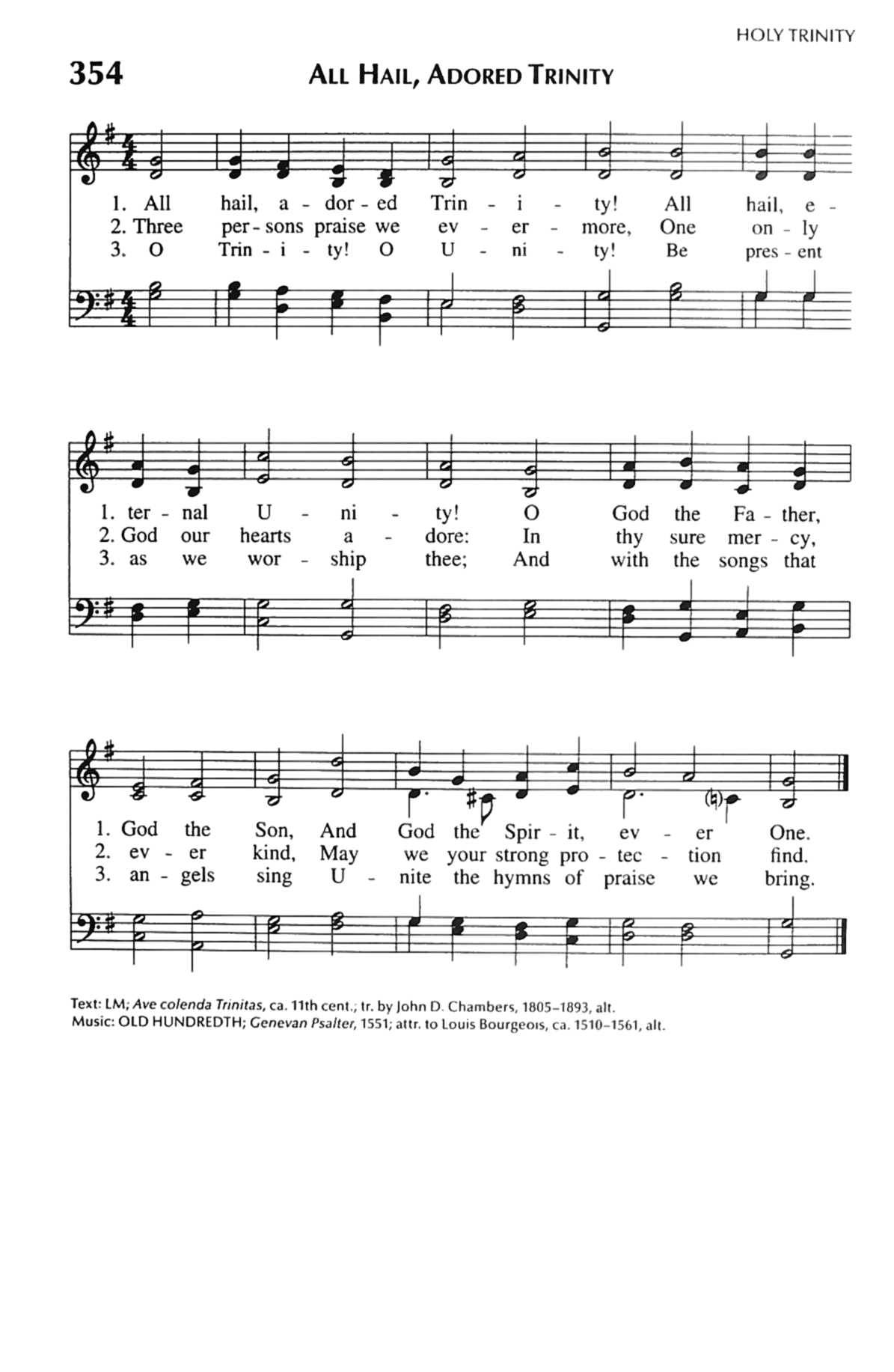

📬 Subscribe to Our Devotional Updates
Receive weekly hymns, devotionals, and website features directly in your inbox.
✅ Thank you! You'll start receiving our updates soon.
⭐ Recommend This Hymn
Share this beautiful hymn with others
This hymn is found in these hymnals
Open the hymnal that contains this hymn:
Hymns with the same subject
More hymns about Adoration, Glory of God, God the Father, Holiness of God, Holy Spirit, Jesus Christ, Majesty of God, Protection, The Holy Trinity, Worship
- How Great Thou Art — Carl Boberg
- Holy, Holy, Holy! Lord God Almighty! — Reginald Heber
- Hail! holy, holy, holy Lord! — Charles Wesley
- Come, Thou Almighty King — Anonymous
- Majesty, Worship His Majesty — Jack W. Hayford
- Be Thou Exalted — Fanny J. Crosby
- Light of Light, Enlighten Me — Benjamin Schmolck
- Blessed Be The Name Of The Lord — William H. Clark
More hymn subjects
Recently Added Hymns
-
 Let All Together Praise Our GodNikolaus Herman 1560
 -
 Holy, Holy, Holy, Lord, God of hosts, Eternal KingChristopher Wordsworth 1862
 -
 Hail, Redeemer, King DivinePatrick Brennan 1856
 -
 Father, We Thank Thee, Who Hast PlantedBland Tucker 1939
 -
 Father, See Thy Children Bending at Thy ThroneWilliam B. Trevelyan 1906
Latest Updated Hymnals
-
Open
 The People's HymnalUpdated 2 weeks, 2 days ago · 1961
 -
Open
 Book of Common Praise (BoCP1915)Updated 2 months, 3 weeks ago · 1915
 -
Open
 Our Great Redeemer's PraiseUpdated 4 months, 2 weeks ago · 2022
 -
Open
 The Parish Hymnal (1873)Updated 4 months, 3 weeks ago · 1873
 -
Open
 Book of Common Praise (BCP1998)Updated 5 months ago · 1998
Hymn Information
To view the author's biography, click their name above.
MIDI File
Ready to load
Download MIDI
Popular Hymns
Recent Blog Posts



Popular Blog Posts
-
 Lessons from the Book of Haggai: Putting God…4 months ago
 -
 Easter vs Passover: How a Biblical Feast Bec…6 months ago
 -
 The Full Story of the Birth of Jesus Christ:…9 months, 3 weeks ago
 -
 The 30 Most Famous Christmas Hymns and Carols1 year, 1 month ago
 -
 The Story Behind the Hymn “Amazing Grace”9 months, 2 weeks ago
Visit Us on Social Media
Latest from X (Twitter)
Tweets by HymnalLibraryLatest from Facebook
Latest on YouTube
Loading latest video...
Daily Bible Verse
Disclaimer
The hymns, sheet music, MIDI files, and related content on this website are provided for educational and research purposes only.
- Public Domain: Many of the hymns featured here are in the public domain and may be freely used.
- Copyrighted Works: Some hymns may still be under copyright protection. Where applicable, permission has either been requested from the copyright owner, or the content is shared under the principles of fair use for educational purposes.
⚠️ Important Notice: If you wish to reproduce, distribute, or use any copyrighted hymn beyond personal study or educational use, you must obtain permission directly from the copyright holder. This website does not grant any rights for commercial use yet.
If there is any other question please address it to us in our Contact Page, for further assistance. Thank you for using the site. May God Bless You.
Recently Added · Dictionary of Hymnology
Browse dictionary →- Jonathan Bush Atchinson 1 week, 6 days ago · Biography 107
- At Thy transfiguration, Lord 1 week, 6 days ago · Hymnology 107
- At Thy Feet, our God and Father 1 week, 6 days ago · Hymnology 100
- At Thy feet, O Christ, we lay 1 week, 6 days ago · Hymnology 91
- At Thy command, our dearest Lord 1 week, 6 days ago · Hymnology 108