
12 Ways to Deepen Your Relationship with God
1 week, 2 days ago
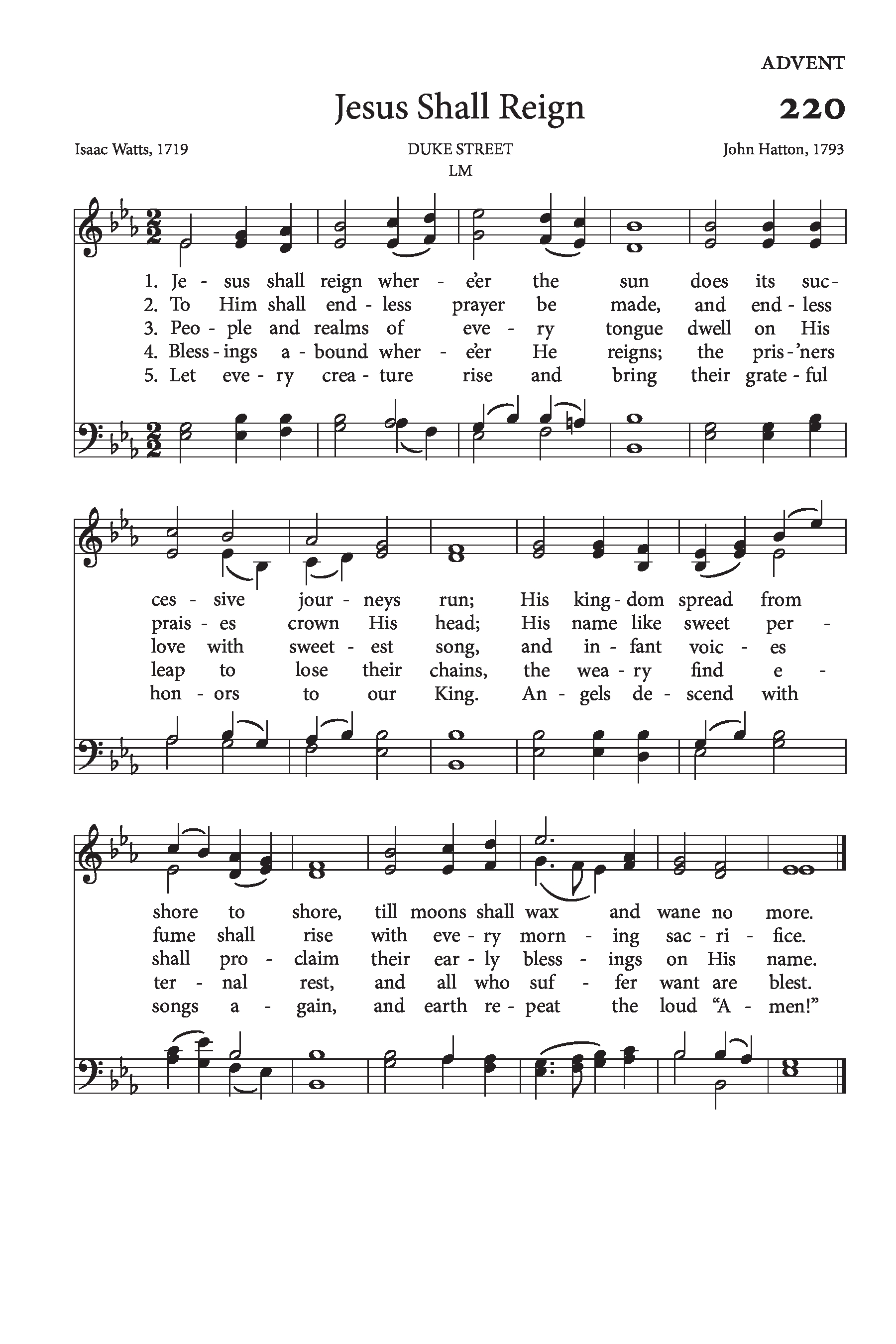
Jesus Shall Reign Where'er the Sun
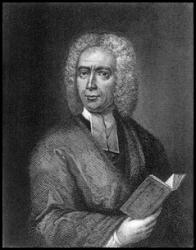
By Isaac Watts (1719)
Mark it for others looking for a hymn like this.
New
Lyrics
1. Jesus shall reign where'er the sun
does its successive journeys run,
his kingdom stretch from shore to shore,
till moons shall wax and wane no more.
2. To him shall endless prayer be made,
and praises throng to crown his head.
His name like sweet perfume shall rise
with every morning sacrifice.
3. People and realms of every tongue
dwell on his love with sweetest song,
and infant voices shall proclaim
their early blessings on his name.
4. Blessings abound where'er he reigns:
the prisoners leap to lose their chains,
the weary find eternal rest,
and all who suffer want are blest.
5. Let every creature rise and bring
the highest honors to our King,
angels descend with songs again,
and earth repeat the loud amen.
Bible Reference
Psalm 72
Lectionary & readings
Open today’s (or any date’s) assigned scriptures and find related hymns across church calendars. Useful when planning worship around this song’s themes or its Bible reference.
Hymn scripture: Psalm 72
About This Hymn
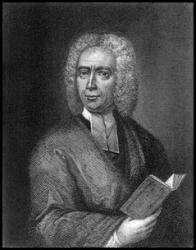
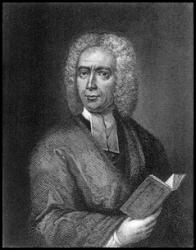
Author – Isaac Watts (1674–1748)
Composer – John Hatton (c. 1710–1793)
Tune Name – “Duke Street”
Meter – Long Meter (LM, 88.88)
Scripture Reference – Psalm 72
“The mighty God, even the Lord, hath spoken, and called the earth from the rising of the sun unto the going down thereof.” – Psalm 50:1 (KJV)
Among the earliest hymns with a clear missionary vision, Isaac Watts’s “Jesus Shall Reign Where’er the Sun” remains one of the most powerful and enduring declarations of Christ’s global lordship. Written in 1719, this hymn came well before the organized evangelical missionary movements of the late 18th century. At the time, most of the Christian world had not yet grasped the full weight of the Great Commission. It would be decades later, in 1792, that William Carey—often called the "father of modern missions"—would issue his famous call to action. Yet Watts, already known for his groundbreaking hymn paraphrases of the Psalms, infused Psalm 72 with such profound prophetic and missionary zeal that the hymn became a rallying cry for generations of believers. His rendering of the psalm anticipates the universal reign of Christ, portraying a world transformed under the justice and mercy of the Messiah.
Isaac Watts, often referred to as the father of English hymnody, produced over 600 hymns throughout his life. His contributions revolutionized congregational singing, shifting it from exclusive use of metrical psalms to rich theological hymns of personal faith and doctrinal depth. This particular hymn is based on Psalm 72, a royal psalm of Solomon, reimagined by Watts to speak of the messianic kingdom of Christ. Its verses reflect a time when the gospel would reach every nation, and “people and realms of every tongue” would proclaim the Savior’s name. Such a vision inspired countless missionaries who would later carry these words into the most remote corners of the earth. In one striking example from 1862, some 5,000 believers in the South Sea Islands sang this hymn together in celebration as their king formally replaced a pagan constitution with a Christian one—an extraordinary testimony to the hymn’s power to unify and inspire across cultures.
The musical setting most commonly associated with “Jesus Shall Reign” is the majestic and stately tune “Duke Street,” composed by John Hatton. Very little is known about Hatton beyond his residence on Duke Street in the town of St. Helens, England, from which the tune presumably gets its name. He is believed to have died tragically in a stagecoach accident shortly after composing the tune. “Duke Street” first appeared in Henry Boyd’s A Select Collection of Psalm and Hymn Tunes in 1793, initially intended for a metrical setting of Psalm 19 by Joseph Addison. However, the tune's dignified and uplifting character proved a perfect match for Watts’s triumphant missionary hymn, and the pairing has remained standard ever since. The four-square meter and confident melody make it easily singable, reinforcing the text’s global proclamation of Christ’s reign.
Alongside this hymn, Isaac Watts’s other well-loved works include “I Sing the Mighty Power of God,” “O God, Our Help in Ages Past,” “When I Survey the Wondrous Cross,” “Am I a Soldier of the Cross?” and “Joy to the World!”—many of which are still sung in worship today. These hymns exhibit Watts’s extraordinary ability to marry Scripture with poetic expression in a form that was accessible to congregations yet deeply theological. His paraphrases of the Psalms, in particular, brought new life to public worship and paved the way for the rich tradition of English-language hymnody that followed. “Jesus Shall Reign,” though written over 300 years ago, continues to capture the hearts of Christians worldwide with its vision of Christ’s eternal and universal kingship—a vision that still fuels missionary passion and worship across the globe.
From the Dictionary of Hymnology
Related terms and concepts automatically matched to this hymn.
Come, we that love the Lord Hymn
Isaac Watts’s “Heavenly Joy on Earth” (1707/1709), ten stanzas. Wesley’s Charlestown form (1736–7) and Cotterill’s “Come ye who love the Lord” (1819) head the many altered texts in later books.
Read moreCome, let us join our cheerful songs Hymn
One of Watts’s best-known hymns (1707/1709) on Revelation 5 usually appears in four stanzas omitting “Let all that dwell above the sky”; Bingham supplies a Latin version.
Read moreAll ye that [who] love the Lord, rejoice Hymn
Isaac Watts’s paraphrase of Psalm cxlix., from his Psalms of David, 1719, titled “Praise God, all His saints; or, The Saints judging the World.” Most collections omit its final stanzas.
Read moreStaff Visualizer
Open in MIDI StudioPowered by HTML MIDI PLAYER, MIDI FILE Made by Hymnal Library. · Study chords & lyrics in MIDI Studio
Want weekly hymns and devotionals?
This hymn also appears in these hymnals
Click a spine to pull out the hymnal, then open it.
Hymns with the same subject
More hymns about Atonement, Children, Kingship of Christ, Pilgrimage
- Because He Lives - Bill & Gloria Gaither
- Onward Christian Soldiers - S. Baring-Gould
- O Holy Night - Placide Cappeau
- A Child of the King - Harriet E. Buell
- We Three Kings of Orient Are - John H. Hopkins
- Bread of Heaven, On Thee We Feed - Josiah Conder
- Safely Through Another Week - John Newton
- Take Up Thy Cross - A. H. Ackley
More hymn subjects
Recently Added Hymns
-
 Holy Father, We Adore TheeE. F. Stewart circa. 1870s
-
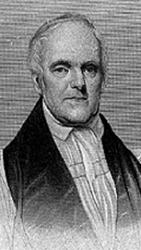 Holy Father, Great CreatorAlexander Viets Griswold 1837
-
Holy Father, cheer our way (Light at Evening Time)Richard H. Robinson 1869
-
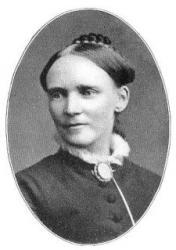 I Could Not Do Without Thee, O Savior of the LostFrances R. Havergal 1873
-
I Bow My Forehead to the DustJohn Greenleaf Whittier 1865
Latest Updated Hymnals
-
Open
 Book of Common Praise (BoCP1915)Updated 1 week, 3 days ago · 1915
-
Open
 400+ Christmas Carols Book: Sheet Music for PianoUpdated 2 weeks, 1 day ago · 2014
-
Open
 Psalms of GraceUpdated 2 weeks, 3 days ago · 2022
-
Open
 Spurgeon's Own Hymn BookUpdated 2 weeks, 3 days ago · 1866
-
Open
 The New Apostolic Church HymnalUpdated 1 month, 1 week ago · 2008
Hymn Information
Click a linked name to open their biography.
MIDI File
Popular Hymns
Recent Blog Posts



Popular Blog Posts
-
 Lessons from the Book of Haggai: Putting God…6 months ago
-
 Easter vs Passover: How a Biblical Feast Bec…8 months ago
-
 The Full Story of the Birth of Jesus Christ:…11 months, 3 weeks ago
-
 The 30 Most Famous Christmas Hymns and Carols1 year, 3 months ago
-
 The Story Behind the Hymn “Amazing Grace”11 months, 2 weeks ago
Visit Us on Social Media
Latest from X (Twitter)
Tweets by HymnalLibraryLatest from Facebook
Latest on YouTube
Loading latest video...
Daily Bible Verse
Disclaimer
The hymns, sheet music, MIDI files, and related content on this website are provided for educational and research purposes only.
- Public Domain: Many of the hymns featured here are in the public domain and may be freely used.
- Copyrighted Works: Some hymns may still be under copyright protection. Where applicable, permission has either been requested from the copyright owner, or the content is shared under the principles of fair use for educational purposes.
⚠️ Important Notice: If you wish to reproduce, distribute, or use any copyrighted hymn beyond personal study or educational use, you must obtain permission directly from the copyright holder. This website does not grant any rights for commercial use yet.
If there is any other question please address it to us in our Contact Page, for further assistance. Thank you for using the site. May God Bless You.
Recently Added · Dictionary of Hymnology
Browse dictionary →- Index of Authors and Translators (H–Z) 6 days, 7 hours ago · History 1
- Index of First Lines (We–Z) / Index of Authors (A–Hincks) 6 days, 7 hours ago · History 2
- Work while it is to-day / Yet there is room / Yonge, Charlotte M. / Zyma vetus 6 days, 7 hours ago · Hymn 1
- Wordsworth, Elizabeth 6 days, 7 hours ago · Biography 0
- Wilton, Richard / Winks, William Edward / Wiseman, Card. Nicholas / Woodward, G. R. / Wordsworth, Bp. C. 6 days, 7 hours ago · Biography 1
Can’t find a hymn or lyric?
Leave your question in the forum for others to answer — requests, missing lines, writers, and worship ideas welcome.