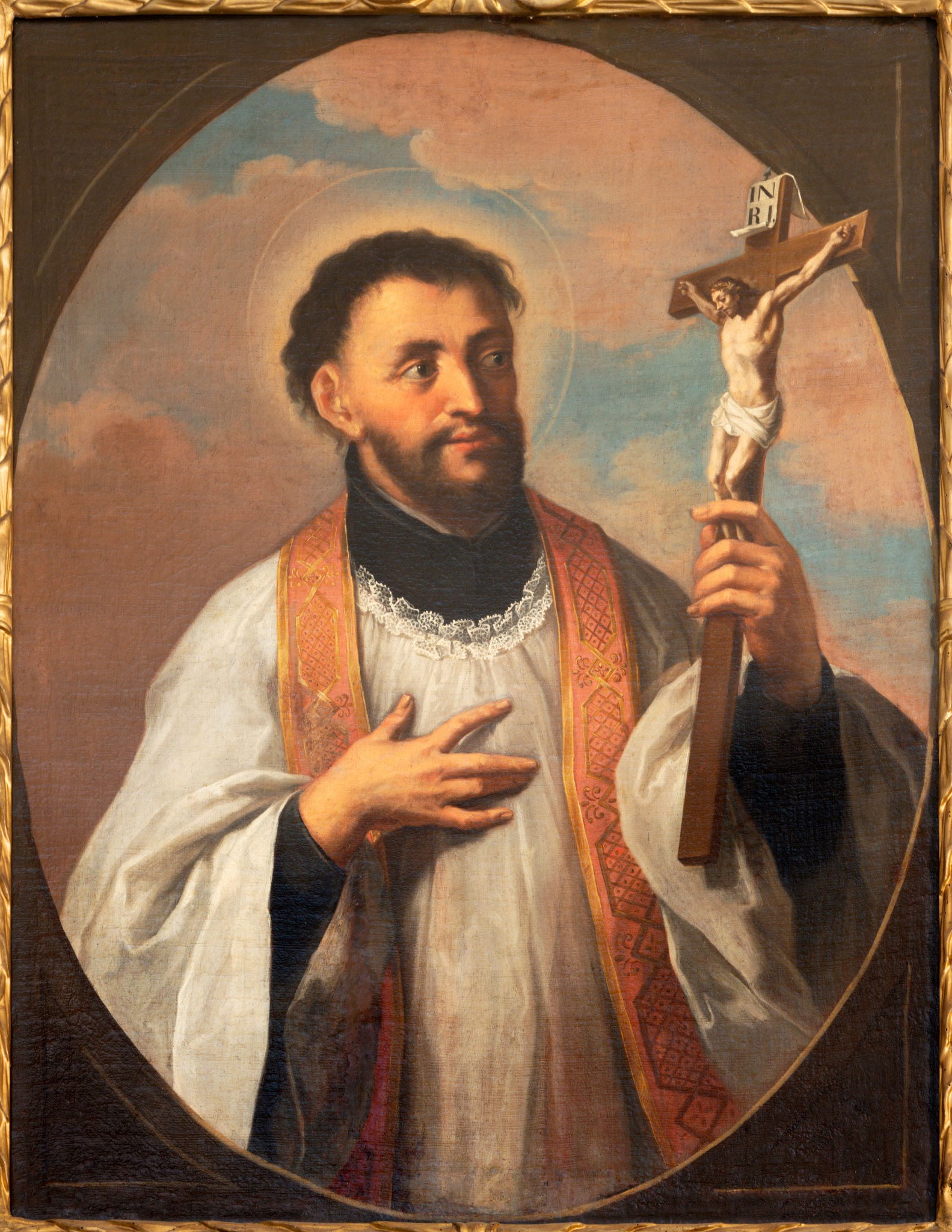

Saint Francis Xavier, the celebrated Roman Catholic missionary, was born at Xavier Castle near Pamplona, Spain, on April 7, 1506, as the son of Don John Giasso and Donna Maria d'Azpilcueta y Xavier. Known to history by his mother's surname, he entered the University of Paris at eighteen, where he graduated and subsequently taught. During his time at the university, he met Ignatius Loyola and became one of the original converts in the foundational circle of the Society of Jesus, which was officially formed at Montmartre near Paris on August 15, 1534. He joined Loyola in Venice in 1537 to serve at a hospital for incurables, subsequently traveling to Rome where King John III of Portugal requested Jesuit members for missionary work in the East Indies. Departing Rome in March 1540, Xavier set sail on April 7, 1541, and arrived in Goa on May 6, 1542. From his base in Portuguese India until his death on Shangchuan Island near Canton on December 22, 1552, he carried out extensive missionary journeys across Travancore, Ceylon, Malacca, and Japan. Though numerous accounts assign miraculous deeds to his life, his historical legacy remains closely linked to his pioneering evangelical work in Asia. In hymnology, two Latin hymns are traditionally associated with his name: O Deus ego amo Te, Nam prior Tu amasti me and O Deus ego amo Te, Nec amo Te ut salves me. While modern scholarship finds no evidence supporting his authorship of the former, the latter strongly reflects his characteristic self-abnegation and spiritual devotion.
Related Hymns
Hymns in the library connected to this dictionary topic.
Related Hymn Sheets
3 shown at a time — use the arrows to browse all 1 sheet.
Related Authors
Writers connected to this dictionary topic.
Keywords
Related terms for this dictionary entry.
Recent Dictionary Entries
Newly added terms from the Dictionary of Hymnology.
If you notice any mistake or have suggestions, please contact us on our contact page.