



What Do People Often Miss in the Parable of …
5 hours ago
The Spacious Firmament on High
By Joseph Addison (1712)
Mark it for others looking for a hymn like this.
New
Lyrics
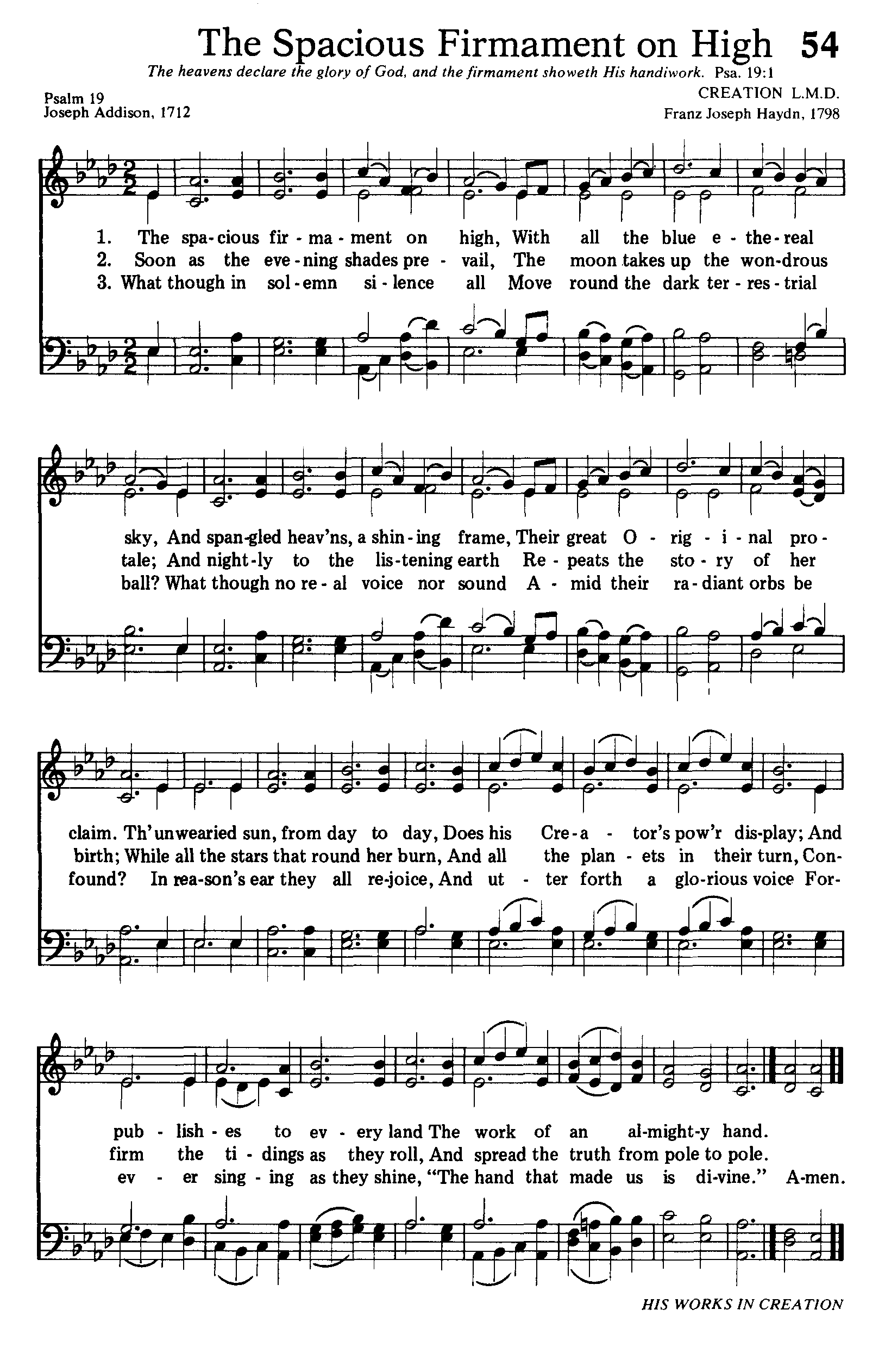
1. The spacious firmament on high,
with all the blue ethereal sky,
and spangled heavens, a shining frame,
their great Original proclaim.
The unwearied sun from day to day
does his Creator's power display,
and publishes to every land
the work of an almighty hand.
with all the blue ethereal sky,
and spangled heavens, a shining frame,
their great Original proclaim.
The unwearied sun from day to day
does his Creator's power display,
and publishes to every land
the work of an almighty hand.
2. Soon as the evening shades prevail
the moon takes up the wondrous tale,
and nightly to the listening earth
repeats the story of her birth;
whilst all the stars that round her burn,
and all the planets in their turn,
confirm the tidings, as they roll,
and spread the truth from pole to pole.
the moon takes up the wondrous tale,
and nightly to the listening earth
repeats the story of her birth;
whilst all the stars that round her burn,
and all the planets in their turn,
confirm the tidings, as they roll,
and spread the truth from pole to pole.
3. What though in solemn silence all
move round the dark terrestrial ball;
what though nor real voice nor sound
amid their radiant orbs be found;
in reason's ear they all rejoice,
and utter forth a glorious voice,
for ever singing as they shine,
'The hand that made us is divine.'
move round the dark terrestrial ball;
what though nor real voice nor sound
amid their radiant orbs be found;
in reason's ear they all rejoice,
and utter forth a glorious voice,
for ever singing as they shine,
'The hand that made us is divine.'
Bible Reference
Psalm 19:1
Lectionary & readings
Open today’s (or any date’s) assigned scriptures and find related hymns across church calendars. Useful when planning worship around this song’s themes or its Bible reference.
Hymn scripture: Psalm 19:1
About This Hymn
“The Spacious Firmament on High” is a majestic hymn penned by Joseph Addison, an English essayist and statesman, in 1712. The hymn is a poetic meditation on the natural revelation of God’s glory as seen in the skies, sun, moon, and stars. Inspired by Psalm 19, the hymn emphasizes how creation silently proclaims the majesty and order of its Creator, even though it uses no words or speech. Addison’s eloquent style and philosophical tone make this hymn both a song of worship and a thoughtful reflection on divine wisdom as expressed through the heavens.
The first stanza begins with a sweeping view of the sky, described as the “spacious firmament,” and draws attention to the celestial bodies—sun, moon, and stars—that move with remarkable harmony. The orderly motion of the planets and the regular rising and setting of the sun are not random but are seen as the handwork of a wise and powerful God. Addison marvels that although these heavenly bodies are silent, without voice or sound, they nevertheless proclaim the greatness of their Maker to all who observe them. This echoes the psalmist’s awe in Psalm 19, where the heavens declare God’s glory without speaking a word.
In the second stanza, the hymn focuses specifically on the sun as it rises “in royal state” and travels across the sky, shedding light and warmth on all creation. Its path is fixed and faithful, a daily testimony to divine consistency. The imagery here draws on ancient understanding of the cosmos but conveys a timeless truth: that the created world operates according to divine design. The sun’s daily circuit becomes a metaphor for God’s sustaining providence, offering light, order, and life to the earth below.
The final stanza brings together all the heavenly bodies as a grand chorus of praise. Though they do not speak, their very presence is a “loud proclaim” of their Creator’s power and wisdom. Addison suggests that nature itself is a kind of scripture, a universal revelation that speaks to all people in all lands. The stars and planets, with their silent order and beauty, testify to a divine Author who governs all things. In a world often filled with noise and distraction, the quiet witness of the heavens calls humanity to look upward and consider the greatness of God.
“The Spacious Firmament on High” is often paired with the tune “Creation” by Franz Joseph Haydn, adapted from his oratorio The Creation. Together, the words and music lift the heart and mind toward the glory of God revealed in the natural world. This hymn stands as a classic example of sacred poetry in English hymnody, blending theological depth with literary elegance, and encouraging all who sing it to join creation in praising the Lord.
From the Dictionary of Hymnology
Related terms and concepts automatically matched to this hymn.
Addison, Joseph Biography
Joseph Addison (1672-1719), essayist, statesman and author of Cato, contributed six hymns to The Spectator in 1712, including "The spacious firmament on high." His authorship was challenged on behalf of Marvell and Richmond, without success.
Read moreAddison, Lancelot Biography
Lancelot Addison, D.D. (1632-1703), father of Joseph Addison, was Dean of Lichfield and published Devotional Poems in 1699.
Read moreAlexander, Joseph Addison Biography
Joseph Addison Alexander (1809–1860), Presbyterian minister and Princeton professor, was a great Hebraist and commentator. Parts of his poem “The Doomed Man” appear as hymns in a few American Calvinistic collections.
Read moreStaff Visualizer
Open in MIDI StudioPowered by HTML MIDI PLAYER, MIDI FILE Made by Hymnal Library. · Study chords & lyrics in MIDI Studio
Want weekly hymns and devotionals?
This hymn also appears in these hymnals
Click a spine to pull out the hymnal, then open it.
Hymns with the same subject
More hymns about Creation, Glory of God, Joy
- O Day of Rest and Gladness - Christopher Wordsworth
- Awakening Chorus - Chas. H. Gabriel
- Praise the Lord, Ye Heavens Adore Him - Richard Mant
- O Brother, Be Faithful - Uriah Smith
- New Songs of Celebration Render - Erik Routley
- Bow Down Your Ear, O Lord, Hear Me - Anonymous
- Let the Whole Creation Cry - Stopford A. Brooke
- Here I Am to Worship - Tim Hughes
More hymn subjects
Explore other themes across the library.
Hymns about Redeemer
Hymns about Gratitude
Hymns about Battle
Hymns about Conversion
Hymns about Love of God
Hymns about Morning
Hymns about New Year
Hymns about Eternal Life
Browse all subjects →
Latest Updated Hymnals
-
Open
 Book of Common Praise (BoCP1915)Updated 3 days, 6 hours ago · 1915
-
Open
 400+ Christmas Carols Book: Sheet Music for PianoUpdated 3 days, 6 hours ago · 2014
-
Open
 Psalms of GraceUpdated 4 days, 14 hours ago · 2022
-
Open
 Spurgeon's Own Hymn BookUpdated 4 days, 16 hours ago · 1866
-
Open
 The New Apostolic Church HymnalUpdated 3 weeks, 5 days ago · 2008
Hymn Information
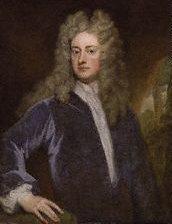
Click a linked name to open their biography.
MIDI File
More Hymns by Joseph Addison
Hymns from 1712
Popular Hymns
Recent Blog Posts


Popular Blog Posts
-
 Lessons from the Book of Haggai: Putting God…5 months, 3 weeks ago
-
 Easter vs Passover: How a Biblical Feast Bec…7 months, 2 weeks ago
-
 The Full Story of the Birth of Jesus Christ:…11 months, 1 week ago
-
 The 30 Most Famous Christmas Hymns and Carols1 year, 2 months ago
-
 The Story Behind the Hymn “Amazing Grace”11 months, 1 week ago
Visit Us on Social Media
Latest from X (Twitter)
Tweets by HymnalLibraryLatest from Facebook
Latest on YouTube
Loading latest video...
Daily Bible Verse
Disclaimer
The hymns, sheet music, MIDI files, and related content on this website are provided for educational and research purposes only.
- Public Domain: Many of the hymns featured here are in the public domain and may be freely used.
- Copyrighted Works: Some hymns may still be under copyright protection. Where applicable, permission has either been requested from the copyright owner, or the content is shared under the principles of fair use for educational purposes.
⚠️ Important Notice: If you wish to reproduce, distribute, or use any copyrighted hymn beyond personal study or educational use, you must obtain permission directly from the copyright holder. This website does not grant any rights for commercial use yet.
If there is any other question please address it to us in our Contact Page, for further assistance. Thank you for using the site. May God Bless You.
Can’t find a hymn or lyric?
Leave your question in the forum for others to answer — requests, missing lines, writers, and worship ideas welcome.