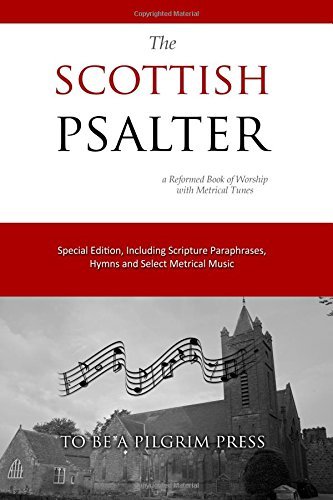
Following the Reformation in Scotland, the sharp revulsion from the Roman Church and its traditional Latin liturgies led immediately to the establishment of divine services in the vernacular. Following the pattern set by Reformed churches on the Continent, the Scottish reformers turned to the Hebrew Psalter for their praise. For popular use and to align closely with the original scriptural structures, they chose metrical paraphrases of the Psalms rather than prose chanting.
Metrical psalmody remained the only form of vocal praise in Scottish congregations until at least 1749. In the three principal branches of Scottish Presbyterianism, the introduction of human-composed hymns—distinct from the official scriptural paraphrases—did not become general until the latter half of the nineteenth century. The United Presbyterian Church adopted them after 1852, followed by the Established Church after 1870, and the Free Church after 1873. Consequently, the exclusive use of the Hebrew Psalter exerted a profound, foundational influence upon the Scottish mind and character for centuries.
The evolution of metrical psalmody and hymnody in Scotland progressed through six distinct historical stages.
I. The Preparatory Stage (1533–1562)
The early development of congregational singing in Scotland drew its primary examples and materials from the work of French and English reformers.
1. The French Influence
Clement Marot began translating the Psalms into French verse about 1533, printing his first thirty versions in Paris in 1542. John Calvin integrated twelve of Marot's early versions into his Strassburg collection of 1539, Aulcuns Pseaumes et Cantiques, utilizing texts altered by Pierre Alexandre. Marot subsequently fled to Geneva, where he revised his work and added nineteen new versions to produce the Cinquante Psaumes of 1543. Following Marot's death, Theodore de Beza continued the task at Calvin's request, culminating in the complete French Genevan Psalter of 1562. The French movement influenced Scottish psalmody through the weight of its example, the adoption of French tunes, and the composition of versions using French metrical structures.
2. The Anglo-Genevan Development
In England, Thomas Sternhold issued nineteen metrical psalms in an undated edition around 1547. This was expanded to thirty-seven versions in 1549, and reached forty-four versions in 1551 with the assistance of John Hopkins. English exiles carried these texts to Geneva during the Marian persecutions, where they were published alongside seven versions by William Whittingham in the 1556 volume One and Fiftie Psalmes of Dauid. Subsequent Anglo-Genevan editions in 1560 and 1561 integrated additional translations by Whittingham, John Pullain, and William Kethe. The 1561 edition, Foure Score and Seuen Psalmes of Dauid, served as the foundational basis for the first official Scottish Psalter.
3. The Dundee Psalms
The earliest psalm versions produced within Scotland appeared in the collection commonly known as the Dundie Psalmes or The Gude and Godlie Ballates. Titled Ane Copendious buik of godlie Psalmes and spirituall Sangis in its earliest perfect extant edition of 1578, evidence suggests it circulated in a rudimentary form before 1546. Attributed largely to the brothers John and Robert Wedderburn, the 1578 edition is divided into four parts:
-
The Catechisme: Formulations of the Ten Commandments, Creed, and Lord's Prayer.
-
Spirituall Sangis: Sixteen spiritual songs heavily drawn from German sources.
-
Ballatis of the Scripture: Twenty scriptural ballads.
-
Psalmes of Dauid: Twenty-two metrical psalms alongside other spiritual verses, translated primarily out of Latin and German sources, mixed with secular ballads adapted for sacred purposes.
II. The Psalter of 1564–65
To establish a uniform system of praise, the General Assembly of 1561 ordered the completion of an official Scottish Psalter. Rather than following the English Psalter of 1562, the appointed committee adopted all eighty-seven versions from the Anglo-Genevan Psalter of 1561, including translations by Sternhold, Hopkins, Whittingham, Pullain, and Kethe. To fill the remaining vacancies, they added fifteen original versions by John Craig, six by Robert Pont, and forty-two selections from the English Psalter of 1562.
The complete work was published at Edinburgh by Robert Lekprevik in 1564 under the title The Forme of Prayers and Ministration of the Sacraments.... On December 26, 1564, the General Assembly ordained that every minister, reader, and exhorter in Scotland secure and use a copy. The collection included unique contributions from Scottish authors:
-
John Craig: Contributed fifteen versions, including Psalms 24, 56, 75, 102, 105, 108, 110, 117, 118, 132, 136, 140, 141, 143, and 145.
-
Robert Pont: Contributed six versions, including Psalms 57, 59, 76, 80, 81, and 83.
Musical settings were an integral component of the volume. In 1635, Andro Hart published a landmark edition providing the proper tunes harmonized in four parts. An attempt was made by Charles I and the Scottish Privy Council in 1634 to suppress this volume in favor of a new translation begun by King James I and completed by William Alexander, Earl of Stirling. However, the forced introduction of this replacement alongside Laud's Service Book in 1637 provoked a national uprising, effectively ending the monopoly and securing the status of the older Psalter until the mid-seventeenth century.
III. The Psalter of 1650
The drive for uniformity of worship between the parliaments of England and Scotland during the Westminster Assembly of 1643 led to the development of a new, shared Psalter. While the English Parliament favored the metrical version of Francis Rous, the General Assembly of the Church of Scotland deemed the Westminster revision unsatisfactory for public use.
In 1647, the Assembly appointed John Adamson, Thomas Craufurd, John Row, and John Nevey to thoroughly revise the text. The committee was explicitly instructed to utilize the alternative metrical versions of Zachary Boyd and Sir William Mure of Rowallan, alongside the older 1564–65 Psalter. After extensive review by regional presbyteries, the final text was authorized for public use:
The Authorization of 1650
The Psalms of David in Meeter. Newly translated and diligently compared with the Original Text and former Translations... Allowed by the Authority of the General Assembly of the Kirk of Scotland, and appointed to be sung in Congregations and Families. (Edinburgh: Printed by Evan Tyler, 1650).
This 1650 version became the exclusive vehicle for vocal praise across Presbyterian Scotland, surviving all subsequent proposals for modernization. Concurrently, Gaelic-speaking congregations received specialized translations. The first complete Gaelic Psalter was published by Robert Kirk in 1684, followed by the Synod of Argyle's version in 1694. Subsequent revisions by Alexander Macfarlane (1753) and John Smith (1787) culminated in a uniform, authorized Gaelic Psalter published by the General Assembly in 1826.
IV. Scripture Songs (1564–1708)
While the 1564–65 Psalter contained a small number of spiritual songs in its late reprints, these pieces lacked formal ecclesiastical status. In 1647 and 1648, the General Assembly requested Zachary Boyd to translate additional scriptural songs into meter, but the political disruptions of the era halted the project.
The issue resurfaced in 1696 when the Assembly directed its commission to revise the spiritual songs composed by Patrick Simson. Although regional committees in Edinburgh and Glasgow recommended a select list of strictly scriptural songs drawn from Simson's printings and manuscripts, the initiative faltered. The General Assembly of 1708 authorized the publication of these revised songs to clear out the remaining stock held by the author's estate, but no general distribution occurred, and the project was quietly abandoned.
V. The Translations and Paraphrases (1741–1781)
Following an overture in 1741, the General Assembly appointed a dedicated committee to compile metrical translations of select scriptural passages. The resulting draft, Translations and Paraphrases of several Passages of Sacred Scripture, was printed in 1745. Due to the disruptions caused by the Jacobite rising, the collection was not widely reviewed by presbyteries until 1751, when the Assembly recommended its use in private families. This initial collection comprised forty-five paraphrases, drawing heavily from the published hymns of Isaac Watts, Philip Doddridge, and Nahum Tate, alongside contributions from Scottish writers like Hugh Blair and William Robertson.
In 1775, the Synod of Glasgow and Ayr petitioned the Assembly to formally permit these texts in public worship. Rather than giving immediate approval, the Assembly initiated a thorough revision and expansion of the material. The enlarged collection was presented as a formal draft in 1781.
                  [ 1745 Draft Collection ]
                   • 45 Scriptural Paraphrases
                   • Approved for private family use only
                               │
                               ▼
                  [ 1781 Expanded Collection ]
                   • Revised text of original 45 paraphrases
                   • Addition of new paraphrases and hymns
                   • Permitted for public worship by Ministers
On June 1, 1781, the General Assembly permitted this collection to be used in public worship where the parish minister found it edifying. Although the 1781 Translations and Paraphrases never received the definitive, statutory sanction granted to the 1650 Psalter, they achieved deep entrenchment across Scottish Presbyterianism.
VI. The Hymnals (1807–1864)
The transition from strictly scriptural paraphrases to modern hymnbooks within the Established Church of Scotland was a prolonged process spanning the first half of the nineteenth century:
| Year | Action and Development |
| 1807–1814 | General Assembly committees draft collections containing entire psalms and scriptural portions, printing an amended selection of 16 entire psalms and 24 portions in 1814. |
| 1820–1822 | A revised collection containing 32 psalm versions, 17 paraphrases, and 2 doxologies is sent to presbyteries, but fails to receive formal authorization. |
| 1852–1855 | The Assembly orders a draft of 123 hymns. While the full list is rejected in 1854, a small selection of 25 hymns, paired with Thomas Ken's morning and evening hymns, is issued in 1855. |
| 1860–1861 | A new committee presents an expanded draft of 85 hymns. Following revisions, it is allowed in 1861 as Hymns for Public Worship, containing 89 hymns, 22 doxologies, and minor liturgical responses. |
| 1864 |
The collection undergoes further textual revision, removing 22 hymns and adding 53, highlighting the necessity for a more stable and comprehensive hymnal. |
The compilation of the 1781 Translations and Paraphrases was a major turning point in Scottish church praise. It shifted the Church of Scotland from singing only the Psalms to accepting a broader range of scriptural texts. This monumental task was managed by a dedicated General Assembly committee that included some of the most influential figures of the Scottish Enlightenment.
The committee did not just gather new poems; they also heavily edited the older 1745 draft collection. They smoothed out the meters, adjusted theological tones, and added new material to create the final 67 paraphrases and 5 hymns.
The Committee Membership
The General Assembly committee was a mix of prominent "Moderate" party ministers, scholars, and legal minds of eighteenth-century Edinburgh. The key figures who guided the editorial process included:
-
Dr. Hugh Blair: A celebrated professor of Rhetoric and Belles Lettres at the University of Edinburgh and minister of the High Kirk (St. Giles'). His literary authority heavily shaped the style of the collection.
-
Dr. William Robertson: Principal of the University of Edinburgh and a noted historian. As leader of the Moderate party in the Church of Scotland, his backing was crucial for getting the collection accepted.
-
John Logan: Minister of South Leat and a poet. He served as an active editor and contributor, though his role later sparked controversy over who actually wrote some of the verses.
-
Dr. John Morrison (Morison): Minister of Canisbay, Caithness. A skilled classical scholar, he brought several important original poems to the committee.
-
Thomas Randall (later Davidson): Minister of Inchture and later of the Tolbooth Church, Edinburgh. He was one of the few evangelical voices on the committee.
-
Dr. Ronald Anderson: Minister of Lady Yester's Church, Edinburgh, who assisted in arranging and organizing the final texts.
Authorship and Editorial Recasts
The 1781 collection contains 67 Paraphrases arranged by the order of the books of Scripture, followed by 5 Hymns. Rather than using all-original material, the committee built on English nonconformist hymnody and adjusted it for Scottish Presbyterian use.
1. English Nonconformist Contributions (Revised)
The foundation of the collection relied heavily on English writers, but the committee heavily edited these texts to make them sound smoother and more dignified:
-
Dr. Isaac Watts: The primary source for the collection. Watts wrote the original versions for roughly 26 of the paraphrases (including Paraphrases 3, 7, 20, 41, 46, and 50) and 3 of the hymns.
-
Dr. Philip Doddridge: Contributed the original texts for 5 paraphrases, including the famous Paraphrase 2 ("O God of Bethel, by whose hand"), which the committee heavily revised from his initial draft.
-
Nahum Tate: The co-author of the Tate and Brady New Version of the Psalms provided the initial text for Paraphrase 37 ("While humble shepherds watched their flocks").
2. Scottish Authors and Committee Contributors
The original Scottish contributions gave the collection its distinct flavor. The primary Scottish authors on the committee were:
-
Dr. John Morrison: He contributed several elegant New Testament paraphrases. His most famous are Paraphrase 19 (Isaiah 9:2–8, "The race that long in darkness pined") and Paraphrase 30 (Hoseay 6:1–4, "Come, let us to the Lord our God").
-
John Logan and Michael Bruce: The authorship of these pieces remains one of Scottish literature's great debates. Logan published them under his own name, but evidence suggests many were written by Michael Bruce, a brilliant young poet who died in 1767. Logan had access to Bruce's manuscripts after his death. These include Paraphrase 8 ("Few are thy days, and full of woe") and Paraphrase 18 ("Behold! the mountain of the Lord").
-
Dr. Hugh Blair: Beyond editing, Blair wrote Paraphrase 4 ("How still and peaceful is the grave") and worked closely with Morrison on others.
-
William Robertson: The father of Principal Robertson, he contributed early versions of Paraphrase 42 ("Let not your hearts with anxious thoughts") and Paraphrase 43 ("You now must hear my voice no more") to the 1745 draft, which were kept and polished for 1781.
-
Thomas Randall: Contributed Paraphrase 49 ("Though perfect eloquence adorned").
Summary of the 1781 Authorship Split
The final collection of 72 pieces breaks down roughly by these primary original authors, though nearly every single one passed through the committee's strict editorial hands:
| Original Author | Number of Contributions | Notable Examples |
| Isaac Watts | ~26 Paraphrases / 3 Hymns | Paraphrase 46 ("Vain are the hopes the sons of men"), Hymn 5 |
| John Morrison | 7 Paraphrases | Paraphrase 19 ("The race that long in darkness pined"), Paraphrase 30 |
| Michael Bruce / John Logan | ~6 Paraphrases / 1 Hymn | Paraphrase 18 ("Behold! the mountain of the Lord"), Paraphrase 8 |
| Philip Doddridge | 5 Paraphrases | Paraphrase 2 ("O God of Bethel, by whose hand") |
| William Robertson (the Elder) | 3 Paraphrases | Paraphrase 42 ("Let not your hearts with anxious thoughts") |
| Hugh Blair | 2 Paraphrases | Paraphrase 4 ("How still and peaceful is the grave") |
| Nahum Tate / Anonymous / Others | Remaining Pieces | Paraphrase 37 ("While humble shepherds watched their flocks") |
The Committee's Aesthetic: The Moderate party valued elegant language and smooth phrasing. While some stricter Presbyterians at the time complained that the committee watered down the raw emotion of the old texts, this polished style is exactly what helped these paraphrases endure in hymnbooks worldwide for over two centuries.
Related Authors
Writers connected to this dictionary topic.
Keywords
Related terms for this dictionary entry.
Recent Dictionary Entries
Newly added terms from the Dictionary of Hymnology.
If you notice any mistake or have suggestions, please contact us on our contact page.