




What Do People Often Miss in the Parable of …
5 hours ago
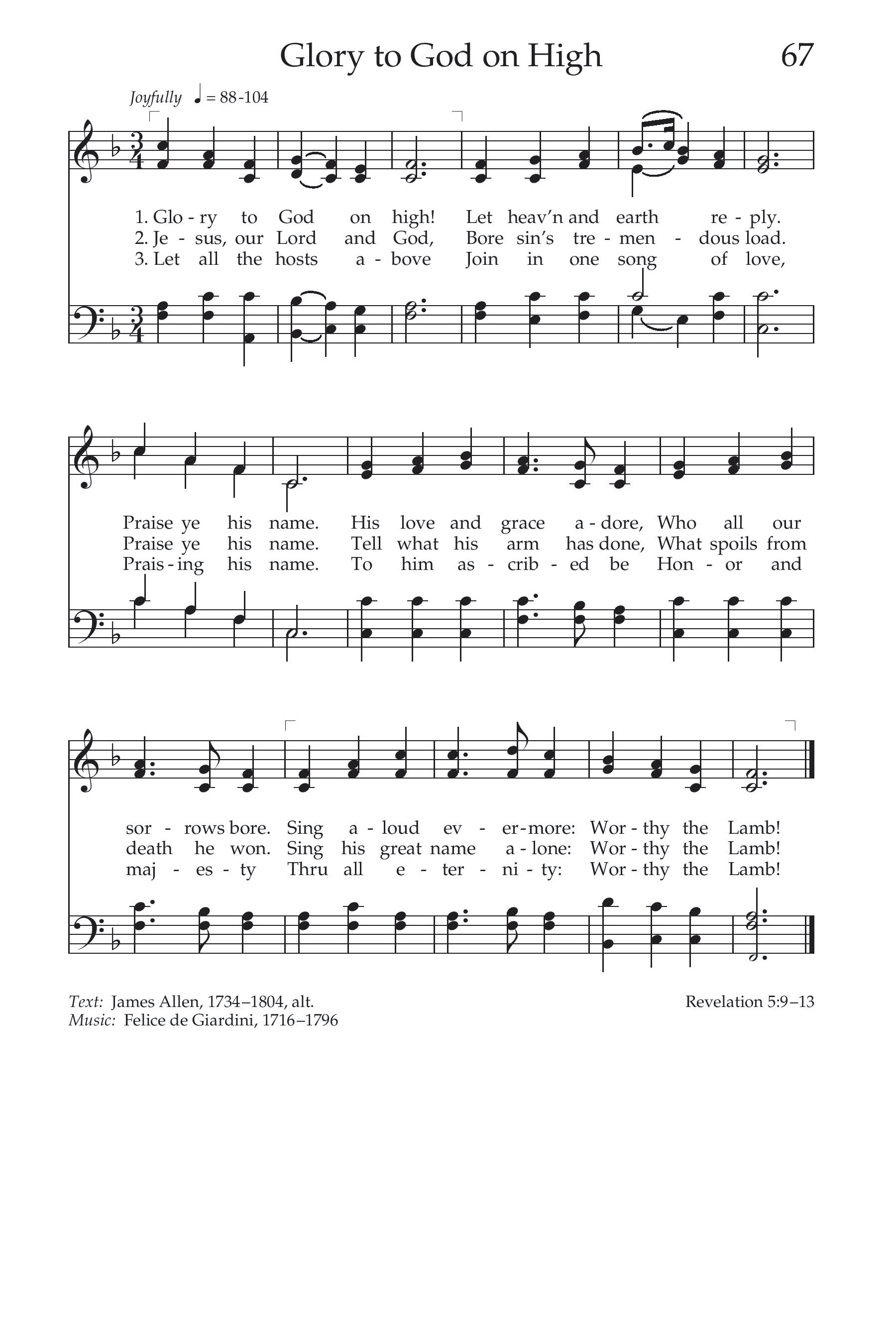
Glory to God on High
By James Allen (1761)
Mark it for others looking for a hymn like this.
New
Lyrics
1. Glory to God on high!
Let heaven and earth reply,
'Praise, praise his name!'
Angels his love adore,
Who all our sorrows bore
and saints cry evermore,
'Worthy the Lamb!'
Let heaven and earth reply,
'Praise, praise his name!'
Angels his love adore,
Who all our sorrows bore
and saints cry evermore,
'Worthy the Lamb!'
2. All those around the throne
cheerfully join in one,
praising his name;
we, who have felt his blood
sealing our peace with God,
sound his dear fame abroad,
'Worthy the Lamb!'
cheerfully join in one,
praising his name;
we, who have felt his blood
sealing our peace with God,
sound his dear fame abroad,
'Worthy the Lamb!'
3. Join, all the ransomed race,
our Lord and God to bless:
praise, praise his name;
in him we will rejoice,
making a cheerful noise,
shouting with heart and voice,
'Worthy the Lamb!'
our Lord and God to bless:
praise, praise his name;
in him we will rejoice,
making a cheerful noise,
shouting with heart and voice,
'Worthy the Lamb!'
4. Though we must we change our place,
yet we will never cease
praising his name;
to him we'll tribute bring,
hail him our gracious King;
and without ceasing sing,
'Worthy the Lamb!'
yet we will never cease
praising his name;
to him we'll tribute bring,
hail him our gracious King;
and without ceasing sing,
'Worthy the Lamb!'
Bible Reference
Luke 2:14
Lectionary & readings
Open today’s (or any date’s) assigned scriptures and find related hymns across church calendars. Useful when planning worship around this song’s themes or its Bible reference.
Hymn scripture: Luke 2:14
About This Hymn
“Glory to God on High,” written by James Allen in 1761, is a hymn of exalted praise that echoes the angelic proclamation at the birth of Christ. Its opening words, drawn directly from Luke 2:14, immediately set the tone of joyful adoration, inviting worshippers to join in the heavenly chorus that first announced the Savior’s coming. Allen’s hymn combines theological depth with heartfelt devotion, celebrating the glory, mercy, and saving grace of God revealed through Jesus Christ.
James Allen, a minister and hymn writer associated with the early evangelical revival in England, sought to write hymns that expressed both sound doctrine and warm affection for the Redeemer. In “Glory to God on High,” he succeeds beautifully. The hymn unfolds as a call to worship the triune God—Father, Son, and Holy Spirit—whose love and redemption bring peace to the human heart. Its phrases flow with reverence and thanksgiving, reminding believers that true joy and harmony begin in giving glory to God.
The text portrays salvation as the greatest demonstration of divine glory. Christ’s coming into the world is seen not only as the fulfillment of prophecy but as the ultimate expression of God’s goodness and mercy. The hymn leads singers to contemplate the wonder of the incarnation: that the eternal Son of God took on human flesh to bring peace between God and mankind. Each line resounds with gratitude, affirming that every redeemed soul has reason to join in heaven’s song of praise.
Musically, the hymn is often sung to noble and stately tunes that match its tone of majesty. Its verses have been arranged in various hymnals across denominational traditions, testifying to its lasting influence and universal appeal. The simplicity of the words allows the grandeur of the message to shine through, making it suitable for congregational singing during Christmas services and other occasions of worship focused on God’s glory.
Spiritually, “Glory to God on High” calls believers to lift their eyes from earthly concerns and fix them on the divine majesty of Christ. It reminds us that worship is not merely an act of emotion but a response to divine revelation. The same glory that filled the skies over Bethlehem now fills the hearts of those who know the Redeemer. Through praise, believers unite with the angels in declaring that God alone is worthy of honor and adoration.
Ultimately, this hymn stands as both a celebration and a confession. It celebrates the glory of God made known through Jesus Christ and confesses the believer’s joy in His salvation. By singing “Glory to God on High,” the Church continues the eternal song of heaven, proclaiming the good news that the peace of God has come to dwell with men through His beloved Son.
From the Dictionary of Hymnology
Related terms and concepts automatically matched to this hymn.
Ingemann, Bernhardt Severin; Ingham, Benjamin; Inghamite Hymnody Biography
Mixed column: Danish poet B. S. Ingemann (1789–1862) and “Through the night of doubt and sorrow”; Benjamin Ingham with two Moravian hymns; Inghamite Society and the Kendal Hymn Book (1757).
Read moreBatty, Christopher Biography
Christopher Batty (1715–1797) and his brother William (d. 1788), Inghamite hymn writers, contributed dozens of pieces to the Kendal Hymn Book, 1757; a few remain in wider use.
Read moreAllen, Oswald Biography
Oswald Allen (1816–1878), of Kirkby Lonsdale, was a bank clerk who published Hymns of the Christian Life in 1861, with 148 hymns, a few of which are in common use.
Read moreStaff Visualizer
Open in MIDI StudioPowered by HTML MIDI PLAYER, MIDI FILE Made by Hymnal Library. · Study chords & lyrics in MIDI Studio
Want weekly hymns and devotionals?
Hymns with the same subject
More hymns about Glory of God, Joy, Praise
- Praise the Lord, Ye Heavens Adore Him - Richard Mant
- Never Cease to Praise - Jeff Bourque
- Praise we our God with joy - Frederick Oakeley
- Joy Fills Our Inmost Hearts Today - W. Chatterton Dix
- How Great Thou Art - Carl Boberg
- Heaven Came Down and Glory Filled my Soul - John W. Peterson
- 10,000 Reasons (Bless the Lord) - Matt Redman and Jonas Myrin
- Joyful, Joyful, We Adore Thee - Henry Van Dyke
More hymn subjects
Latest Updated Hymnals
-
Open
 Book of Common Praise (BoCP1915)Updated 3 days, 5 hours ago · 1915
-
Open
 400+ Christmas Carols Book: Sheet Music for PianoUpdated 3 days, 5 hours ago · 2014
-
Open
 Psalms of GraceUpdated 4 days, 13 hours ago · 2022
-
Open
 Spurgeon's Own Hymn BookUpdated 4 days, 15 hours ago · 1866
-
Open
 The New Apostolic Church HymnalUpdated 3 weeks, 5 days ago · 2008
Hymn Information

Click a linked name to open their biography.
MIDI File
Hymns from 1761
Popular Hymns
Recent Blog Posts


Popular Blog Posts
-
 Lessons from the Book of Haggai: Putting God…5 months, 3 weeks ago
-
 Easter vs Passover: How a Biblical Feast Bec…7 months, 2 weeks ago
-
 The Full Story of the Birth of Jesus Christ:…11 months, 1 week ago
-
 The 30 Most Famous Christmas Hymns and Carols1 year, 2 months ago
-
 The Story Behind the Hymn “Amazing Grace”11 months, 1 week ago
Visit Us on Social Media
Latest from X (Twitter)
Tweets by HymnalLibraryLatest from Facebook
Latest on YouTube
Loading latest video...
Daily Bible Verse
Disclaimer
The hymns, sheet music, MIDI files, and related content on this website are provided for educational and research purposes only.
- Public Domain: Many of the hymns featured here are in the public domain and may be freely used.
- Copyrighted Works: Some hymns may still be under copyright protection. Where applicable, permission has either been requested from the copyright owner, or the content is shared under the principles of fair use for educational purposes.
⚠️ Important Notice: If you wish to reproduce, distribute, or use any copyrighted hymn beyond personal study or educational use, you must obtain permission directly from the copyright holder. This website does not grant any rights for commercial use yet.
If there is any other question please address it to us in our Contact Page, for further assistance. Thank you for using the site. May God Bless You.
Can’t find a hymn or lyric?
Leave your question in the forum for others to answer — requests, missing lines, writers, and worship ideas welcome.