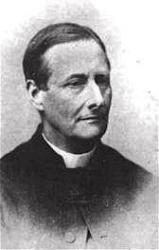
S. Baring-Gould
Biography
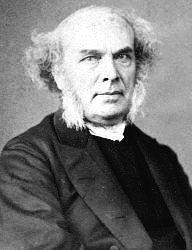
The Rev. Sabine Baring-Gould (1834–1924) was one of the most prolific, eccentric, and colorful figures of the Victorian era. An Anglican priest, hagiographer (biographer of saints), novelist, folklorist, and scholar, he published more self-penned volumes than almost any of his contemporaries. Yet, despite writing massive 15-volume histories and pioneering the preservation of traditional English folk music, he remains best known across the globe for writing the definitive, driving processional anthem of the 19th-century church: "Onward, Christian Soldiers."
Born into a wealthy landowning family in Exeter, Devon, Baring-Gould spent much of his youth traveling across Europe, gaining a broad, cosmopolitan education before studying at Clare College, Cambridge. He took Holy Orders in 1864 and began his ministry in the industrial North of England at Horbury, near Wakefield. It was here, in 1865, that his most famous hymn was born out of a purely practical, pastoral dilemma.
Tasked with leading a massive contingent of poor Sunday School children on a Whitmonday march to a neighboring village, Baring-Gould realized the children desperately needed a rhythmic, stirring song to keep them walking in step over the long distance. Sitting down at his desk, he penned the lines to "Onward, Christian Soldiers" in less than ten minutes. Though originally set to a melody by Haydn, the text achieved permanent global fame when it was paired with Sir Arthur Sullivan’s thunderous, custom-written tune ST. GERTRUDE in 1871, turning it into a cross-denominational phenomenon.
Master of the Manor: Lew Trenchard
In 1881, Baring-Gould inherited his family's grand ancestral estate, becoming both the Squire and the Rector of Lew Trenchard in Devon. This rare dual role allowed him to spend the final four decades of his life operating as a benevolent, highly independent country patriarch.
From his study at Lew Trenchard, his literary output was staggering, spanning hundreds of titles across an array of subjects:
-
Theology & History: His monumental Lives of the Saints (15 volumes) became a standard reference work for the high-church movement.
-
Folklorism: Recognizing that traditional oral culture was dying, he traveled the rugged landscapes of Dartmoor to collect and publish traditional English folk songs, preserving music that would have otherwise been lost to history.
-
Hymnody: Beyond "Onward, Christian Soldiers," he penned the beloved evening hymn "Now the Day Is Over" and translated the historic Danish text "Through the Night of Doubt and Sorrow."
Summary of Major Works
| Category | Representative Works | Significance |
| Hymns & Carols |
"Onward, Christian Soldiers" "Now the Day Is Over" "The Gabriel Message" (Translation) |
Defined the Victorian Anglo-Catholic liturgical style; focused heavily on processional and children's hymnody. |
| Hagiography | Lives of the Saints (15 vols., 1872–1877) | A massive, historically comprehensive documentation of Christian martyrs and saints. |
| Folklore & Myths |
Curious Myths of the Middle Ages (1866) Songs and Ballads of the West (1889) |
Pioneered the academic collection of regional folklore and oral musical traditions before they vanished. |
A Defiant Love Story: Baring-Gould's personal life was as unconventional as his career. While serving in Horbury, he fell deeply in love with Grace Taylor, a teenage mill girl from a lower-class family. Defying rigid Victorian class structures, he paid to send her away to be educated in royalty-style etiquette before marrying her. The marriage was remarkably happy and lasted 48 years, producing 15 children.
Baring-Gould passed away peacefully at his beloved Lew Trenchard estate on January 2, 1924, at the age of 89. He was buried in the churchyard next to his wife, leaving behind an unparalleled legacy as a brilliant polymath who successfully bridged the gap between grand academic history and the simple, rhythmic songs of everyday singing congregations.
Dictionary of Hymnology
All the world in sin was lying Hymn
A hymn on redemption by S. Baring-Gould, printed in the Church Times on July 30, 1864, and included in the People’s Hymnal, 1867, in eight stanzas.
ReadHymns by S. Baring-Gould
Includes hymns they wrote and hymns where they are credited as co-author, translator, paraphraser, or adapter.
| # | Title | Year | Views | |
|---|---|---|---|---|
| 1 | Gabriel's Message | 1892 | 3117 | View |
| 2 | Onward Christian Soldiers | 1865 | 6785 | View |
Recently added hymns
Suggestions or corrections: contact us.
Leave it in the forum for others to answer — hymn requests, lyrics help, writers, worship planning, and more.